Researcher: Ban on insider trading would harm prediction markets

Balbinder Singh Gill of Stevens Institute says a June 2 paper finds a full insider-trading ban would reduce prediction markets’ accuracy and participation and recommends calibrated enforcement.
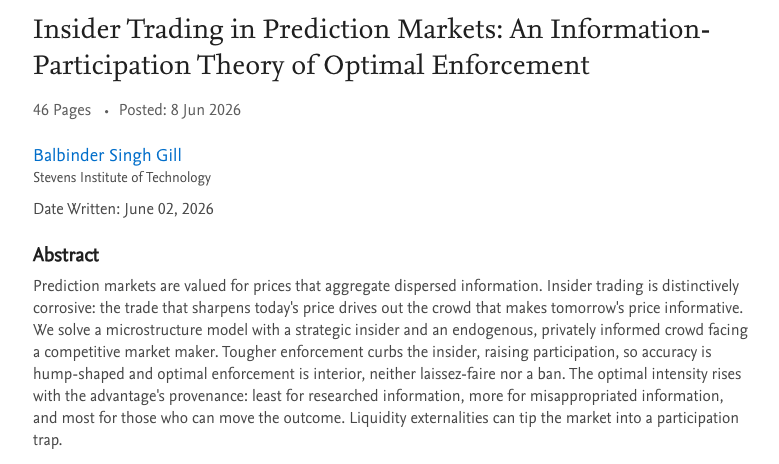
Balbinder Singh Gill, an assistant professor of finance at Stevens Institute of Technology, released a paper on June 2 arguing that an outright ban on insider trading in prediction markets would reduce those markets’ usefulness. His formal economic model finds that an intermediate level of enforcement maximizes price accuracy and trader participation.
Gill’s model describes a trade-off in which an informed trader’s bet can improve a market’s price accuracy immediately by revealing information, while a large insider presence can discourage other traders and reduce the market’s informativeness over time. The analysis shows a hump-shaped relationship between enforcement intensity and price accuracy: too little enforcement lets insiders crowd out ordinary participants, and too much enforcement removes insiders’ positive informational contribution.
The paper recommends different enforcement levels based on the source and nature of the information. Information developed through independent research should face the least punishment, the paper states, because penalties can reduce incentives to gather and share that research. Misappropriated information, such as leaked or classified data, should face stronger enforcement. The strongest sanctions should apply to people who can directly influence outcomes, for example a political candidate placing bets on their own race.
Gill wrote, “trading on a genuine, independently researched edge is the activity society should be most reluctant to punish,” and added, “trading by those who can move the outcome warrants the stiffest enforcement, because their positions invite manipulation.” He concludes that enforcement should be “calibrated rather than maximal.”
The paper was released as regulators and lawmakers increase scrutiny of prediction markets. The Commodity Futures Trading Commission’s chief enforcement official warned in April that trading on illegal insider information in these markets could prompt enforcement action. In May, U.S. House members opened a probe into Kalshi and Polymarket over potential insider trading.
Gill’s paper cites recent enforcement cases. In May, a former employee of a technology firm was charged with trading on nonpublic search trend information and allegedly earned about $1.2 million on a prediction platform. In April, a U.S. service member was charged with using classified knowledge to trade on a separate market.
Market operators have begun adding safeguards. Kalshi created an oversight panel to curb insider trading and says it will require some users to disclose employer information when betting in sensitive contracts, such as those tied to corporate performance or national security, and has developed a “specific risk score” to flag markets with elevated insider-trading or manipulation risk. Those changes follow recommendations from an audit committee review and pressure from lawmakers and regulators.
In the paper, Gill states that neither laissez-faire enforcement nor a blanket prohibition produces the best market outcomes and recommends rules keyed to the type of information and a trader’s ability to affect results.
The material on GNcrypto is intended solely for informational use and must not be regarded as financial advice. We make every effort to keep the content accurate and current, but we cannot warrant its precision, completeness, or reliability. GNcrypto does not take responsibility for any mistakes, omissions, or financial losses resulting from reliance on this information. Any actions you take based on this content are done at your own risk. Always conduct independent research and seek guidance from a qualified specialist. For further details, please review our Terms, Privacy Policy and Disclaimers.
Articles by this author