What Is an Instant Exchange Swap Aggregator?
Learn how Instant Exchange swap aggregators collect quotes, select routes and settle trades without holding user balances. Clear breakdown of the mechanics.
An instant Exchange swap aggregator collects live quotes from multiple liquidity sources, selects a suitable route for a given pair and amount, and coordinates settlement without requiring the user to maintain a balance on the platform. This means that the platform does not maintain a permanent user balance. It does not mean that the user retains control of the funds throughout execution: the service or its liquidity provider may temporarily control the assets while the swap is processed. Funds move from the user’s wallet to a temporary deposit address and then to the destination wallet. The aggregator itself does not hold long-term user balances. Quickex is one practical implementation of this model.
Disclaimer
This article is for informational purposes only and does not constitute financial, legal or investment advice. Cryptocurrency involves risk of loss. Rates, routes and policies change. Always verify the live interface before sending funds.
Last reviewed: 1 September 2026.
Table of Contents
- What Is a Swap Aggregator?
- How Does Quote Aggregation Work?
- How Is the Routing Decision Made?
- Why Is There No Intermediate User Balance?
- What Happens During a Typical Aggregated Swap?
- How Does Quickex Implement the Aggregator Model?
- How Is a Swap Aggregator Different from a DEX or CEX?
- What Are the Main Risks of Instant Exchange Aggregators?
- Conclusion
- FAQ
What Is an Instant Exchange Swap Aggregator?
An Instant Exchange Swap Aggregator is a service that helps users exchange one cryptocurrency for another by comparing rates across multiple liquidity sources and then coordinating the chosen path.
The defining characteristics are:
- The user does not open a permanent trading account or deposit funds into a long-term balance.
- The service sources liquidity from external providers rather than relying solely on its own order book.
- Funds move from the user’s own wallet to a one-time deposit address and, after processing, to the user’s designated receiving address.
The aggregator’s main technical jobs are therefore rate discovery, route selection and coordination of settlement.
It is not a traditional crypto exchange and it is also distinct from a pure on-chain DEX aggregator that operates entirely through smart contracts on a single chain.
How Does Quote Aggregation Work?
When a user selects a pair and an amount, the aggregator queries its connected liquidity sources in real time.
These sources can include centralized exchange liquidity, market makers, other instant-swap providers and, in some architectures, selected decentralized venues.
Each source returns a quote that typically includes the expected output amount, any embedded fees, available depth for that size, and sometimes estimated execution time.
The aggregator then normalises these quotes so they can be compared on a consistent basis — most importantly, the net amount the user is expected to receive after fees and network costs.
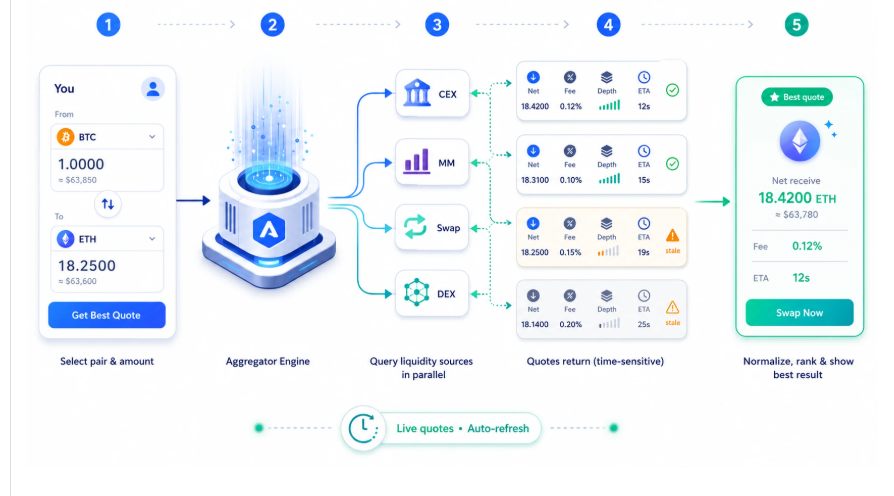
Because market conditions change continuously, the quotes are time-sensitive.
A rate that looks best at the moment of the query may no longer be available a few minutes later if liquidity moves or a provider updates its pricing.
This aggregation layer is what allows the user to see a single interface instead of manually checking multiple platforms.
The quality of the final quote depends on the breadth of connected sources, the speed of the polling, and how the system handles incomplete or stale responses.
How Is the Routing Decision Made?
After collecting quotes, the aggregator’s routing logic evaluates which path is most suitable for the specific trade.
Factors commonly considered include:
- Net output amount for the user
- Available liquidity at the requested size
- Network fees on the relevant chains
- Reliability or historical success rate of the source
- Any constraints the user has set, for example, fixed versus floating rate
Depending on implementation, an aggregator may use one provider or split execution across multiple sources.
Smaller trades are often routed to a single best source.
Larger amounts may be handled differently if the system supports order splitting, although this is not universal.
Once a route is chosen, the system generates a one-time deposit address for the input asset and displays the expected, or locked, output amount together with any relevant network notes.
If the selected provider later becomes unavailable or the quote expires, the order may need to be recreated or an alternative path selected, depending on the platform’s rules.
Why Is There No Intermediate User Balance?
In a classic custodial exchange the user first deposits funds into an account controlled by the platform.
Those funds sit in the platform’s wallets until the user later withdraws them. A swap aggregator is designed differently. There is no persistent user balance.
The only time the service, or its liquidity partners, temporarily controls the assets is during the short window between receipt of the deposit and delivery of the output asset.
After the swap is completed, nothing remains on the platform under the user’s name.
This design has two direct consequences:
- The user does not need to trust the platform with long-term custody.
- The user remains responsible for providing a correct receiving address and for managing their own private keys before and after the swap.
The absence of an intermediate balance is one of the clearest practical distinctions between an aggregator of this type and a traditional exchange account.
What Happens During a Typical Aggregated Swap?
- The user selects the input and output assets and enters the amount.
- The aggregator queries its liquidity sources and returns a live quote, fixed or floating.
- The user reviews the quote, the estimated or locked receive amount, and any network warnings.
- The user pastes the destination wallet address.
- The system generates a unique deposit address for that order.
- The user sends the exact amount of the input asset from their own wallet.
- Once the deposit reaches the required number of confirmations, the aggregator, or its chosen liquidity partner, executes the conversion.
- The output asset is sent directly to the address the user provided.
- The order is marked complete; no residual balance remains on the platform.
Blockchain confirmations are often a major component of total settlement time, although provider processing can also contribute.
The exact duration therefore varies by network conditions and the specific route chosen.
How Does Quickex Implement the Aggregator Model?
Quickex operates as an instant exchange that aggregates liquidity from multiple sources.
According to the platform’s public materials, when a user requests a swap the system compares live quotes and routes the order to the source offering the most favourable conditions at that moment.
Users do not create an account or maintain a balance for standard swaps.
They send funds from their own wallet and receive the output asset at the address they specify.
The platform supports both fixed-rate and floating-rate options and displays the relevant figures before the user sends anything.
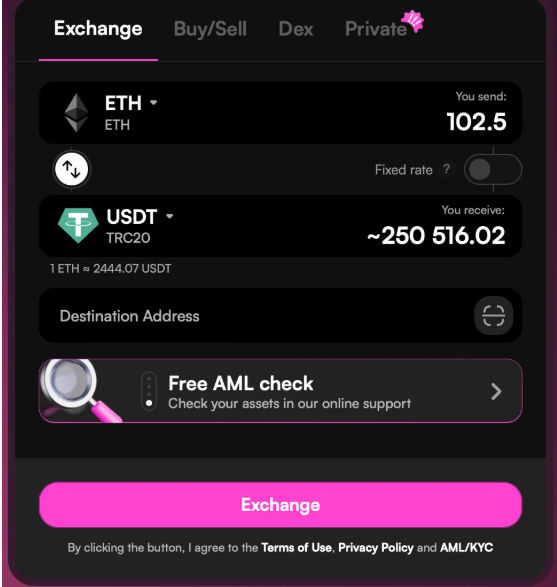
A concrete illustration is the ability to swap ETH to USDT.
In this flow the user selects Ethereum as the input asset and USDT, on the chosen network, as the output, reviews the live quote, provides a receiving address, and sends ETH to the generated deposit address.
After confirmation and processing, USDT is delivered to the user’s wallet.
The same mechanics apply across the wide range of other pairs the service supports.
This implementation follows the general aggregator pattern: quote collection, route selection, temporary handling during execution, and direct delivery to the user-controlled address, without a persistent platform balance.
How Is a Swap Aggregator Different from a DEX or CEX?
| Feature | Instant Exchange Swap Aggregator | Pure DEX, e.g. Uniswap | Custodial CEX |
| User account | Not required for standard flow | Not required | Required |
| Long-term custody | No | No | Yes |
| Liquidity source | Multiple external providers | On-chain pools | Platform order book / MMs |
| Cross-chain capability | Common | Limited or via bridges | Common |
| Settlement | Temporary control during swap | Atomic on-chain | Internal ledger |
| Primary user responsibility | Correct address + private keys | Gas, slippage, contract risk | Account security + KYC |
The aggregator model sits between the full self-custody of a pure DEX and the account-based convenience of a custodial exchange.
It typically offers broader asset coverage and simpler cross-chain movement than most single-chain DEXs, while avoiding the need for a permanent deposit balance.
Source references for the DEX side of the comparison include the public documentation of major protocols such as Uniswap.
What Are the Main Risks of Instant Exchange Aggregators?
- Temporary control of funds — During the short processing window the assets are not under the user’s direct control.
- Rate movement — Floating-rate quotes can change between the moment the quote is shown and the moment the deposit is detected. Fixed-rate quotes lock the amount for a limited time and may include a pricing premium for that certainty.
- Liquidity variation — The best available rate depends on the depth and conditions at the connected sources at that exact moment.
- AML screening — Many aggregators apply risk-based checks. Flagged deposits may be delayed or require additional information.
- Address risk — Sending to the wrong network or an incorrect address is irreversible.
- Dependency on partners — Execution quality depends in part on the liquidity providers the aggregator uses.
Understanding these points helps users set realistic expectations and choose the appropriate tool for a given trade size and pair.
Conclusion
Instant Exchange Swap Aggregators solve a practical problem: liquidity is fragmented across many venues, and manually comparing rates is time-consuming.
By collecting quotes, selecting a route and coordinating settlement without requiring a permanent user balance, they offer a middle path between pure on-chain DEXs and traditional custodial exchanges.
The core mechanics — quote aggregation, route selection, and the absence of an intermediate balance — remain consistent across well-designed implementations.
Platforms such as Quickex illustrate how this model works in practice for everyday pairs, including the ability to swap ETH to USDT.
Users who understand the flow, the temporary nature of fund control, and the residual risks are better equipped to decide when an aggregator is the right tool for a given exchange.
Description based on publicly documented aggregator mechanics and platform materials reviewed in September 2026. Implementation details can differ between services and change over time.
FAQ
- How Does a Swap Aggregator Work?
A swap aggregator collects live quotes from multiple liquidity sources, selects a route, and coordinates settlement so that the user sends one asset from their wallet and receives another at a specified address.
The aggregator itself does not maintain a long-term user balance.
The quality of the result depends on the connected liquidity sources and current market conditions.
- Does the Aggregator Hold My Funds?
A swap aggregator does not maintain a long-term user balance, although funds may be temporarily controlled during execution.
After the output asset is delivered, nothing remains on the platform under the user’s name.
- What Is the Difference Between an Aggregator and a DEX?
A pure DEX executes swaps directly against on-chain liquidity pools via smart contracts.
An aggregator sources liquidity from multiple external providers and presents a unified interface, often with stronger cross-chain coverage.
Both models avoid long-term custodial balances, but the technical and risk profiles differ.
- Why Do Rates Differ Between Aggregators?
Each aggregator connects to a different set of liquidity sources and applies its own routing logic and fee structure.
Live market conditions also change continuously, so quotes are time-sensitive and should be checked at the moment of use.
- Is an Instant Exchange Aggregator Completely Risk-Free?
No — users still face address risk, possible rate movement, temporary loss of control during processing, and the possibility of compliance-related delays on flagged deposits.
Understanding these residual risks is part of using the model responsibly.
- Can I Use an Aggregator Without Creating an Account?
Yes — that is one of the defining features of the instant exchange aggregator model for standard swaps.
The user interacts only with a temporary deposit address and a receiving address they control.
The material on GNcrypto is intended solely for informational use and must not be regarded as financial advice. We make every effort to keep the content accurate and current, but we cannot warrant its precision, completeness, or reliability. GNcrypto does not take responsibility for any mistakes, omissions, or financial losses resulting from reliance on this information. Any actions you take based on this content are done at your own risk. Always conduct independent research and seek guidance from a qualified specialist. For further details, please review our Terms, Privacy Policy and Disclaimers.
Articles by this author