Guarda Wallet: Multi-Chain Crypto Management and Web3 in One Self-Custodial System
Guarda Wallet combines support for 70+ blockchains and 1M+ assets with self-custody, multi-device access, and integrated Web3 tools. Here is how that setup works when a crypto portfolio expands across networks, services, and different types of on-chain activity.
Crypto gets harder to manage long before a portfolio becomes unusually large. The friction starts when one wallet holds Bitcoin, another asset lives on a different network, tokens move between ecosystems, Web3 applications enter the workflow, and the same user wants access from several devices. Every additional moving part creates another place where a transaction, fee, recovery step, or integration needs to behave as expected.
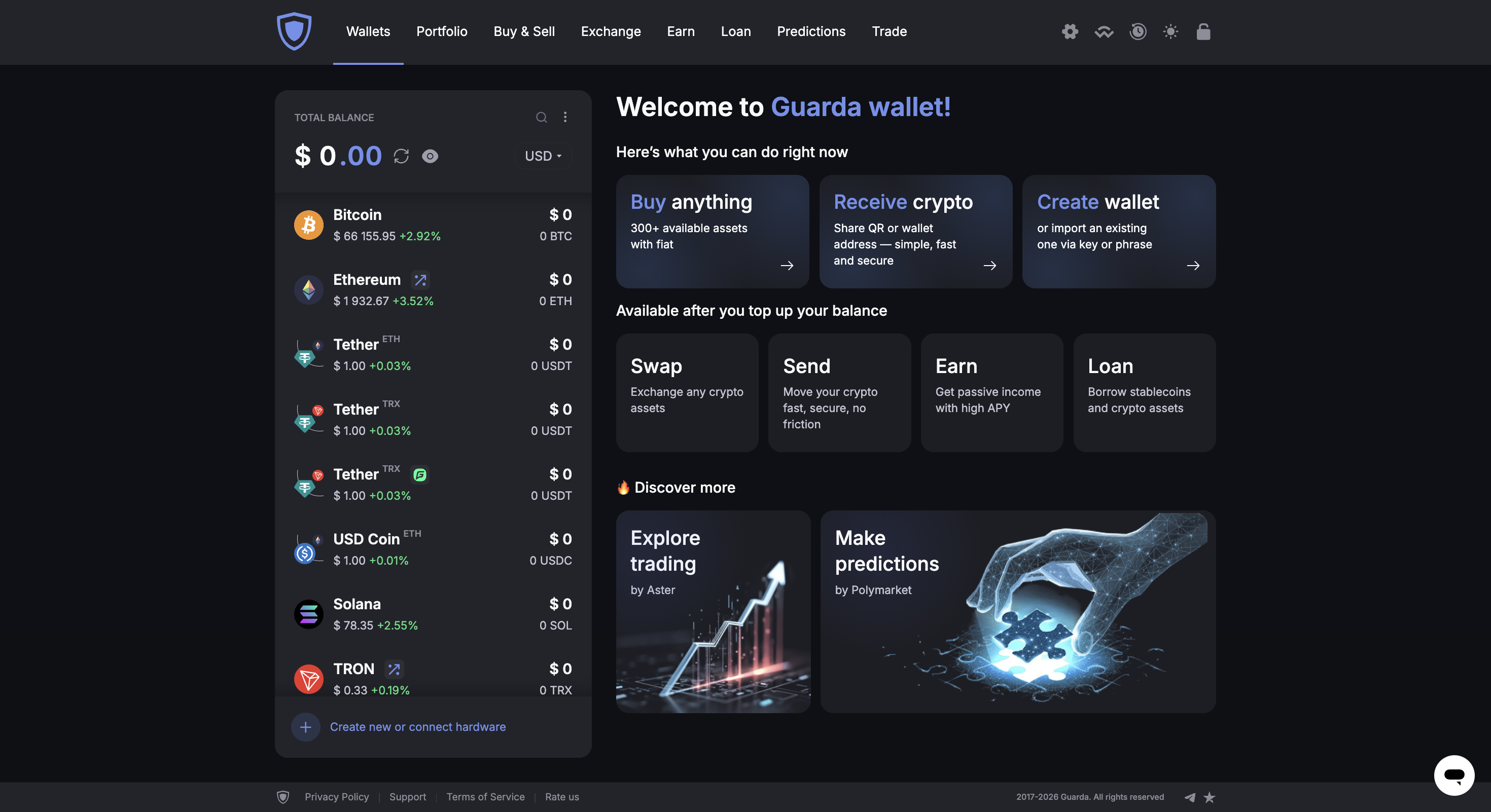
That is the problem Guarda approaches with a multi-chain model. Guarda is a self-custodial crypto wallet that supports 70+ blockchains and 1M+ assets and is available through Web, Desktop, Mobile, and a Browser extension. The point of that coverage is not simply to display a long asset list. It is to keep different parts of a growing crypto setup accessible through one wallet while the user retains control of private keys.
What makes multi-chain crypto difficult to manage?
A portfolio spread across different blockchains is not just a larger version of a single-chain portfolio. The networks supported in Guarda include ecosystems such as Bitcoin, Ethereum, Solana, XRP, TRON, Cardano, Monero, and others. They don’t all use the same transaction logic, fee model, or supported wallet functions.
That distinction becomes practical when assets start moving. A token transfer may require the native currency of its network for fees. Some networks use additional transaction fields. A feature available for one asset may not be available for another. Even inside one wallet, “supported” and “supports every action” are not the same thing. Guarda’s own documentation, for example, distinguishes network-fee currencies for different token standards and gives network-specific instructions where additional requirements apply.
This is why multi-chain coverage works better as a starting point than as a final measure of a wallet. What matters next is whether assets, transactions, access, recovery, and additional services can be handled without turning every new blockchain into a completely separate workflow.
How Guarda approaches multi-chain self-custody
Self-custody sits at the center of Guarda’s model. The wallet states that private keys remain under the user’s control and are stored locally rather than being held by Guarda. It also says it does not store users’ passwords, funds, or sensitive wallet data.
That model stays relevant as the number of assets grows. Instead of opening custodial accounts for different parts of a portfolio, users can create and manage supported wallets from the same broader Guarda environment. The current product covers 70+ blockchains and 1M+ assets, including both EVM and non-EVM ecosystems.
Access is also spread across several surfaces. Guarda provides web, desktop, mobile, and browser-extension versions. That gives users options when their crypto activity moves between a phone and computer, although it does not mean every function has identical availability on every platform.
A multi-chain wallet becomes more useful when breadth does not create unpredictability. The aim is not to pretend that different blockchains work the same way, but to keep their supported actions understandable from one self-custodial system.
What can you do with crypto in Guarda?
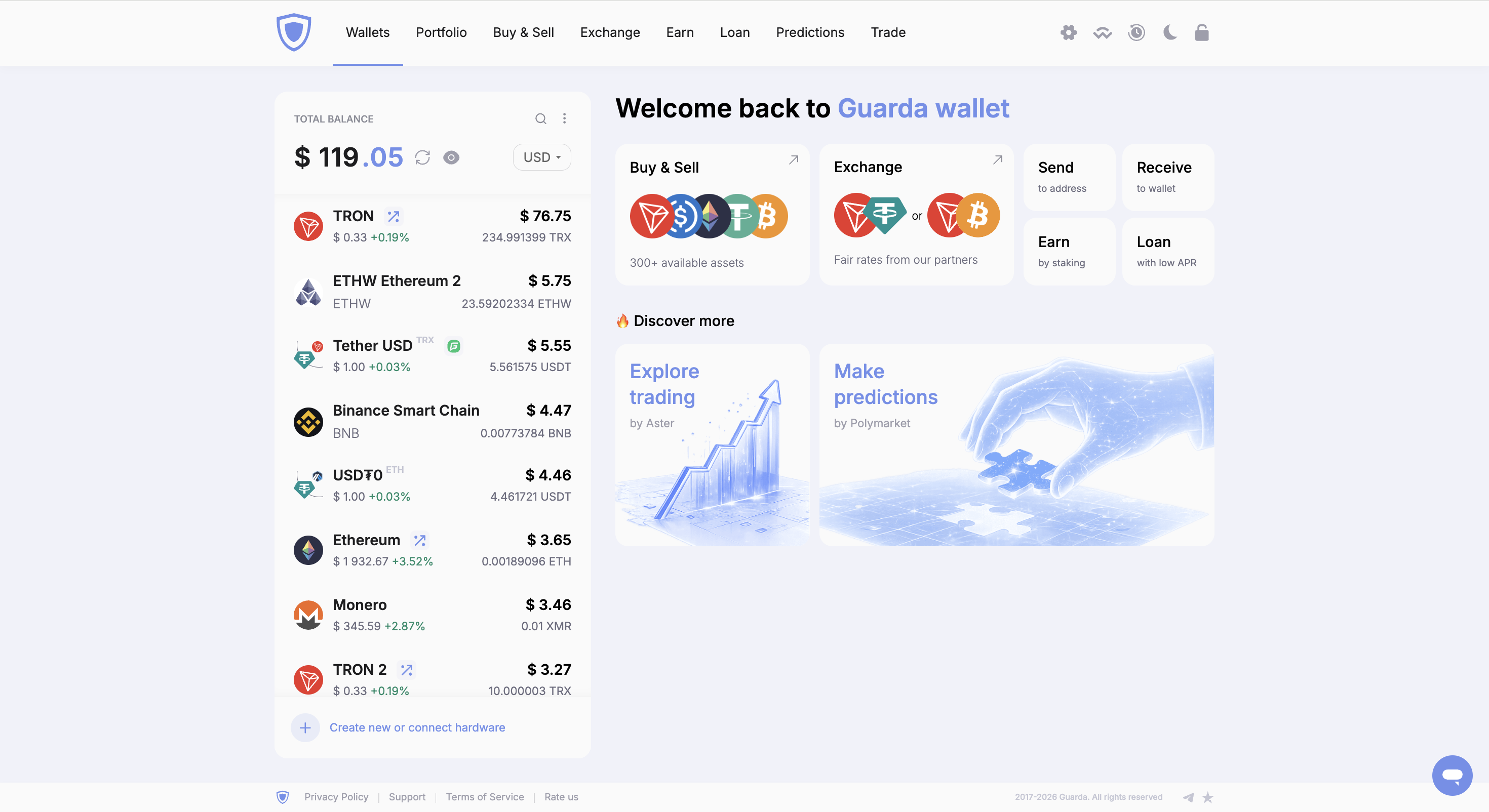
The basic layer is familiar: users can store, send, and receive supported assets. Guarda also integrates buying, selling, and swapping, allowing several common crypto actions to happen from the wallet rather than requiring a separate interface for each one. Purchases and swaps can involve external providers, so their fees and conditions should be considered separately from ordinary blockchain network fees.
From there, the functionality becomes more specific.
Staking is currently available across 14 networks according to Guarda. The staking page identifies supported currencies and their platform availability, which is worth checking before assuming that every asset held in Guarda can also be staked there.
Crypto loans provide another route for using holdings without first selling them. Guarda documents an integrated partner solution that allows supported crypto to be used as collateral for borrowing stablecoins. The loan itself comes with provider terms, collateral requirements, and other conditions, so it should be treated as an integrated financial service rather than a standard wallet transaction.
There are also features built around particular blockchain requirements. Guarda’s Gas-Free Wallet for USDT on TRON, available on web and desktop, lets users send supported USDT with a zero TRX balance instead of maintaining TRX specifically for transaction resources. That is a useful example of multi-chain depth: the wallet addresses a network-specific friction point rather than applying one generic transaction model everywhere.
For shared-control setups, Guarda also documents multisignature wallets for Bitcoin and Ethereum, where more than one signature can be required to authorize a transaction.
Moving from holding crypto to Web3 activity
Holding assets is only one part of modern wallet use. Once users interact with decentralized applications, markets, or trading protocols, the wallet becomes an authorization layer as well as a place to manage balances.
Guarda integrates WalletConnect in its mobile application. Its current documentation describes connecting to Web3 services by QR code or deeplink and approving Ethereum transactions, messages, and data from the wallet. The important step is still user approval: incoming requests can be reviewed before they are signed.
Prediction markets go a step further by bringing a Web3 service into Guarda’s web and desktop interfaces. The integration is powered by Polymarket and uses on-chain markets where users can take positions on real-world outcomes. Guarda documents the flow through a Polygon wallet, with USDC.e used for positions and POL required for network fees. Availability can depend on location because Polymarket restricts access in certain jurisdictions.
Guarda also includes Perps through an interface to Aster, a decentralized perpetual trading protocol. That widens the range of actions accessible from the wallet, but the distinction between wallet infrastructure and an external protocol matters: trading conditions, market risks, and protocol-specific terms do not become Guarda wallet guarantees simply because the interface is integrated.
These features move the wallet beyond passive asset management and into active Web3 use. They also make clarity more important. A swap, staking action, prediction-market position, collateralized loan, and perpetual trade do not have the same mechanics or risk profile, even when the entry point sits inside the same wallet.
What matters when using several networks and devices?
The more complex the setup, the less useful a feature count becomes on its own. There are a few practical questions worth asking before making any action:
- Is the function available for the specific asset, network, and Guarda platform you are using?
- Is the cost a blockchain network fee, a wallet-level fee, or a charge associated with an integrated provider?
- Does the action leave the wallet and interact with a third-party protocol?
- Is the backup current enough to reflect changes made to the wallet?
- Do you understand what is being signed before confirming an irreversible transaction?
These checks matter because complexity can create operational mistakes even when every individual feature works as designed.
Guarda also reports a success rate of at least 99.9% for sending tokens and updating balances. That is company-supplied operational data rather than an independently measured GNcrypto statistic, but it adds an execution metric to the multi-chain story. Breadth becomes more meaningful when routine wallet operations continue to perform consistently as users move between supported assets and networks.
Complex crypto handled with precision matters most at this point. The goal is not to remove the differences between blockchains. It is to keep those differences from turning the user’s wallet into a collection of disconnected operational problems.
Security, backup, and getting help when something goes wrong
Self-custody gives the user control, but it also makes recovery part of the product experience.
Guarda uses an encrypted backup system. Its Help Center states that wallet data is encrypted with AES and recommends keeping the backup separately from the password. Users should also save an updated backup when they make relevant changes to their wallet setup. If the required backup is lost, Guarda cannot recreate access on the user’s behalf.
For users who want to combine the Guarda interface with hardware-held keys, Ledger integration keeps private keys on the connected Ledger device while Guarda acts as the interface for blockchain operations.
Guarda also has an integration with ERA Wallet. Its current documentation says private keys remain on the ERA device and transactions requiring signatures are reviewed and approved there, while supported portfolio actions remain accessible through Guarda.
Guarda lists 24/7 live support. That does not change the custody model: support cannot take control of a wallet or recreate recovery information it does not possess. What it can provide is a route to a human answer when a network, transaction, integration, or recovery flow needs troubleshooting.
Is Guarda Wallet right for your crypto setup?
Guarda becomes most relevant when crypto activity stops being one asset and one action. A portfolio may span several blockchain ecosystems, move between phone and desktop, use staking or swaps, connect to Web3 applications, or occasionally require a more specialized function such as a loan, prediction market, perpetual trade, multisig wallet, or Gas-Free USDT transfer on TRON.
The trade-off is that more functionality also means more conditions to understand. Not every feature is available for every network or platform. Some services depend on external providers. Self-custody means recovery responsibility stays with the user. And actions such as lending, predictions, and perpetual trading introduce risks beyond simply holding crypto.
For users who understand those boundaries, the value of a multi-chain wallet is not that it makes every blockchain identical. It is that a growing set of assets and actions can remain manageable without giving up control of the keys. Guarda’s approach is to combine that self-custody with broad blockchain coverage, multiple access points, Web3 functionality, recovery tools, and human support – keeping the system useful as the user’s crypto activity becomes more complex.
The material on GNcrypto is intended solely for informational use and must not be regarded as financial advice. We make every effort to keep the content accurate and current, but we cannot warrant its precision, completeness, or reliability. GNcrypto does not take responsibility for any mistakes, omissions, or financial losses resulting from reliance on this information. Any actions you take based on this content are done at your own risk. Always conduct independent research and seek guidance from a qualified specialist. For further details, please review our Terms, Privacy Policy and Disclaimers.
Articles by this author