Ethereum price rallies as Fusaka upgrade launches

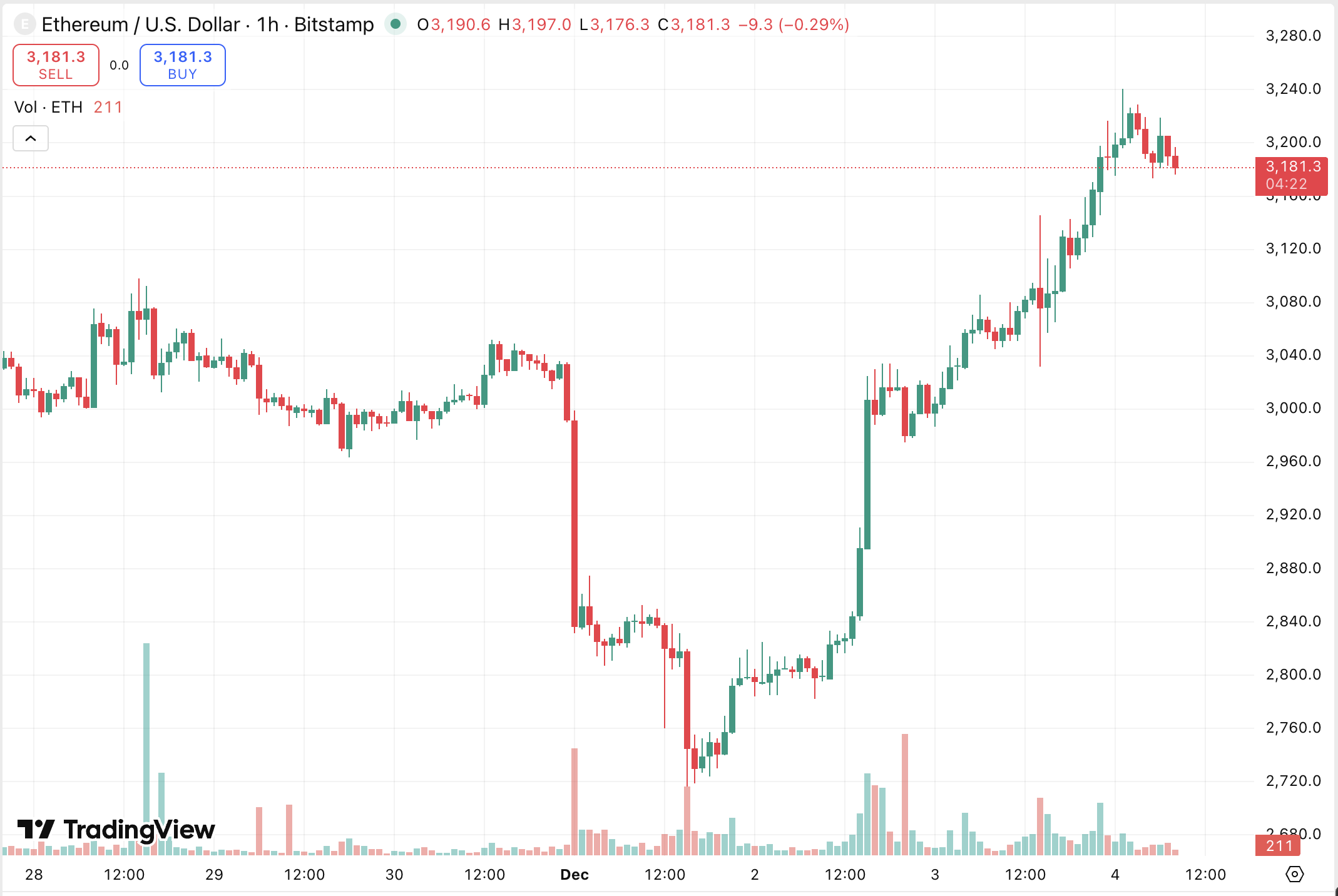
Ethereum activated its Fusaka upgrade on mainnet on Wednesday, December 3, 2025, and the price of ETH climbed to around $3,200 – up about 4% on the day – as traders reacted to new data-scaling features that promise cheaper transactions for layer-2 networks and more room for future growth.
In the hours after Fusaka went live at block height 18,200,000, ETH traded roughly between $3,150 and $3,210, while 24-hour trading volume expanded from about $28.2 billion to $32 billion, pointing to a short-term pickup in activity around the upgrade. Analysts linked the move to fresh buying from “shark” wallets holding between 1,000 and 10,000 ETH, which appeared to be accumulating into the event.
Fusaka is Ethereum’s second major upgrade of 2025 and was scheduled for December 3 as the next step on the network’s long-term roadmap after Pectra earlier this year. It focuses on scaling Ethereum as a settlement layer by increasing how much data the chain can handle, especially for rollups – layer-2 systems that batch user transactions off-chain and post compressed data back to Ethereum.
At the heart of the upgrade is PeerDAS, short for Peer Data Availability Sampling. Instead of every node downloading and storing all of the large “blob” data packets that rollups post, PeerDAS lets nodes verify availability by sampling only small random pieces. For general users, this means the network can raise data capacity without forcing every participant to run more powerful hardware. Engineers expect bandwidth needs for nodes to drop by as much as 80–85%, making it easier to support more data and more rollups at the same time.
The change unlocks a large increase in blob throughput – the part of Ethereum blocks reserved for temporary rollup data. With PeerDAS in place, the network can scale blob capacity to roughly eight times previous limits, creating more room for rollups to post their batches and, in turn, cut user fees. Early modeling from developers suggests that costs on major rollups such as Arbitrum, Optimism and Base could fall by 40–60% over time as the extra capacity is used.
On social media, Ethereum co-founder Vitalik Buterin highlighted PeerDAS as a milestone for the project’s original scaling vision, describing it as a concrete realization of the data-sharding techniques discussed inside the ecosystem since the mid-2010s. He noted that the arrival of data availability sampling brings Ethereum closer to long-planned sharding-style designs while keeping today’s rollup-centric approach intact.
Teams that index and monitor Ethereum’s layer-2 networks reported signs that rollups had been preparing for higher data throughput ahead of the upgrade. They observed more regular posting of state roots – the summary hashes that represent rollup states – and adjustments to block intervals, changes that could lead to smoother sequencing and more predictable batch submission patterns now that more blob space is available.
Beyond PeerDAS, Fusaka introduces a Blob-Parameter-Only (BPO) mechanism that lets client teams adjust blob capacity between major hard forks. Instead of waiting for a full network upgrade to raise blob limits, BPOs allow more incremental changes, giving Ethereum a way to respond to demand from rollups while keeping the system stable. Base-fee logic for blobs has also been updated so that fees for data storage do not collapse when execution gas prices spike, tying blob pricing more closely to overall load on the network.
The upgrade also includes a set of smaller protocol tweaks aimed at hardening the network and improving user experience. Gas-limit adjustments and transaction caps are designed to stop a single oversized transaction from filling an entire block, reducing the risk of denial-of-service scenarios. Other changes refine how block proposers are selected and announced ahead of time, laying groundwork for features like fast pre-confirmations, and enable wider use of mobile-friendly P-256 signatures, which aligns Ethereum with the cryptography used in many consumer devices.
Developers and market participants described Fusaka as an “infrastructure-heavy” release that strengthens Ethereum’s role as a base settlement layer rather than changing how it feels to use day to day. They argue that by expanding capacity without altering core economics, the upgrade could gradually increase the amount of ETH burned through fees and the rewards paid to validators as more transaction data flows through both the main chain and rollups. One institutional research note suggested that these effects are likely to appear slowly over time rather than in a single, visible jump on the day of the fork.
Enterprise-focused builders pointed to the way Fusaka reduces the data load that validators and rollup operators must process as a key factor for long-term adoption. Lower hardware requirements and more predictable performance could broaden the pool of entities able to run nodes and participate in securing the network, which in turn lowers concentration risk. Some commentators argued that this kind of resilience and predictability is what regulated financial institutions look for when evaluating whether a public blockchain can safely support large-scale issuance and post-trade activity.
With Fusaka now live, attention in the Ethereum community is turning to how quickly rollups will take advantage of the added capacity and whether lower data costs will filter through into noticeably cheaper transactions for end users over the coming months. A smaller follow-up upgrade is already scheduled for December 9 to refine some of the new mechanisms, but for now, the core network change is in place, and markets are watching how activity responds from here.
The material on GNcrypto is intended solely for informational use and must not be regarded as financial advice. We make every effort to keep the content accurate and current, but we cannot warrant its precision, completeness, or reliability. GNcrypto does not take responsibility for any mistakes, omissions, or financial losses resulting from reliance on this information. Any actions you take based on this content are done at your own risk. Always conduct independent research and seek guidance from a qualified specialist. For further details, please review our Terms, Privacy Policy and Disclaimers.
Articles by this author