Crypto spot trading vs. futures trading: what’s the difference?

Spot markets provide a straightforward path to buy and sell digital assets. Spot trading crypto means immediate ownership at the current price, distinct from leveraged derivatives, with on-exchange settlement and optional self-custody. The guide outlines mechanics, costs, risks, and use cases, clarifying when each approach is most appropriate.
On this page
How spot trading works
Spot trading is the straightforward exchange of a digital asset for cash or another asset with near‑instant settlement on the exchange’s books. When you open a spot market such as BTC/USD or ETH/USDT, you are dealing with an order book where buyers post bids, sellers post asks, and a matching engine pairs compatible orders. After a trade is executed, the asset balance updates in your account, and, once any venue‑specific holds clear, those coins can be withdrawn to a personal wallet.
For readers asking what is spot trading in crypto, the essential idea is ownership today rather than a wager on tomorrow. You fund your account with fiat or crypto, choose a trading pair, and decide whether you need immediacy or price control. A market order prioritizes speed by filling at the best available prices, while a limit order waits for the market to come to your chosen level. Many platforms also allow you to set stop or stop‑limit instructions that trigger only if the market reaches a specified threshold, which helps automate entries and exits without constantly watching the screen.
Settlement on centralized exchanges is effectively T+0: once matched, the trade is final and reflected in your balances. Because you receive the underlying asset, you can transfer it off‑exchange for self‑custody, spend it, or use it on‑chain where supported. That flexibility introduces responsibilities: double‑check networks before moving funds, safeguard seed phrases offline, and understand that operational mistakes can be irreversible. In short, spot trading is about acquiring or disposing of the real asset in real time, with risks bounded by the capital you deploy and without the ongoing funding payments common in leveraged derivatives.
Spot trading vs other crypto strategies
In everyday terms, spot trading crypto means paying today’s price to own the underlying coins immediately. That ownership shapes both your risks and your choices. Your position size is limited by the cash or coins you actually have, and there is no interest meter running in the background. If the market falls, your equity falls with it, but you will not face a forced liquidation simply because a maintenance margin threshold was breached.
Margin trading changes that picture by letting you borrow assets to amplify exposure. The benefit is greater flexibility (larger positions and the ability to short when you borrow the asset to sell) but the trade‑off is the constant requirement to keep collateral healthy. Interest accrues on borrowed balances, and sharp moves can trigger liquidations that close positions at disadvantageous levels if equity becomes too thin.
Futures take you one step further away from the underlying coins by replacing them with standardized contracts that reference an index of spot prices. Because you need only post margin, leverage and shorting are built in. That makes futures popular for hedging a spot portfolio or for expressing short‑term views with less capital tied up. However, you assume additional dynamics: funding payments for perpetual contracts, potential basis or roll costs for dated futures, and the operational need to monitor margin.
Options add yet another toolkit: instead of owning or shorting the asset, you can pay a premium for the right to buy or sell at a specified strike. For buyers, maximum loss is the premium; for writers, risk management is more complex, especially with uncovered positions. Compared with spot, options introduce non‑linear payoffs and time decay, which can be powerful in skilled hands but require a distinct learning curve.
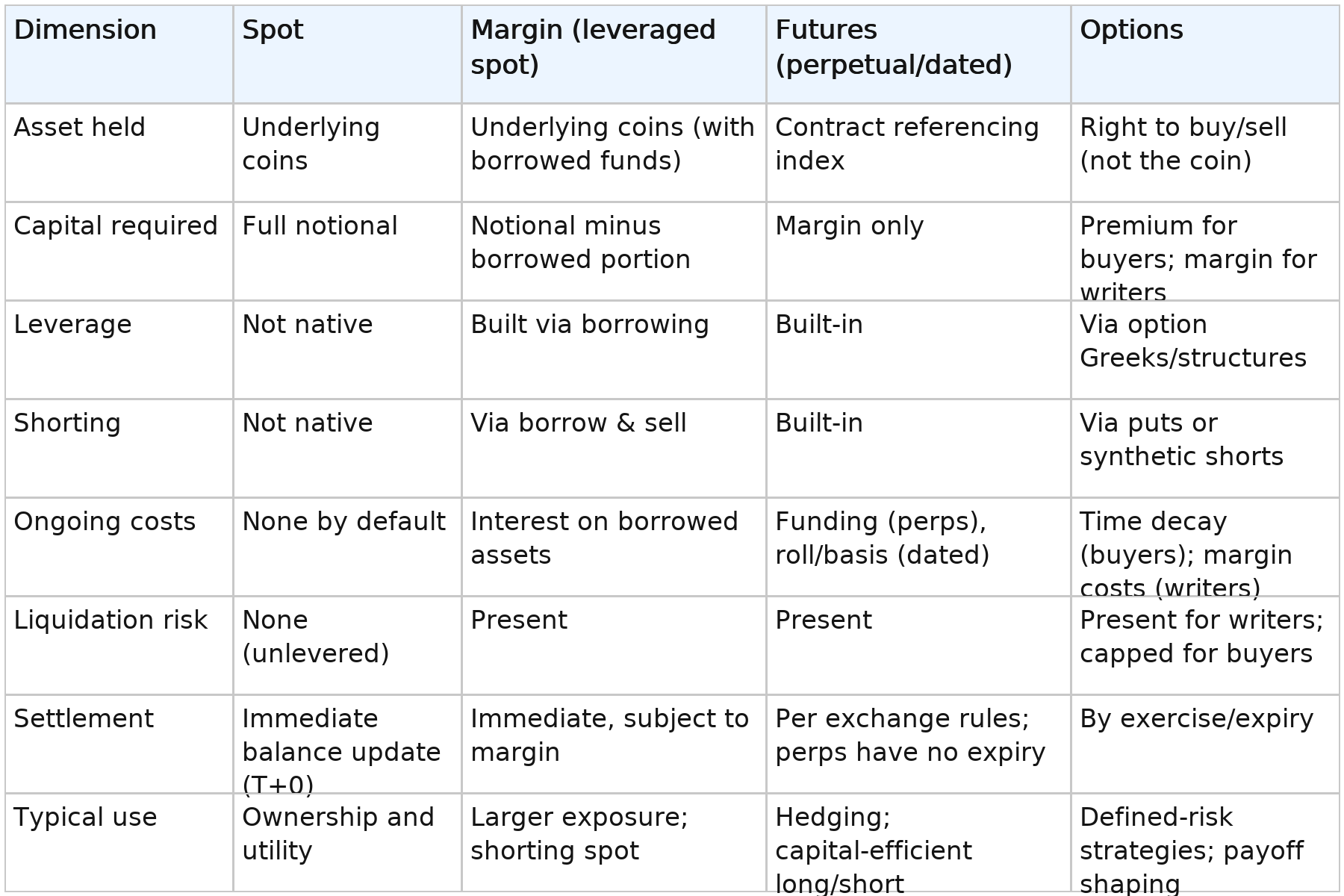
Put together, spot emphasizes simplicity and direct ownership; margin and futures emphasize capital efficiency and flexibility; options emphasize shaping payoff profiles. The best choice depends on whether you prioritize custody and utility of coins, or prefer leveraged instruments with additional costs and responsibilities.
Advantages of spot trading
Whether trades are executed through a conventional exchange interface or a seamless token exchange platform, the underlying principle remains the same: the asset is purchased at today’s price and can be moved on-chain once the transaction is settled.
The mechanics are simple, which directs attention to entries, exits, and custody rather than juggling margin requirements.
- Ownership and utility. Coins can be held, withdrawn, spent, staked, or used on‑chain.
- Simplicity. No expiries, funding rates, or margin calls; decide price, size, and order type.
- Defined downside. Without leverage, the maximum loss per trade is the capital you spent.
- No recurring funding. Perpetual‑style funding payments don’t apply to unlevered spot positions.
- Easier operations. Record‑keeping and taxes are often clearer than with frequent derivatives trades.
Disadvantages and risks of spot trading
Despite its simplicity, spot trading concentrates market risk on the held asset and ties up capital. Positions are not natively shortable, and custody introduces operational exposure beyond the trading interface. Costs and regulatory requirements add additional friction. The points below summarize the principal disadvantages and risk factors relevant to planning and risk control.
- Volatility exposure. Full participation in adverse moves; portfolio value shifts one‑for‑one with price.
- Capital intensity. Full notional must be funded in cash or coins, reducing liquidity versus margin or futures.
- Limited shorting. Bearish views typically require borrowing or derivatives, adding complexity and cost.
- Custody and counterparty. Wallet security, withdrawal or network‑selection errors, and exchange failure risk.
- Costs. Maker/taker fees, spreads on illiquid pairs, and withdrawal/network charges.
- Regulatory and tax. Jurisdiction‑specific compliance and reporting burdens.
When spot trading makes sense
Spot trading tends to be most appropriate when the objective is straightforward ownership and on‑chain utility rather than leveraged speculation. It aligns with strategies such as gradual accumulation, treasury management for businesses that receive or hold crypto, and preparing balances for practical uses like payments, transfers, or staking where supported. In this context, spot crypto meaning is closely tied to immediate delivery and the absence of margin dynamics, which removes funding payments and reduces operational monitoring.
Spot exposure is also relevant when liquidation risk is unacceptable, for example, when a portfolio must remain invested through volatility without the prospect of forced closures. Where futures markets display elevated positive funding or expensive basis, acquiring the asset directly may be more cost‑effective over multi‑week horizons. Conversely, when market conditions are range‑bound and leverage provides limited incremental benefit, unlevered spot can keep costs predictable while preserving the option to withdraw to self‑custody.
Certain accounting and compliance workflows may favor spot holdings as well. Holding the underlying asset can simplify record‑keeping compared with maintaining rolling derivative positions, subject to jurisdictional rules.
Finally, when the goal includes non‑price outcomes: grant disbursements on‑chain, merchant settlement in crypto, or participation in network features that require native tokens, spot positions provide the necessary access without an additional layer of contract management.
The material on GNcrypto is intended solely for informational use and must not be regarded as financial advice. We make every effort to keep the content accurate and current, but we cannot warrant its precision, completeness, or reliability. GNcrypto does not take responsibility for any mistakes, omissions, or financial losses resulting from reliance on this information. Any actions you take based on this content are done at your own risk. Always conduct independent research and seek guidance from a qualified specialist. For further details, please review our Terms, Privacy Policy and Disclaimers.
Articles by this author