
Altrady Trading Bot Review 2026
Affiliate Disclosure:
GNCrypto editors review services independently. If you click on affiliate links, we may earn commissions, which help support our testing. The goal of our reviews is to provide our readers with the most objective and unbiased overviews of available platforms for spot crypto trading.
Altrady

Altrady is a solid fit for traders who want to automate trades via API without moving funds into a third‑party service. But outcomes depend on your settings, and beginners may struggle with the terminal’s logic and plan limits.
GNcrypto's Verdict

Altrady is useful when you want to automate trades across multiple exchanges at the same time using API keys. For our test, we connected two exchanges (Binance and Bybit in spot mode) to see how the terminal behaves in a multi-exchange setup. According to Altrady’s official integrations list, it also supports other venues (for example, OKX, KuCoin, Coinbase Advanced, BingX, Hyperliquid, Binance US, and more). In our hands-on run, the product felt configuration-heavy, but it can be an effective tool for spot trading once it’s set up correctly.
- One terminal for multiple exchanges and accounts.
- Smart Trading with ready-made order workflows.
- Useful tools around trading.
- Signal Bot position limits.
- Paper trading isn’t available for every mode.
- Learning curve and pricing.
On this page
- What Is Altrady & How It Works?
- Altrady’s Core Features and Trading Tools
- Core Automation Modes
- Interfaces and Monitoring
- Open-Source and Self-Hosted
- Altrady Pros and Cons
- Conclusion: Is Altrady Right for You?
- GNcrypto’s Overall Altrady Bot Rating
- Trustworthiness Check
- Methodology – Why You Should Trust Us
- How We Collect Data
- Categories & Weights

Fees & Funding
4.5/5
Leverage & Margin
4.5/5

Fees & Funding
4.2/5
Leverage & Margin
4.2/5

Fees & Funding
4.2/5
Leverage & Margin
4.3/5

Fees & Funding
4.4/5
Leverage & Margin
4.2/5

Fees & Funding
4.5/5
Leverage & Margin
4/5
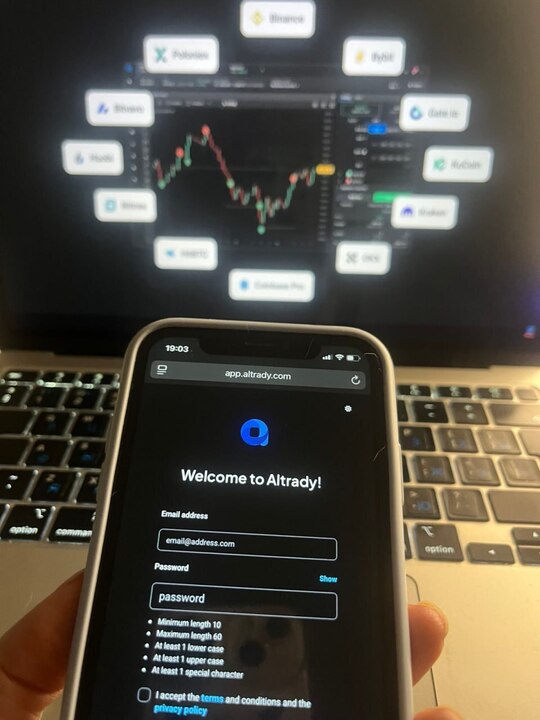
Altrady is a multi-exchange trading terminal with Grid and Signal bots: you connect exchanges via API keys, and orders execute directly on your exchange account. We tested the multi-exchange setup on Binance and Bybit (spot), going from sign-up to Smart Orders and live bot runs. We checked trade-only API access with withdrawals disabled, paper trading, a Grid Bot in a range, a Signal Bot driven by TradingView signals (via automated alerts), and whether notifications/status updates were accurate.
What Is Altrady & How It Works?
In this section, we walk through the real user path: how the Altrady crypto terminal is set up and how it behaves in practice.
1) Sign-up and account setup
We started with the basics: email sign-up and account security settings. Altrady itself doesn’t run KYC; requirements depend on the exchange you connect.
2) Connecting an exchange via API keys
For testing, we connected Binance and Bybit in spot mode. On each exchange, we created a separate API key so the platform could trade but could not withdraw funds:
- Enabled trading permissions (placing orders)
- Disabled withdrawals
- Added access restrictions (if the exchange supports it, such as IP allowlists or trusted settings)
This matters: extra API permissions increase the risk of unauthorized actions. In a normal setup, Altrady should run on a “trade-only” key.
3) Paper trading run
Before going live, we ran the scenario in paper trading. It quickly surfaces common issues: the wrong market, order sizes that are too small, grid configuration mistakes, and over-trading where fees eat most of the result.
What we caught in paper trading:
- Order size below the exchange minimum: on some pairs, the minimum notional is higher than it looks at first glance, and the grid starts failing on constraints. After adjusting sizes and grid spacing, the simulation behaved more consistently.
- Fees and trade frequency: with an overly tight grid, the number of trades spikes, and on a live account taker/maker fees and spread can wipe out profit.
- Signals and sync delays: in multi-exchange mode, you can occasionally see small delays when positions/orders sync—paper mode makes this obvious, and you can judge whether the tool is a fit for scalping.
4) Live run
For the live run, we used a $200 deposit and two approaches (on the connected exchanges):
- Running Grid Bot with basic settings (to see default behavior)
- A configured scenario (to evaluate flexibility, limits, and risk control)
Friction points on live:
- Sync and status updates: during active trading with multiple widgets open, the UI may not refresh instantly, which is fine for swing strategies, but it can annoy fast scalpers.
- Range strategy during a trend: if you run a grid inside a range, you need to define what happens when price breaks out. Without clear stop rules, the bot will keep executing the grid logic and can accumulate a position “where you didn’t want it.”
Takeaway: Check minimum order rules, fees, and exchange constraints, and set stop conditions and risk limits before you run the bot with real money.
Altrady’s Core Features and Trading Tools
Here we focus on what actually matters in Altrady trading bot use cases: bots, Smart Orders, integrations, risk controls, and monitoring.
Core Automation Modes
- Grid bot. Built for range markets: the bot buys lower and sells higher inside a defined price channel; if price breaks out, you should set a stop or a clear rule to pause/exit.
- Signal bot. Signal-based automation: you can trade from algorithmic signals and connect TradingView signals/alerts (via automated notifications).
- DCA layers within signals. In Signal Bot, you can split entries into multiple buys/add-ons based on rules (for example, adding on a pullback) instead of entering with the full amount at once.
- Smart execution (terminal-first). Altrady aims for “fewer clicks”: presets, partial take-profits, trailing, and OCO/conditional workflows. This speeds up manual and semi-automated execution.
Interfaces and Monitoring
Altrady works as a single interface for multiple exchange accounts (depending on your plan). In practice, we boiled monitoring down to three checks:
- The exchange connection is stable and the key hasn’t lost permissions
- Orders are executing according to the bot/preset parameters
- Risk rules are actually enabled (SL/TP, size limits, stop scenarios)
Open-Source and Self-Hosted
Altrady is a commercial product, so there’s no open-source or self-hosted mode. That means you don’t control the execution environment as deeply as you would with a bot you deploy on your own server. The tradeoff is convenience: you connect an exchange via API and get one terminal with bots and analysis tools, with no infrastructure setup required.
Altrady Pros and Cons
In this Altrady review, we focused on real-world use: how predictable the product feels day to day, what genuinely helps, and what can cost you time and money.
Altrady’s strong side is its execution layer: Smart Orders and position management from a single screen, plus bots for common scenarios (grid and signal). At the same time, results depend directly on your configuration. If you don’t verify minimum order rules, fees, and stop logic, you’ll quickly see how a “strategy” turns into a string of random actions.
On pricing: Altrady is a paid terminal, and if your deposit is small, paying for a plan often doesn’t make practical sense. In other words, you’re paying for a smoother interface and faster execution tools not guaranteed returns. On Altrady’s official pricing page, there are three plans (Basic, Essential, and Premium), ranging from €28/month (or €20/month billed annually) to €90/month (or €63/month billed annually). On a small account, the subscription plus exchange fees can take a meaningful bite out of results, especially in high-frequency strategies.
Strengths:
- Multi-exchange control in one window. Convenient if you spread trading across multiple venues.
- Strong Smart Orders and presets. You can pre-build entry/exit logic and make fewer mistakes in manual execution.
- Scanners and alerts for finding setups. Monitoring tools help you spot entries faster and avoid missing moves.
Weaknesses:
- Signal Bot isn’t always great for parallel strategies on the same pair. The “one position per market” constraint can get in the way.
- Simulation and features depend on the exchange and market. Paper trading in Altrady works only for spot, and for futures the available toolset depends on the specific exchange’s API integration.
- Subscription and onboarding can feel heavy. In our test, the UI and setup took longer than in simpler terminals, and independent reviews often note that the subscription is hard to justify on a small deposit.
Conclusion: Is Altrady Right for You?
If you treat Altrady reviews as a tool selection problem, start by deciding what you want to automate: a range grid, TradingView signals, semi-automated execution via Smart Orders, or simply one terminal for multiple exchanges.
Altrady can be a good fit if:
- You trade on multiple exchanges and want execution in one interface
- You’re willing to test ideas in paper trading before going live
- You want a signal bot and a grid without coding, but with parameter control
Altrady is a weaker fit if:
- You expect “default settings” to be profitable out of the box
- You don’t want to monitor risk and define stop rules
- You trade ultra-short timeframes where sync delays and mobile limitations matter
GNcrypto’s Overall Altrady Bot Rating
| Criteria | Rating (out of 5) |
|---|---|
| Automation Quality & Execution | 4.1 |
| Strategy Performance & Backtesting | 3.7 |
| Risk Management & Controls | 3.8 |
| Costs & Fee Transparency | 3.6 |
| Exchange Coverage & Asset Support | 4.3 |
| User Experience & Setup | 3.6 |
| Customer Support & Documentation | 4.2 |
Trustworthiness Check
To keep this Altrady check grounded, we relied on sources you can verify.
- Pricing and limits. Subscription tiers, billing options, and plan limits are listed on Altrady’s official pricing page.
- API security and withdrawal permissions. Altrady’s Help Center explains how API keys are stored and why you should use “trade-only” permissions with withdrawals disabled.
- Supported exchanges. Altrady publishes an official list of integrated exchanges and maintains Help Center pages for supported connections and setup.
- Product documentation. The Help Center documents core tools (Smart Trading, Grid Bot, Signal Bot, paper trading, TradingView alerts), so you can cross-check how features work and where limits apply.
Anyone claiming to represent Altrady and asking you to send funds, share login credentials, or provide withdrawal-enabled API keys is a scam. Use only official channels and keep API keys set to trading-only.
Methodology – Why You Should Trust Us
To ensure our final 1.0–5.0 star score is accurate, we apply a weighted model that prioritizes what matters most for automated trading. At GNcrypto, we don’t just summarize features; we verify them through hands-on testing with real capital. Our goal is to determine if a bot provides a genuine edge or if its costs and technical hurdles outweigh the benefits of automation.
How We Collect Data
Public Sources: We analyze official documentation, subscription pricing tiers, API safety protocols, and supported exchange lists.
First-Hand Testing: We connect the bot to live exchange accounts (such as Binance or Bybit) and deploy $200 of capital to measure execution speed, signal accuracy, and real-world slippage.
Categories & Weights
- Automation Quality & Execution – 30%
- Strategy Performance & Backtesting – 25%
- Risk Management & Controls – 15%
- Exchange Coverage & Asset Support – 10%
- Costs & Fee Transparency – 10%
- User Experience & Setup – 5%
- Customer Support & Documentation – 5%
Latest News



Recommended Articles/Reviews





The material on GNcrypto is intended solely for informational use and must not be regarded as financial advice. We make every effort to keep the content accurate and current, but we cannot warrant its precision, completeness, or reliability. GNcrypto does not take responsibility for any mistakes, omissions, or financial losses resulting from reliance on this information. Any actions you take based on this content are done at your own risk. Always conduct independent research and seek guidance from a qualified specialist. For further details, please review our Terms, Privacy Policy and Disclaimers.