#security
236 articles found
Latest
 Ukraine's Security Service has successfully dismantled a significant underground network that was carrying out unauthorized financial transfers between Russia and Ukraine, making use of banned Russian payment systems and digital currencies.
Active in four regions, these secretive hubs were handling over $1 million each month. Platforms like Yumoney, Webmoney, and various cryptocurrencies were employed to change Russian rubles into digital currencies and subsequently into Ukrainian hryvnia. The primary customer base was made up of hackers and companies participating in under-the-table transactions with Russia.
Ukraine's Security Service has successfully dismantled a significant underground network that was carrying out unauthorized financial transfers between Russia and Ukraine, making use of banned Russian payment systems and digital currencies.
Active in four regions, these secretive hubs were handling over $1 million each month. Platforms like Yumoney, Webmoney, and various cryptocurrencies were employed to change Russian rubles into digital currencies and subsequently into Ukrainian hryvnia. The primary customer base was made up of hackers and companies participating in under-the-table transactions with Russia. The ECOMI Phenomenon: Collectibles Go Digital!
 ECOMI's blockchain ecosystem and the VeVe app offer a novel approach to NFTs and digital trading. This piece dissects the platform's peculiarities, assessing the security and tokenomics features that distinguish it. Check out this insightful read to track the evolution of blockchain applications.
  The total loss incurred surpassed $50 million, causing the Total Value Locked (TVL) of the project to drop by over 40% following the news.
CRV price also plummeted by over 20%.
Security analysts at Beosin reported that the attacker specifically targeted Curve’s factory pools associated with several projects, including Alchemix, JPEG’d, MetronomeDAO, deBridge, and Ellipsis.
The total loss incurred surpassed $50 million, causing the Total Value Locked (TVL) of the project to drop by over 40% following the news.
CRV price also plummeted by over 20%.
Security analysts at Beosin reported that the attacker specifically targeted Curve’s factory pools associated with several projects, including Alchemix, JPEG’d, MetronomeDAO, deBridge, and Ellipsis.  Brian Armstrong has publicly urged US residents to actively support the 21st Century Financial Innovation and Technology Bill, which promises to bring much-needed clarity to cryptocurrency regulation.
Armstrong emphasized that it is ordinary Americans who can have a decisive impact on the outcome of the vote by sending an email to their representatives asking them to support the bill.
In a more detailed statement, Coinbase added that the bill, in addition to protecting consumer rights and enhancing national security, has the potential to spur job creation in the US.
Brian Armstrong has publicly urged US residents to actively support the 21st Century Financial Innovation and Technology Bill, which promises to bring much-needed clarity to cryptocurrency regulation.
Armstrong emphasized that it is ordinary Americans who can have a decisive impact on the outcome of the vote by sending an email to their representatives asking them to support the bill.
In a more detailed statement, Coinbase added that the bill, in addition to protecting consumer rights and enhancing national security, has the potential to spur job creation in the US.  Michael and Amanda Griffis are in hot water with the Commodity Futures Trading Commission (CFTC) as the agency alleges the couple pulled off a grand-scale fraud.
Operating under the auspicious name "Blessings of God Thru Crypto," they enticed over 100 individuals to contribute to their digital assets commodity pool. Accumulating over $6 million, the couple promised high returns and security for the pooled resources.
According to CFTC, these pledges were not only empty but the pooled funds frequently ended up mingling with the Griffis' personal finances.
Michael and Amanda Griffis are in hot water with the Commodity Futures Trading Commission (CFTC) as the agency alleges the couple pulled off a grand-scale fraud.
Operating under the auspicious name "Blessings of God Thru Crypto," they enticed over 100 individuals to contribute to their digital assets commodity pool. Accumulating over $6 million, the couple promised high returns and security for the pooled resources.
According to CFTC, these pledges were not only empty but the pooled funds frequently ended up mingling with the Griffis' personal finances.  The United States Government Accountability Office (GAO) has published a report suggesting that a more robust regulatory framework is required for the use of blockchain in finance.
The report highlighted the lack of regulation around crypto asset trading platforms and stablecoins and identified non-security crypto asset spot markets as the main regulatory gap. According to the GAO, Congress could address these issues by designating a federal regulator to oversee these markets.
Moreover, the report suggests a need for more regulatory coordination and proposes the establishment of a formal mechanism to identify risks and respond to them within an agreed timeframe.
The United States Government Accountability Office (GAO) has published a report suggesting that a more robust regulatory framework is required for the use of blockchain in finance.
The report highlighted the lack of regulation around crypto asset trading platforms and stablecoins and identified non-security crypto asset spot markets as the main regulatory gap. According to the GAO, Congress could address these issues by designating a federal regulator to oversee these markets.
Moreover, the report suggests a need for more regulatory coordination and proposes the establishment of a formal mechanism to identify risks and respond to them within an agreed timeframe.  Ethereum co-founder has raised four primary concerns of Worldcoin: privacy, accessibility, centralization, and security.
While Worldcoin's Proof-of-Personhood (PoP) system is designed to authenticate unique users without revealing personal data, Buterin warns that any data leak could lead to misuse of identity information. He also points out that accessibility is an issue, as participation requires physical access to a device called "Orb," potentially limiting the project's reach. Lastly, he mentions security risks such as phone hacking and coercion to scan irises.
Despite these concerns, Buterin does see the value in the concept of Worldcoin, and suggests a combination of social-graph-based, general-hardware biometric, and specialized-hardware biometric techniques as a potential solution.
Ethereum co-founder has raised four primary concerns of Worldcoin: privacy, accessibility, centralization, and security.
While Worldcoin's Proof-of-Personhood (PoP) system is designed to authenticate unique users without revealing personal data, Buterin warns that any data leak could lead to misuse of identity information. He also points out that accessibility is an issue, as participation requires physical access to a device called "Orb," potentially limiting the project's reach. Lastly, he mentions security risks such as phone hacking and coercion to scan irises.
Despite these concerns, Buterin does see the value in the concept of Worldcoin, and suggests a combination of social-graph-based, general-hardware biometric, and specialized-hardware biometric techniques as a potential solution.  Bobby Dresser, the CEO of Optimism Foundation, announced on GitHub that they have approved proposals from O(1) Labs and RISC Zero for the integration of zero-knowledge proofs.
O(1) Labs suggests creating a new solution based on the Kimchi system, currently used in the Mina Protocol project. This move is expected to enhance both the performance and security of cross-chain communication.
Bobby Dresser, the CEO of Optimism Foundation, announced on GitHub that they have approved proposals from O(1) Labs and RISC Zero for the integration of zero-knowledge proofs.
O(1) Labs suggests creating a new solution based on the Kimchi system, currently used in the Mina Protocol project. This move is expected to enhance both the performance and security of cross-chain communication.  The U.S. Senate is considering a new bill aimed at imposing strict anti-money laundering (AML) rules on decentralized finance (DeFi) protocols.
The Crypto-Asset National Security Enhancement Act of 2023 targets entities controlling DeFi protocols or providing their applications. It requires customer vetting, AML programs, and reports of suspicious activities.
In absence of a controlling entity, anyone investing over $25 million in a protocol's development would be responsible.
The U.S. Senate is considering a new bill aimed at imposing strict anti-money laundering (AML) rules on decentralized finance (DeFi) protocols.
The Crypto-Asset National Security Enhancement Act of 2023 targets entities controlling DeFi protocols or providing their applications. It requires customer vetting, AML programs, and reports of suspicious activities.
In absence of a controlling entity, anyone investing over $25 million in a protocol's development would be responsible. 
 Terraform Labs was looking to the positive verdict in the "SEC versus Ripple" litigation as a precedent for its own safeguard against allegations from the U.S. Securities and Exchange Commission. Yet, Judge Jed Rakoff has dashed such hopes.
The crux of the matter is a substantial divergence in the judge's view concerning the Howey Test, which assesses whether an asset is a security. Terraform Labs' token purchases were clearly carried out by users with profit expectations - a paramount criterion for securities. Therefore, it renders the precise method of purchase irrelevant.
The dichotomy between the two judges' decisions underscores the persisting uncertainty in the landscape of cryptocurrency regulations.
Terraform Labs was looking to the positive verdict in the "SEC versus Ripple" litigation as a precedent for its own safeguard against allegations from the U.S. Securities and Exchange Commission. Yet, Judge Jed Rakoff has dashed such hopes.
The crux of the matter is a substantial divergence in the judge's view concerning the Howey Test, which assesses whether an asset is a security. Terraform Labs' token purchases were clearly carried out by users with profit expectations - a paramount criterion for securities. Therefore, it renders the precise method of purchase irrelevant.
The dichotomy between the two judges' decisions underscores the persisting uncertainty in the landscape of cryptocurrency regulations.  Bendigo Bank, one of Australia's leading banks, has decided to limit high-risk crypto payments to protect its customers from potential scams.
As a result, Bendigo Bank has become the fourth major bank in Australia to implement such security measures. However, the precise criteria used to block transactions remain unknown.
Bendigo Bank, one of Australia's leading banks, has decided to limit high-risk crypto payments to protect its customers from potential scams.
As a result, Bendigo Bank has become the fourth major bank in Australia to implement such security measures. However, the precise criteria used to block transactions remain unknown. 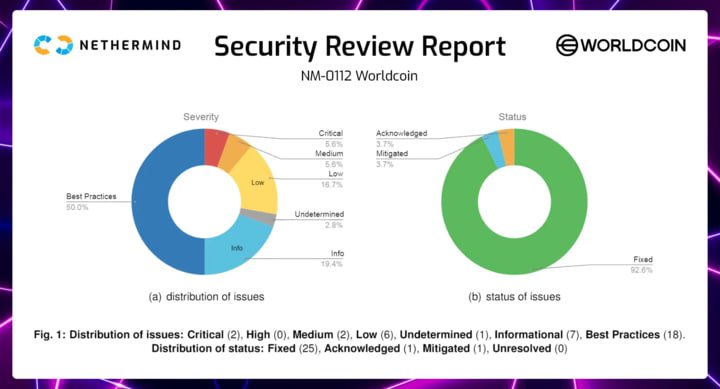 Worldcoin Addresses Security Concerns
Worldcoin has released its audit reports amid increasing criticism of its data collection practices.
The audit revealed a total of 29 security issues with the protocol.
Out of these, 27 have been fixed, one was mitigated, and another was acknowledged.
The audit was conducted by security consulting firms Nethermind and Least Authority.
Worldcoin Addresses Security Concerns
Worldcoin has released its audit reports amid increasing criticism of its data collection practices.
The audit revealed a total of 29 security issues with the protocol.
Out of these, 27 have been fixed, one was mitigated, and another was acknowledged.
The audit was conducted by security consulting firms Nethermind and Least Authority.  Optimism announced Law of Chains v0: a foundation for the future of Superchain.
Law of Chains v0 will change Optimism Governance to govern standards for multiple chains, defining the necessary conditions for integration into Superchain and prioritizing user security. According to the developers, this will:
1. Preserve a unified, neutral, and open blockchain space.
2. Conduct blockchain modernization.
3. Ensure infrastructure availability.
Optimism aims to officially unveil this project and the first version of the new chain governance process after discussions with the community in the next governance season.
Optimism announced Law of Chains v0: a foundation for the future of Superchain.
Law of Chains v0 will change Optimism Governance to govern standards for multiple chains, defining the necessary conditions for integration into Superchain and prioritizing user security. According to the developers, this will:
1. Preserve a unified, neutral, and open blockchain space.
2. Conduct blockchain modernization.
3. Ensure infrastructure availability.
Optimism aims to officially unveil this project and the first version of the new chain governance process after discussions with the community in the next governance season.  EraLend, a cryptocurrency lending protocol, was victimized by a re-entrancy attack, leading to substantial losses of $3.4 million.
The project's team confirmed via Twitter that the threat has been contained, and all loan transactions have been halted. As a precautionary measure, it's currently recommended to avoid making USDC deposits.
EraLend, a cryptocurrency lending protocol, was victimized by a re-entrancy attack, leading to substantial losses of $3.4 million.
The project's team confirmed via Twitter that the threat has been contained, and all loan transactions have been halted. As a precautionary measure, it's currently recommended to avoid making USDC deposits. 

At the UN Table: AI's Bright Horizons vs. Looming Threats
 In mid-July, for the first time, world leaders assembled at the UN Security Council to grapple with the risks tied to widespread AI adoption. The discussion bore fruit in the form of a three-year action plan, with the United Kingdom poised to potentially take the lead in global regulation.