US spot ETFs turn negative as Bitcoin price slips below key support
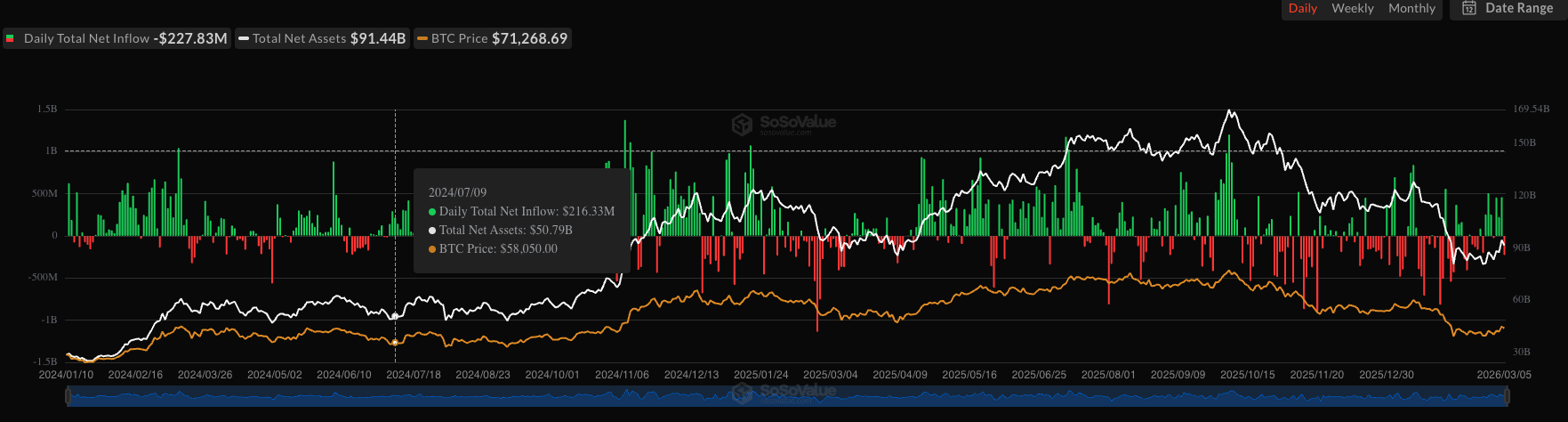
Bitcoin fell below $70,000 after US spot bitcoin ETFs recorded $227.9 million in net outflows on March 5, snapping a three-day run of more than $1.1 billion in inflows.
On March 5, US spot Bitcoin exchange-traded funds posted $227.9 million in net outflows, ending a three-day inflow streak that had brought in more than $1.1 billion. Bitcoin price pulled back to $70K, down over 4% in the past 24 hours, with Ether and other large tokens lower as well.
ETF flows were positive from March 2 to March 4, with estimated net inflows of $458.2 million, $225.2 million, and $461.9 million. BlackRock’s iShares Bitcoin Trust led inflows during those sessions before recording outflows on March 5, according to data provider SoSoValue.
Analysts at Bitfinex pointed to stronger spot buying and improving institutional activity since the weekend escalation in the Iran conflict. Their market note highlighted roughly $3.5 billion in market purchases across exchanges since March 1 in what they described as a “systemic manner.” They also flagged a shift in the Coinbase premium, which turned positive after about 40 days in negative territory, a gauge often used to track US-based demand.
Leverage metrics remained contained. Bitfinex reported that open interest has risen in line with price and that perpetual funding rates stayed moderate. The team identified a dense long-liquidation zone near $70,500 and pointed to potential support near $66,000 if selling builds.
Binance Research described the market as “watchful, not panicked” after Bitcoin fell toward $63,000 during the initial geopolitical shock and then rebounded above $70,000. The group noted market sentiment was in “Extreme Fear” through February, funding rates fell to their lowest levels since 2023, and selling from long-term holders eased as spot ETFs logged their first positive weekly flow since mid-January.
Some observers viewed price action as range-bound. Nansen’s research team tracked trading between roughly $60,000 and $71,000 in recent weeks and pointed to a need for a clean break above the top of that band to confirm a stronger trend. The firm also reported that institutional flows continue to lean toward stablecoins and yield strategies rather than outright directional bets.
Others looked at Bitcoin’s role across assets during periods of stress. Matt Mena, a crypto research strategist at 21Shares, noted that recent performance has revived debate over Bitcoin as a “flight-to-safety” or “gold beta” trade, after gold rallied first and Bitcoin followed. He added that spot ETF holders, on balance, kept positions with only modest reductions in total shares outstanding.
QCP Capital urged caution and pointed to energy prices and bond yields as key drivers for risk assets. The firm observed that Bitcoin initially held firm, then pushed higher on strong ETF inflows and rising open interest, before giving back part of the advance as broader market volatility returned. Future direction, in QCP’s view, may depend on whether oil prices remain high enough to keep yields elevated.
Cross-asset signals were mixed. Binance Research found Bitcoin’s relationship with crude oil to be inconsistent and dependent on market regime, warning against using it as a straightforward hedge for energy shocks. The group also highlighted ongoing market concerns around geopolitical escalation, pressure on software margins tied to AI spending, and fragility in private credit.
With leverage not yet stretched, some indicators point to a healthier backdrop than past rallies driven by derivatives. Even so, renewed ETF outflows and macro uncertainty continue to shape near-term trading. CryptoQuant characterized the latest strength as a relief rally unless demand holds through upcoming US payrolls and inflation data, along with further geopolitical headlines.
The material on GNcrypto is intended solely for informational use and must not be regarded as financial advice. We make every effort to keep the content accurate and current, but we cannot warrant its precision, completeness, or reliability. GNcrypto does not take responsibility for any mistakes, omissions, or financial losses resulting from reliance on this information. Any actions you take based on this content are done at your own risk. Always conduct independent research and seek guidance from a qualified specialist. For further details, please review our Terms, Privacy Policy and Disclaimers.
Articles by this author