Public Bitcoin miners sell record 32,000 BTC in Q1

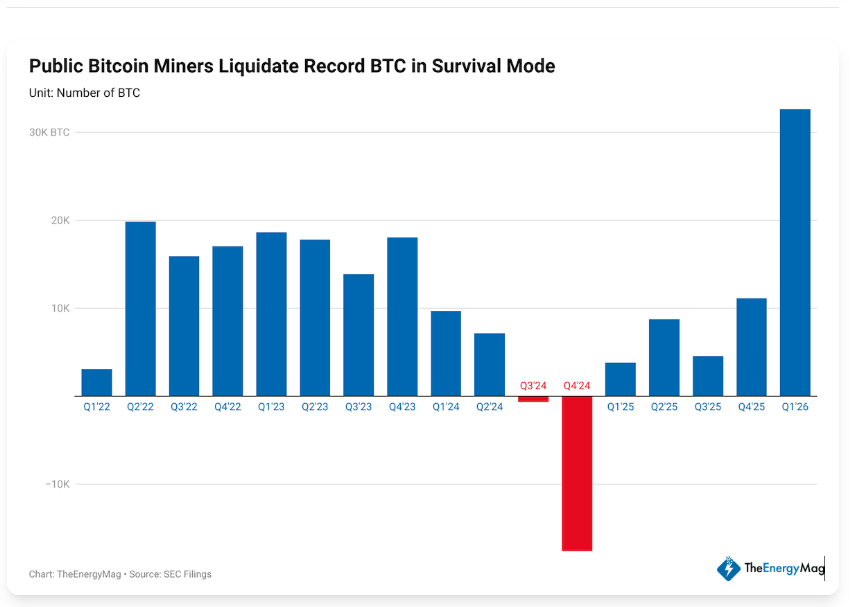
Public bitcoin miners sold more than 32,000 BTC in Q1 2026, the largest quarterly liquidation since 2022 as firms split between raising cash and holding reserves.
Public bitcoin miners sold more than 32,000 BTC in the first quarter of 2026, the largest quarterly liquidation since the 2022 sell-off. The total already surpasses net sales across all four quarters of 2025 and could rise as remaining earnings reports are filed. Major public operators reporting or disclosing sales include Marathon Digital, CleanSpark, Riot Platforms, Cango, Core Scientific and Bitdeer.
Several firms cited the need for cash to fund operations and meet debt obligations in a tighter financing environment. Companies that disclosed sales said they used some proceeds to bolster operating liquidity and shore up balance sheets.
Mining revenue per unit of computing power, known as hashprice, has fallen to the low $30 per PH/s range. Network difficulty is roughly ten times higher than in 2021 and the 2024 halving cut miner block rewards in half. Bitcoin’s market price remains below its late-cycle peak above $120,000. Those factors have reduced bitcoin produced per unit of hashpower and compressed margins for operators with older equipment or higher power costs.
Not all public miners are selling. American Bitcoin, the proprietary mining unit carved out of Hut 8, reported more than 7,000 BTC in reserves and about 28 exahashes per second of proprietary hashrate in early April. The unit added roughly 15 EH/s of Antminer S21 machines by pledging about 3,000 BTC as collateral, a structure that limited upfront cash outlay and gives the company the option to redeem the collateral within 24 months. Public filings and recent data indicate American Bitcoin’s all-in cash cost of production is about $55,000 per bitcoin, or roughly $25 per PH/s. Matt Prusak, American Bitcoin’s president and interim CFO, said the company is focused on careful growth and that it is accumulating rather than selling at present.
Power cost differences are affecting who can hold reserves. New West Data, an oil producer that mines using flared natural gas from its own sites, reports effective power costs below $0.02 per kilowatt-hour. At that rate, less efficient machines remain profitable at current hashprice levels; a firm paying $0.02/kWh can sustain equipment with efficiencies near 60 J/TH. New West tripled both oil production and bitcoin compute capacity in 2025 and operates about 15 megawatts of computing power. Sean McDonough, New West’s president and CEO, noted the company’s power structure enables continued expansion.
Other operators are pursuing software and operational efficiency. Luxor introduced a fleet management tool called Commander that evaluates hashrate and power market conditions every five minutes and adjusts power settings across a fleet. Luxor reported Commander delivers an 8% to 14% improvement in profitability versus traditional on/off curtailment strategies and that the platform has scaled to about 5 EH/s of customer hashrate. Luxor’s firmware platform, LuxorOS, now supports roughly 45 EH/s, and the company provided a case study showing a 50% faster recovery time for a 1.1 EH/s fleet after curtailment events. Ethan Vera, Luxor’s chief operating officer, said the company aims to improve uptime and efficiency without additional capital spending.
Earnings and operational disclosures due in the coming weeks will add detail on sales totals, balance sheet positions and operator strategies. Those filings could change the quarter’s reported totals and provide updated data on each firm’s production costs, reserves and capital plans.
The material on GNcrypto is intended solely for informational use and must not be regarded as financial advice. We make every effort to keep the content accurate and current, but we cannot warrant its precision, completeness, or reliability. GNcrypto does not take responsibility for any mistakes, omissions, or financial losses resulting from reliance on this information. Any actions you take based on this content are done at your own risk. Always conduct independent research and seek guidance from a qualified specialist. For further details, please review our Terms, Privacy Policy and Disclaimers.
Articles by this author