PrimeXBT vs Binance comparison 2026: fees, tools, and trust for beginners
PrimeXBT and Binance are two common ways to trade crypto futures in 2026, but they reward different habits. We compared fees, 8 hour funding, liquidity, tools, and trust signals, then mapped the results to beginner scenarios so you can pick the platform that helps you lose less while you learn.

Fees & Funding
4.5/5
Leverage & Margin
4.5/5

Fees & Funding
4.2/5
Leverage & Margin
4.2/5

Fees & Funding
4.2/5
Leverage & Margin
4.3/5

Fees & Funding
4.4/5
Leverage & Margin
4.2/5

Fees & Funding
4.5/5
Leverage & Margin
4/5
After a beginner style test, the difference is clear. Choose Binance if you want the deepest liquidity on majors, the widest futures menu, and a more mature risk engine. Choose PrimeXBT if you want a simpler trade flow and a demo first way to build habits, with negative balance protection as a comfort guardrail.
PrimeXBT vs Binance at a glance
| Category | PrimeXBT | Binance | Winner |
|---|---|---|---|
| Trading Fees & Funding Costs | 4.0 | 4.6 | Binance |
| Leverage & Margin Requirements | 4.0 | 4.6 | Binance |
| Contract Selection & Liquidity | 3.5 | 5.0 | Binance |
| Platform Performance & Risk Controls | 3.8 | 4.4 | Binance |
| Security & Regulatory Compliance | 3.4 | 4.2 | Binance |
| User Experience & Trading Interface | 4.2 | 4.5 | Binance |
| Customer Support & Educational Resources | 4.0 | 4.4 | Binance |
| Total | 4.0 / 5.00 | 4.4 / 5.00 | Binance |
We tested both platforms with $200 deposits, opening small leveraged positions (5×-10×) on BTC and ETH perpetuals. We monitored funding rates across multiple 8-hour cycles, tested stop-loss behavior during volatility, measured order execution speed and spread width during US and Asia trading hours, and compared total trading costs over multi-day holds.
Fees & liquidity
In our PrimeXBT vs Binance tests, “cost” was not just the maker and taker fee you see on a pricing page. For beginner accounts, the real damage usually comes from three places: trading fees on every entry and exit, funding charged every 8 hours, and the silent tax you pay inside the spread when you hit market orders.

Fee logic (what you pay to get in and out). PrimeXBT is easy to reason about: the platform pushes a low baseline maker fee (0.01%) and a tiered taker structure, so the math stays simple when you are trading small sizes and learning to place limit orders. Binance also runs a tiered schedule, but in our experience its biggest advantage is not “a slightly better fee line” — it is how often your trade fills close to the price you expect.
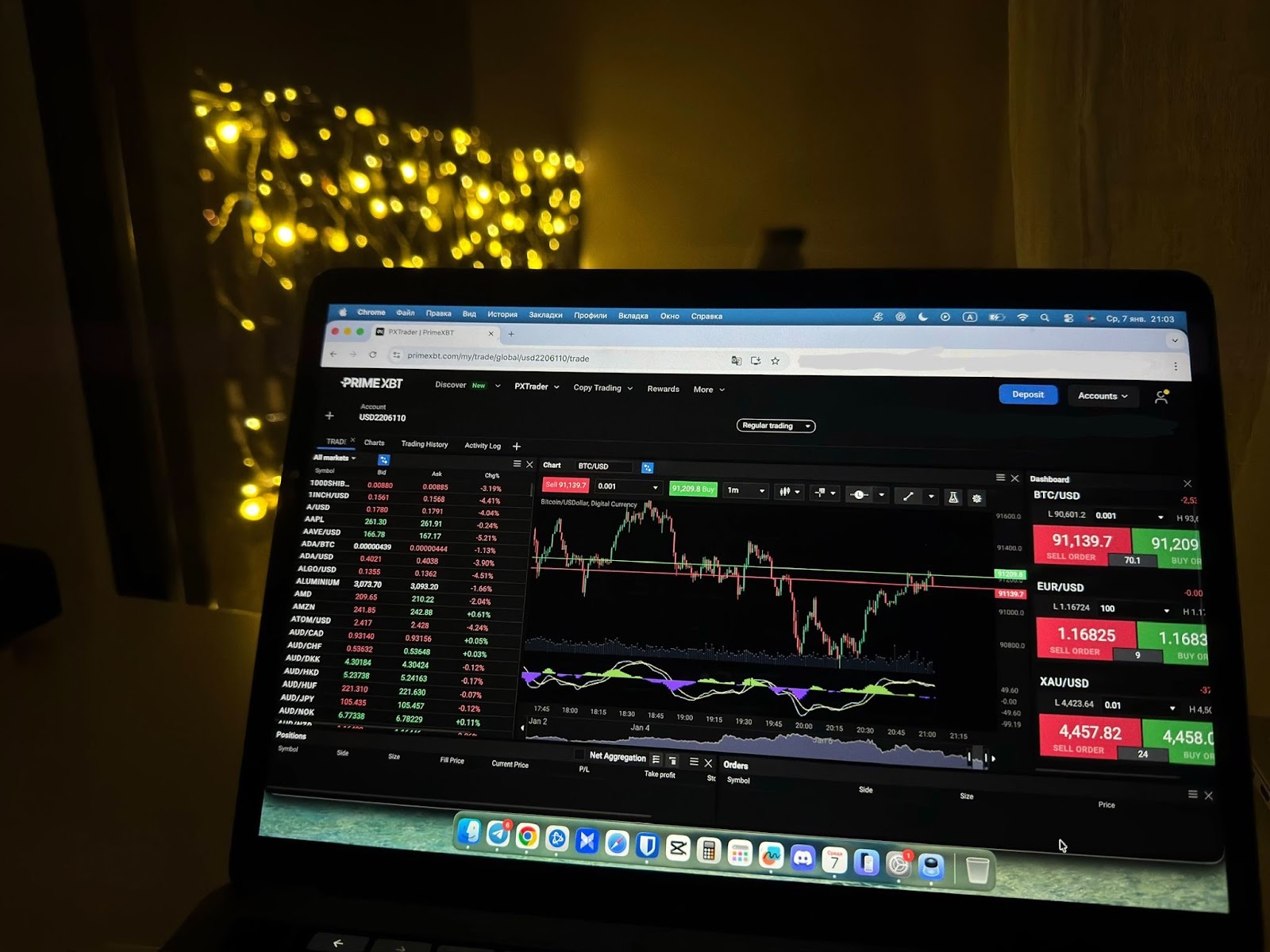
Funding every 8 hours (what you pay to stay open). Both platforms settle funding in 8-hour cycles. The beginner-friendly way to estimate it is:
- 24 hours = 3 funding periods
- 3 days = 9 funding periods
- 7 days = 21 funding periods
Funding is quoted as a percentage of your position, but it hits your margin balance. That is why it feels amplified on 10x: the fee is small on paper, but it comes out of a much smaller collateral pile.
Liquidity as a hidden fee (spread and slippage). Binance is typically the cleaner venue for majors when volatility spikes: deeper books tend to keep spreads tighter and reduce slippage on $1K–$4K notional orders. PrimeXBT is often fine for “learning-sized” positions, but we would avoid rushing into market orders on thinner contracts or during news.
Quick reality check: $200 margin at 10x is a $2,000 position. Two taker fills plus a few funding cycles can shave off meaningful dollars even if price barely moves – and that is often what turns a choppy week into a frustrating stop-out.
Trading tools
In a Binance vs PrimeXBT tools check, we asked one beginner-focused question: which platform makes it easier to trade with discipline when you are tired, distracted, or trading around news?
Order types that prevent rookie mistakes. Binance Futures is the more feature-rich toolbox. In practice, that means you can build “guardrails” into the order itself: trailing stops to lock gains without babysitting the chart, conditional orders to enter only if price confirms, and execution helpers like TWAP when you do not want to slam the book with a single market order.
PrimeXBT feels simpler. For most new traders, that is not a weakness. In our experience, the first month is less about exotic order types and more about getting the basics right every single time: place the position, set a stop-loss, set a take-profit (or a clear manual exit plan), and avoid accidental over-sizing. PrimeXBT’s flow is closer to that “one clean routine,” which reduces misclicks and hesitation.
Position management (how many knobs is too many). Binance gives you more controls and more settings across margin modes, order triggers, and advanced execution. The upside is flexibility. The downside is cognitive overload: beginners can end up changing three parameters they do not fully understand and then blaming the platform when the trade goes sideways.
PrimeXBT’s interface is more direct for the core futures workflow. We think it works best for traders who want fewer choices and a repeatable checklist.
Automation and APIs (without the tech rabbit hole). If your plan includes bots, signals, or any kind of semi-automated execution later, Binance is the more natural ecosystem. PrimeXBT is better treated as “manual trading first, automation later.”
Practice paths. We would start on PrimeXBT’s demo to rehearse the full cycle (entry → SL/TP → close) until it is muscle memory. On Binance, the biggest benefit is not a demo experience; it is having enough tools to turn your rules into orders, so you do not have to rely on willpower.
Risk & regulation
When beginners say “I want a safe platform,” we think they usually mean two things: (1) I do not want to get wrecked by a weird price spike, and (2) I do not want to worry about the platform itself (account security, transparency, legal signals). This is where Binance and PrimeXBT feel different in day-to-day use, even if both can be used responsibly. In this PrimeXBT vs Binance comparison, we care less about marketing and more about what protects you when you are learning.
Risk engine (why you get liquidated). Binance Futures feels closer to a mature derivatives venue. The most beginner-friendly concept is mark price vs last price: in normal human terms, it is designed to reduce the chance you get liquidated just because the chart printed a fast wick for a second. Combine that with clearly explained liquidation rules and the backstops (insurance funds and ADL), and our view is that Binance behaves more predictably when the market gets chaotic.
Negative balance protection (comfort factor, not a magic shield). PrimeXBT’s big “trust difference” for nervous beginners is its negative balance protection story. Psychologically, that matters: you are not sitting there imagining you will somehow owe money after a violent move. But we want to be very clear: negative balance protection does not stop liquidations. It is a “you cannot lose more than your balance” guardrail, not a feature that saves bad risk management.
Account security (what we would set up before trading). If you do one practical thing today, do this: lock down your login before you touch leverage.
On Binance, we see a more “modern retail security” toolkit: passkeys (or at least strong 2FA), device checks, and withdrawal protections like allowlists/whitelists. Our take is simple: Binance gives you more ways to harden the account — but only if you actually turn them on.
On PrimeXBT, security tends to feel more straightforward. That can be a plus because beginners sometimes mess up complicated security menus. But in this comparison, trust often comes less from “login features” and more from the broader picture: what you can verify publicly, and what signals the platform gives about oversight.
Transparency (what you can verify). Binance’s strongest “trust signal” for many beginners is Proof of Reserves. The simplest way to think about it: it is a public, checkable snapshot meant to show customer assets are backed by reserves, instead of “trust us.” You do not need to understand crypto math to understand why that feels reassuring.
PrimeXBT does not lean on PoR in the same way, so if your personal rule is “I want to be able to verify something,” Binance usually wins the trust vibe.
Regulation signals (how it presents itself). We try not to oversell regulation because it is not a magic stamp of safety. But as a beginner, you can still read simple signals.
Binance has a public licenses/registrations page and regularly communicates jurisdictional structuring efforts. In our opinion, that does not guarantee perfection, but it is a real “adult in the room” signal versus platforms that stay vague.
PrimeXBT feels more like a pragmatic trader platform: fewer high-profile trust signals and less of the onshore-brand aura. The trade-off is that it leans into clear retail comfort mechanics (like negative balance protection), but it will not feel as institution-shaped as Binance.
Where this difference shows up in real life.
- “I got wicked out once and I am paranoid now.” → You will probably sleep better with mark price + clearly explained liquidation rules (Binance).
- “My biggest fear is somehow ending up negative after a crazy move.” → Negative balance protection can be emotionally comforting (PrimeXBT).
- “This is my first big platform and I want visible trust signals.” → Proof of Reserves + modern login security is a strong combo (Binance).
PrimeXBT vs Binance: which should you choose?
This is the short version we would tell a friend who is starting futures: pick the platform that reduces your most likely beginner mistake. For some people that is execution and liquidity. For others it is workflow simplicity and not getting lost in settings.
If you want the deepest liquidity on majors and the widest futures menu → Choose: Binance
If you want the simplest futures workflow while you build habits (entry → SL/TP → exit) → Choose: PrimeXBT
If you want advanced automation-style order tools (like trailing stop or TWAP) to turn rules into orders → Choose: Binance
If your biggest beginner fear is “what if I end up negative after a violent move” → Choose: PrimeXBT
If trust signals like Proof of Reserves and modern login security (passkeys) matter most to you → Choose: Binance
If you prefer to rehearse the full trade cycle in demo before risking real money → Choose: PrimeXBT
If you plan to scale into more serious, multi-position futures trading over time → Choose: Binance
Our practical default: if you are unsure, we would start with Binance for execution and risk infrastructure, and keep PrimeXBT as a simpler practice lane (especially in demo) until your routine is solid.
Get started
New traders can access exclusive benefits through our partnership links: Binance referral and PrimeXBT referral both offer fee discounts and trading credits. Our testing methodology and ratings remain independent.
How we test futures trading platforms
We evaluate platforms using our weighted, category-based model across 7 criteria: Trading Fees & Funding Costs, Leverage & Margin Requirements, Contract Selection & Liquidity, Platform Performance & Risk Controls, Security & Regulatory Compliance, User Experience & Trading Interface, and Customer Support & Educational Resources. Each criterion receives a score from 1.0 to 5.0, weighted by importance.
Our testing combines public data (fee schedules, contract lists, proof-of-reserves) with hands-on verification using real capital, not demo accounts. We open leveraged positions, monitor funding cycles, test order execution during volatility, and measure costs over multi-day holds.
For full methodology: How we test crypto futures trading platforms
The material on GNcrypto is intended solely for informational use and must not be regarded as financial advice. We make every effort to keep the content accurate and current, but we cannot warrant its precision, completeness, or reliability. GNcrypto does not take responsibility for any mistakes, omissions, or financial losses resulting from reliance on this information. Any actions you take based on this content are done at your own risk. Always conduct independent research and seek guidance from a qualified specialist. For further details, please review our Terms, Privacy Policy and Disclaimers.
Articles by this author