Blockchain and AI: the most powerful tech combo
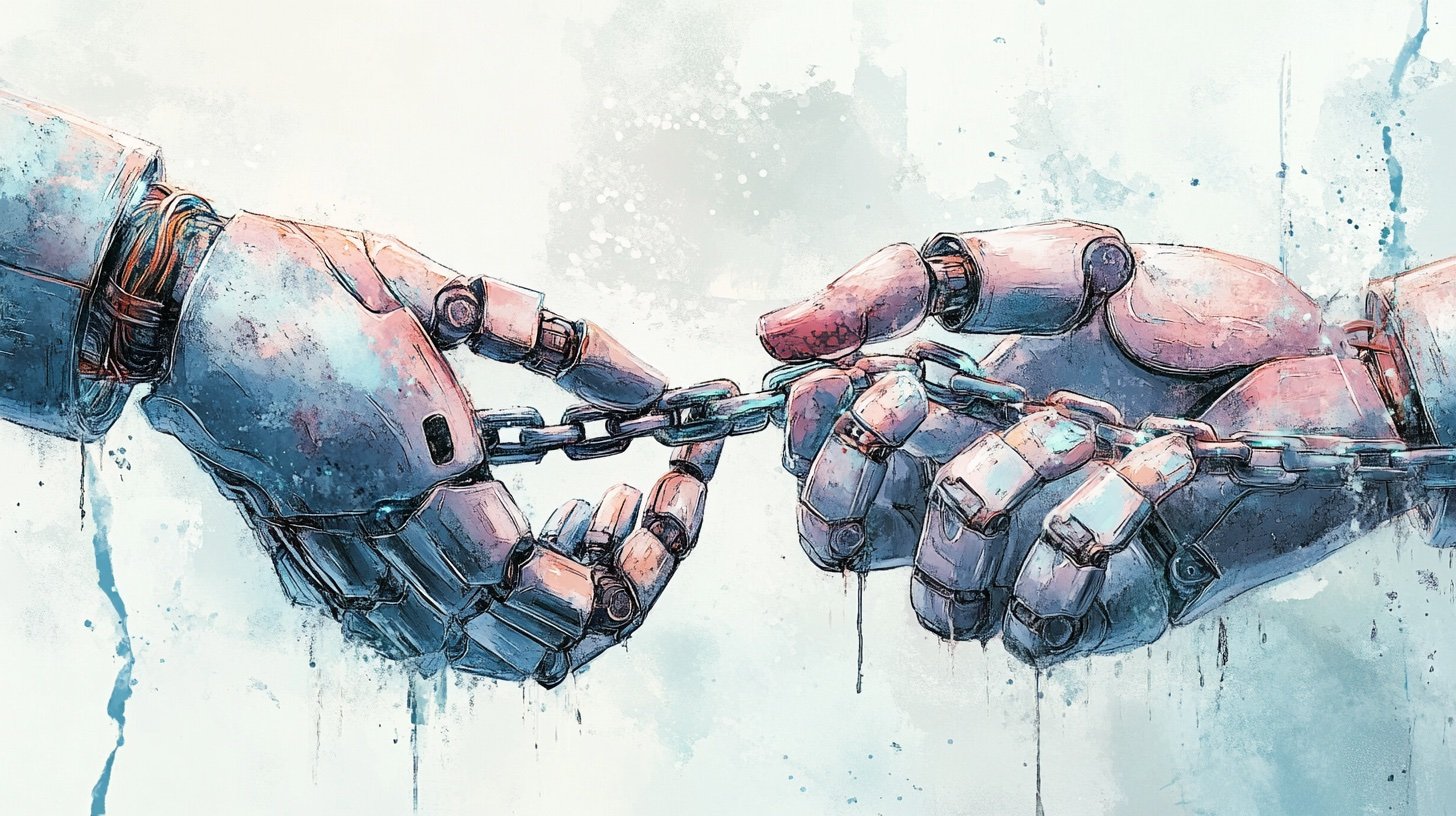
Blockchain changed how we trust data. AI learned to think like humans. Now, as the two meet, they create something bigger than the sum of their parts.
In this article, you’ll see how this tandem is rewriting the rules, solving old problems, and paving the way for new opportunities.
AI for smarter and scalable blockchains
A big challenge for blockchains is scaling and speeding up transactions. This is where AI and blockchain find synergy: together, they can analyze huge data sets in real time, optimize resource allocation, and predict peak network loads.
In classic blockchains (such as Bitcoin, Ethereum), each transaction is processed by one node. This creates bottlenecks during high network loads. With AI, blockchains can balance loads dynamically, manage sharding smarter, adjust block sizes, and react quickly to DDoS attacks or anomalies.
AI can analyze user activity patterns and predict possible spikes, automatically redirecting traffic through Layer 2 solutions (rollups or state channels). This is especially important for decentralized exchanges (DEX), DeFi platforms, games, and NFT marketplaces, where high throughput is critical for user experience.
Moreover, AI is integrated into smart contracts, which can independently optimize gas costs and prevent inefficient computations. Such technologies are already being tested by major blockchain ecosystems, including Ethereum and Solana.
In blockchain-based financial services, AI analyzes risk factors, detects fraudulent schemes, and protects users from attacks in real time. As a result, AI and blockchain allow DeFi projects to work faster and more reliably, even as the number of network participants grows.
Blockchain as a shield for AI data and privacy
In the era of big data and artificial intelligence, the issue of information protection becomes critically important. This is where AI in blockchain comes in: the distributed structure of blockchain ensures transparency, traceability, and data immutability, which is especially important for training neural networks.
Training AI takes massive datasets. Often these include sensitive personal information – like medical records, financial transactions, or customer profiles. Storing such data in centralized repositories exposes them to hacking, theft, or manipulation (data poisoning). Blockchain solves this problem: it stores hashes and metadata of datasets, records every data access, and guarantees that the original information has not been altered.
Using zero-knowledge proofs, it’s possible to confirm the accuracy of data without revealing the data itself. This is critical for sectors regulated by GDPR, HIPAA, and other data protection requirements. Major pharmaceutical and research companies are already implementing AI in blockchain solutions for exchanging anonymized medical data between clinics worldwide so that scientists can conduct research on large data sets without exposing patient identities.
In finance, AI algorithms assess customer creditworthiness, monitor suspicious activity in real time, and help prevent money laundering (AML). Blockchain records all operations, making them immutable, which significantly reduces the risk of fraud and makes independent auditing easier. Many neobanks and payment systems already integrate blockchain and artificial intelligence for client scoring, automated lending, and cyberattack prevention.
For example, large logistics operators use IoT devices, AI, and blockchain to track food supply chains from farm to store, cutting losses and ensuring quality. These examples prove that this tandem not only improves business process efficiency but also sets new standards of trust and transparency in the digital economy.
Other examples include Cortex (adds AI computation to smart contracts), Numeraire (decentralized AI-based hedge fund), and DeepBrain Chain (cloud computing for AI on blockchain). Such projects actively attract investment from tech corporations and venture funds, proving the potential of blockchain artificial intelligence synergy.
In the financial sector, this approach ensures secure exchange of transactional information between banks and credit organizations. The transparency and immutability of records make it possible to conduct audits and comply with regulatory requirements. As a result, artificial intelligence and blockchain are forming a new culture of privacy, opening the way to ethical and safe use of AI in sensitive areas.
The future of AI in blockchain
The combination of blockchain AI is becoming the foundation for new models of decentralized artificial intelligence – DeAI (Decentralized AI). This paradigm enables neural networks to be trained and applied on independent blockchain-connected nodes instead of centralized servers.
This setup cuts the risk of big corporations monopolizing data and computing, while keeping models transparent and accountable. Users and companies can jointly train neural networks without sharing the original datasets, exchanging only gradients, weights, or computation results. Technologies such as federated learning, homomorphic encryption, and Multi-Party Computation (MPC) are used for this.
DeAI solutions are already being tested for building decentralized assistants, smart DAOs (Decentralized Autonomous Organizations), platforms for financial market analysis and event prediction. Thanks to this, blockchain AI enables the creation of open and independent ecosystems, where users retain control over data and developers are rewarded for their contribution to algorithm development.
It is very likely that in the future this will lead to the emergence of global AI marketplaces, decentralized expert networks, and collective intelligence platforms without a single point of control or censorship.
Real-world applications of AI + blockchain synergy
The combination of blockchain and artificial intelligence is already modernizing healthcare, as well as the financial technology and logistics sectors. In healthcare, blockchain ensures the reliability and integrity of medical records (EHR), while neural networks analyze them, identifying disease patterns and helping doctors make decisions. Companies use blockchain for:
- tracking the origin of medicines;
- preventing counterfeiting;
- organizing clinical trials with transparent sharing of results among all participants.
In logistics, blockchain is used to track the provenance of goods, record delivery stages, and monitor transport conditions, while AI powers predictive analytics:
- demand forecasting;
- identifying potential delays;
- automating routes;
- optimizing warehouse inventory.
Leading projects driving AI and blockchain integration
Among innovative solutions at the intersection of blockchain artificial intelligence are platforms that create decentralized infrastructure for collaborative AI development.
- SingularityNET, where developers from around the world can deploy, test, and sell AI services, with access and payment tracked by blockchain. This makes the AI services market transparent, lowers entry barriers for independent developers, and protects intellectual rights.
- Ocean Protocol focuses on secure data sharing for AI model training, allowing organizations to rent out data without the risk of exposing sensitive information. Transaction protection and authenticity are ensured by smart contracts and data monetization mechanisms.
- Fetch.AI creates autonomous agents that perform tasks in logistics, finance, and smart cities – from booking transport to optimizing energy consumption. All agent actions are recorded on the blockchain, ensuring transparency and traceability.
The new era of trust and innovation with DeAI
Decentralized artificial intelligence (DeAI) opens a new era of trust and innovation. Thanks to artificial intelligence and blockchain, companies and users get transparent and reliable tools for working with data and digital assets. DeAI provides continuous verification of product origins and automates document flow between independent participants.
In the field of digital identity, blockchain is used to store and verify identity attributes without transferring personal data to third parties, while AI analyzes risks and tailors services to the user.
DAO platforms, where decisions are made based on collective voting and AI predictions, are becoming a new tool for managing digital communities, investment funds, and even city services.
AI in blockchain makes decision-making processes objective and the infrastructure itself protected from external influence and manipulation. This creates ecosystems where innovation happens collectively, and trust is embedded in the very architecture of the system.


Recommended