When will all Bitcoins be mined? The 2140 countdown explained
When Satoshi Nakamoto released Bitcoin’s whitepaper in 2008, he proposed a digital currency with a key feature – limited supply.
On this page
Unlike traditional currencies such as the dollar or euro, which can be printed on demand, Bitcoin is scarce. An unlimited supply of bank-issued money often leads to inflation and devaluation. Satoshi Nakamoto designed Bitcoin with a fixed supply cap of 21 million coins, hardcoded into its protocol.
This built-in scarcity is what earned Bitcoin the nickname digital gold. Limited supply is meant to preserve Bitcoin’s value, as no additional coins can be created once the limit is reached. Next, we’ll look at how Bitcoin’s supply works, when all coins will enter circulation, and what happens afterward.
Mining: the core mechanism that powers the Bitcoin system
Satoshi Nakamoto created Bitcoin as a Peer-to-Peer Electronic Cash System, where users make transactions directly, without going through a financial institution. New coins enter circulation through a process called Bitcoin mining. Miners solve complex cryptographic puzzles to validate transactions and add blocks to the blockchain.
This design is called Proof of Work: miners compete to solve a complex mathematical puzzle that requires time, energy, and hardware, and presenting the correct solution serves as proof of their work.
The steady addition of a constant of amount of new coins is analogous to gold miners expending resources to add gold to circulation. In our case, it is CPU time and electricity that is expended,
Satoshi wrote.
This process secures the network, ensuring transactions are trustworthy without a central authority. Mining not only issues new bitcoins but also prevents double-spending, a critical issue in digital currencies. In return for their contribution to the network, miners earn newly created bitcoins, known as the block reward, plus transaction fees paid by users.
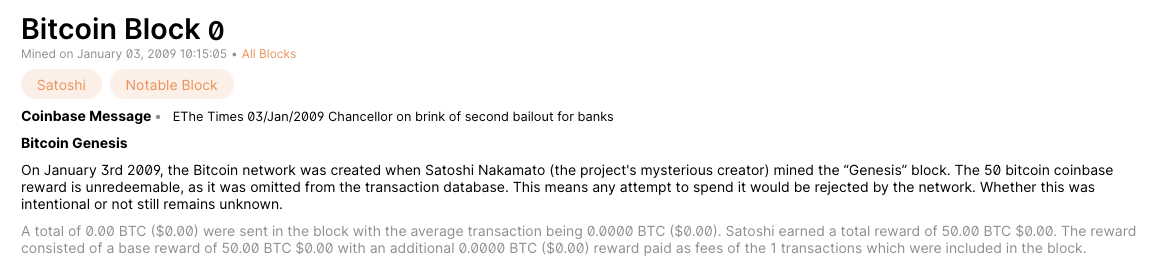
Bitcoin mining began on January 3, 2009, when Satoshi Nakamoto mined the genesis block – the very first block of the Bitcoin blockchain. It carried a reward of 50 BTC, setting the standard for future mining rewards. As more nodes joined the network, new blocks were mined, and the system came to life.
Embedded in the genesis block was a message: “The Times 03/Jan/2009 Chancellor on brink of second bailout for banks.” It hinted that Bitcoin was born as a response to the 2008 financial crisis and growing distrust in traditional banking systems. Just days later, on January 12, 2009, Nakamoto sent 10 BTC to Hal Finney in the first-ever Bitcoin transaction. As of October 2025, about 19.9 million BTC have been mined, representing almost 95% of Bitcoin’s max supply.
What is halving and how does it affect Bitcoin miners?
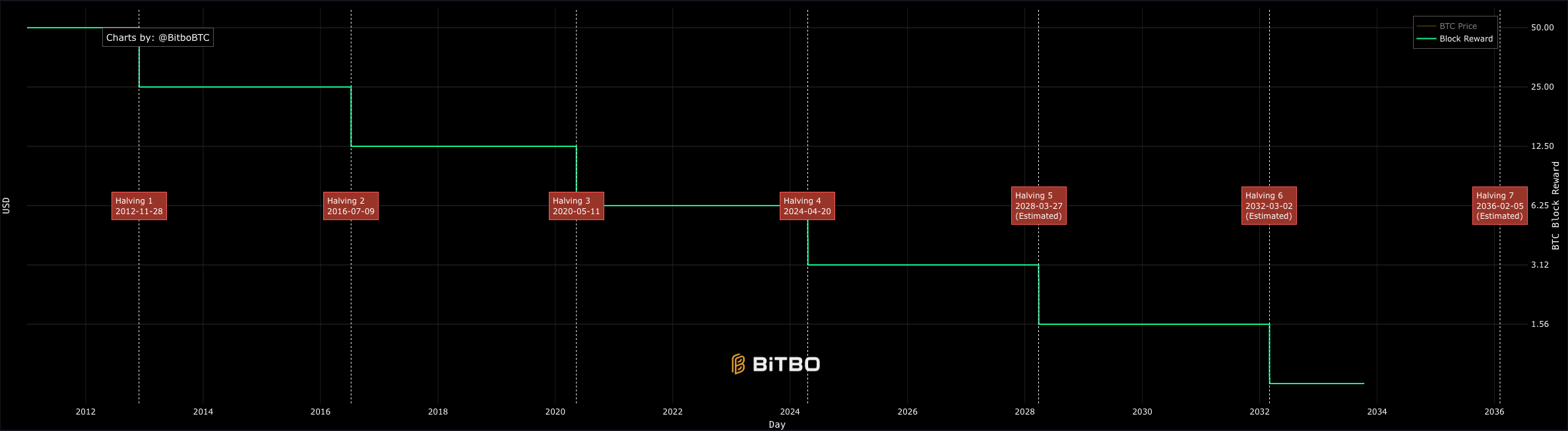
Bitcoin’s halving is a programmed event that reduces the block reward by half every 210,000 blocks, which takes about four years to reach. It’s built into Bitcoin’s code to slow down the creation of new coins over time and to prevent inflation caused by producing too much money.
When Bitcoin first launched in 2009, miners received 50 BTC for each block added to the blockchain. So far, four halving events have occurred: the reward dropped from 50 BTC in 2009 to 25 BTC in 2012, then to 12.5 BTC in 2016, 6.25 BTC in 2020, and 3.125 BTC in 2024. The next halving is expected around 2028, when the block reward will fall to 1.5625 BTC.
Halvings directly affect miners, who rely on block rewards and transaction fees for income. As rewards shrink, mining becomes less profitable unless Bitcoin’s price rises or miners reduce costs (for example, by using cheaper energy).
Historically, Bitcoin’s price has tended to increase in the months and years following each halving, as the reduced supply meets steady or growing demand. This pattern reflects Nakamoto’s vision of a deflationary currency, where scarcity supports long-term value.
As of October 2025, miners face tighter margins. Their earnings depend on Bitcoin’s price, network difficulty, electricity costs, equipment expenses, and other factors.
2140: year when all the Bitcoins will be in circulation
Estimates based on the Bitcoin Network’s design suggest that 2140 is the date when all the Bitcoins will be mined. This date is calculated based on the following factors:
- Creation of new blocks: Bitcoin adds new “blocks” of transactions roughly every 10 minutes. With 210,000 blocks between halvings, each halving cycle takes about 4 years (210,000 × 10 minutes ÷ 60 ÷ 24 ÷ 365 = 4).
- Halving schedule: Each halving makes the reward smaller and smaller. After around 33 halvings, it becomes less than 1 satoshi (the tiniest fraction of a bitcoin), which means no more new bitcoins are practically created.
- Adding up the coins: The total bitcoins come from adding up all the rewards over time. Because the reward keeps halving, this total eventually levels off at 21 million.
- Why 2140: With a halving roughly every 4 years, and about 33 halvings needed to reach the limit, it will take around 132 years from Bitcoin’s start in 2009, landing us close to the year 2140.
The year 2140 is an estimate, as block times can wobble slightly, but it marks the end of new bitcoins. When that happens, miners will no longer earn new coins and will rely solely on transaction fees. This shift will test Bitcoin’s resilience, requiring enough network activity to keep miners engaged.
What happens to Bitcoin after 2140?
When 2140 arrives and all 21 million BTC are mined, Bitcoin enters a new chapter. Nakamoto foresaw this in the whitepaper, writing that “the incentive can transition entirely to transaction fees and be completely inflation free.” With no new coins, miners will rely entirely on fees from users sending bitcoins.
The largest changes after mining ends may include:
- Bitcoin price: Scarcity could push Bitcoin’s value higher, making it a kind of digital gold in an inflationary world. Assuming adoption and usage remain strong, transaction volume may stay high after all coins are mined. In theory, miners could remain profitable relying on network fees, especially if Bitcoin’s price continues to rise.
- Security: Low fees or competing cryptocurrencies could lure miners away, creating potential vulnerabilities. If this happens, organizations interested in keeping Bitcoin secure may fund mining operations to ensure the network remains safe.
- Currency competition: In the future, Bitcoin might challenge fiat currency dominance or be overshadowed by state-backed digital currencies. Its role in the economy will influence how it is used and how it functions in 2140.
- Tech developments: Technology will continue advancing. Innovations like quantum computing may require miners to acquire new equipment and adapt their strategies.
Bitcoin’s state in 2025
While 2140 is a distant future, Bitcoin’s math set by Nakamoto is following a predictable path. By October 2025, 19.9 million of the 21 million BTC are mined, with miners earning 3.125 BTC per block they add to the blockchain. According to blockchain.com, Bitcoin miners’ total daily revenue exceeds $56 million.
From a rebel currency born in 2009, Bitcoin has grown into a global asset, often dubbed digital gold. Its price reached a new high of $126,198 on October 6, 2025, showing that people trust its limited supply, though volatility persists.
The material on GNcrypto is intended solely for informational use and must not be regarded as financial advice. We make every effort to keep the content accurate and current, but we cannot warrant its precision, completeness, or reliability. GNcrypto does not take responsibility for any mistakes, omissions, or financial losses resulting from reliance on this information. Any actions you take based on this content are done at your own risk. Always conduct independent research and seek guidance from a qualified specialist. For further details, please review our Terms, Privacy Policy and Disclaimers.
Articles by this author