Crypto trading: what are perpetual swaps?

Perpetual swaps are a financial tool that crypto traders use to make a profit without the need to buy and own crypto assets.
On this page
When you start in crypto, the first type of trading most people learn is spot trading. That’s buying a coin like Bitcoin or Ethereum, and owning it. You make money if the price goes up and lose money if it goes down.
But there are more strategies and tools beyond spot trading. Perpetual swaps, also called perpetual futures, perpetual contracts, or simply perps, are among the most popular.
What are crypto perpetual futures (and how they work)
A perpetual future is a type of derivative, a contract whose value is based on the performance of an underlying asset. Derivatives can be based on commodities, stocks, interest rates, cryptocurrencies, or other assets. Traders use these tools to speculate on price movements, limit potential losses, or trade larger positions than their funds would normally allow.
So, what is a perpetual contract?
Perpetual contracts allow traders to speculate on the price of a cryptocurrency with flexibility, without an expiration date. They were introduced in May 2016 by the crypto exchange BitMEX and its co-founder Arthur Hayes. Today, many centralized exchanges, including Binance and WhiteBIT (see our WhiteBIT exchange review) , as well as decentralized platforms like Hyperliquid, Aster, and Jupiter, offer perpetual trading.
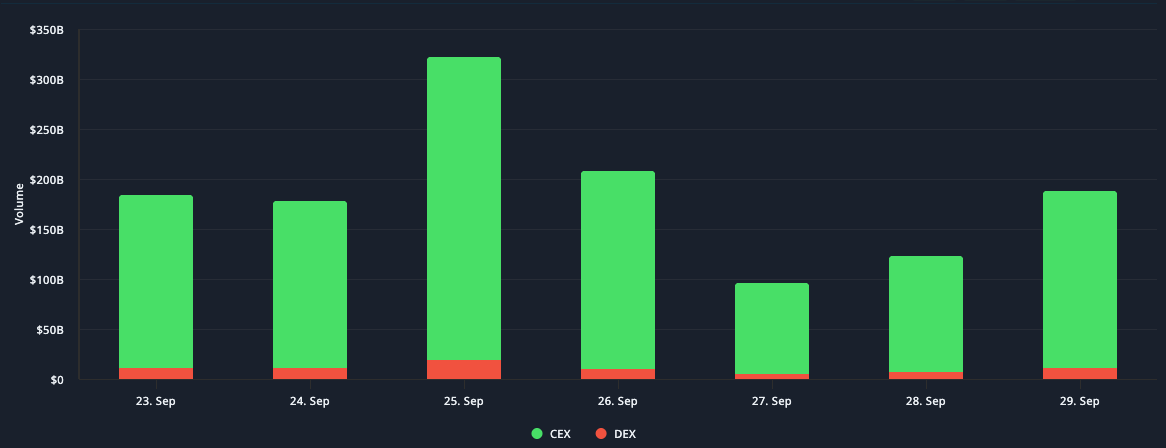
To start with perpetual swaps, traders need to deposit collateral on the platform, called the initial margin. If they believe the price of an asset will rise, they open a long position; if they think it will fall, they open a short position. If their predictions are correct, traders make a profit. Most platforms allow leverage up to 100x, meaning traders can control a larger position than their deposit. For example, with a $1,000 deposit, a trader could open a position worth up to $100,000 – increasing both potential profits and losses.
If the market moves against a trader and the collateral value falls below the minimum threshold, the platform’s automated system triggers auto-liquidation. The position is forcibly closed, and the trader loses their initial margin (or a large portion of it) to prevent the account from going negative.
The funding rate as the key to perpetual contracts
Funding rate is a mechanism that keeps the price of a perpetual futures contract close to the actual market (spot) price of the underlying cryptocurrency. Since perps don’t have an expiry date, the contract price can float above or below the spot price. The funding rate is a periodic payment, usually exchanged every 8 hours, between position holders to balance long and short trades.
- If the funding rate is positive, longs pay shorts, indicating bullish sentiment and a higher futures price.
- If negative, shorts pay longs, suggesting bearish sentiment or a futures price below spot.
Crypto prices and funding rates vary across platforms. According to crypto analytics platform CoinGlass, the maximum Bitcoin funding rate is 0.375% and the minimum is -0.375%. These numbers are calculated based on market interest rates and the difference between the contract price and the underlying asset price. For more volatile assets, such as memecoins or newly launched tokens, funding rates often move outside this range because lower liquidity and sharper price fluctuations create stronger imbalances.
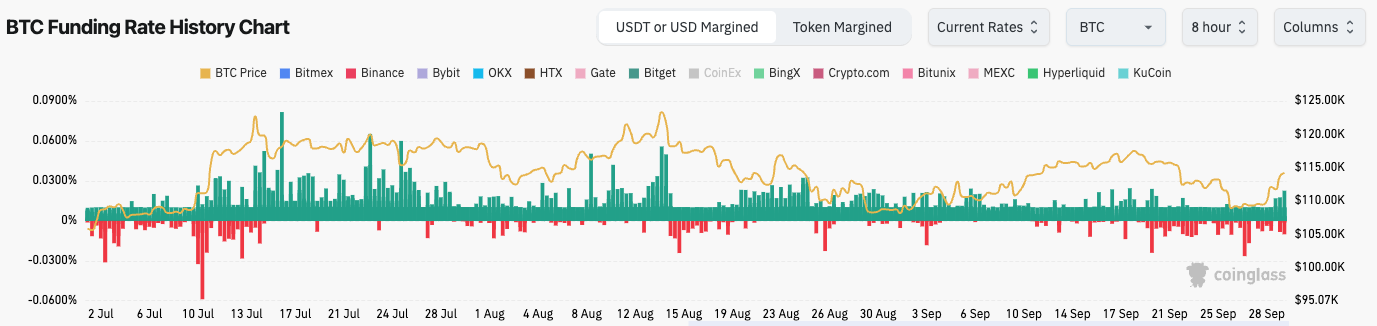
Traders often use price differences between platforms to make a profit, a strategy called arbitrage. Similarly, in perpetual futures, traders can use the funding rate to earn extra profit. Funding rate arbitrage is a trading strategy that profits from the periodic payments exchanged between long and short traders in a perpetual futures contract.
To understand the average funding cost, traders often look at the OI (Open Interest)-weighted funding rate, which shows whether more traders are leaning long or short.
Perpetual futures vs. traditional futures
Perpetual futures are similar to traditional futures in that two parties – long and short – agree on a starting price without actually exchanging the asset. Each side posts margin (collateral), and profits or losses are adjusted in real time as the market moves. The main difference is that traditional futures have a fixed expiration date, while perpetual futures do not.
Because perps never expire:
- There is only one contract per asset instead of multiple with different maturities.
- Traders do not need to roll positions into new contracts.
- Trading is continuous, without expiry-related interruptions.
This structural difference makes perpetual trading crypto specific, even though both markets use margin and real-time settlement.
In traditional finance, the closest equivalent for perps is Contracts for Difference (CFDs). Both products let traders profit from price moves without actually owning the asset and without worrying about expiry dates.
The key distinction is how they’re traded. CFDs are offered by brokers and traded directly with them. This setup can create counterparty risk and less transparent pricing. Perpetual futures, on the other hand, are traded on exchanges, where buyers and sellers interact through an open order book, and the exchange acts as the clearing house, making pricing and settlement more transparent.
Another difference is leverage. Regulators usually cap the leverage that brokers can offer on CFDs, especially in regions like Europe, the UK, and Australia. Crypto perpetual futures often allow far higher leverage – sometimes 50x or even 100x – which can greatly increase both potential profits and the risk of liquidation.
Popular strategies for perpetual futures trading
Perps are the most actively traded crypto derivatives. Due to their flexibility, these contacts are used both for active speculation and for risk management.
For speculation, traders often rely on technical analysis, using strategies like trend following or momentum trading to spot clear price moves. Tools such as moving averages or the Relative Strength Index (RSI) help traders decide when to go long or short.
Apart from direct speculation, perpetual futures crypto contracts are also widely used for hedging and arbitrage. Hedging involves taking an opposite position in perps to protect spot holdings. For example, someone holding Bitcoin might short BTC perps to reduce losses if the market falls.
Arbitrage, on the other hand, takes advantage of temporary price gaps between perps and the spot market, often linked to the funding rate. Basis trading, a common type of arbitrage, involves exploiting price differences between perpetual futures and other derivatives, such as dated futures. Traders can profit by going long on one instrument and short on the other when spreads widen beyond their normal range.
Risks to watch out for in perpetual swaps trading
A major risk in trading crypto perpetual futures is high leverage. These contracts often allow leverage of 50x, 100x, or more, meaning even small price changes can lead to big gains or large losses. Without careful position sizing and stop-loss strategies, traders risk liquidation, potentially losing their entire margin in minutes. Single-day liquidations in the crypto perpetual futures market have frequently exceeded $1 billion during sudden market movements, wiping out hundreds of thousands of leveraged positions.
Another key risk is market volatility. Prices can move quickly and unpredictably, amplifying both gains and losses. Funding rate risk is also an important factor to keep in mind. On most major exchanges, traders pay or receive funding fees every eight hours. Misreading funding rate trends can gradually reduce profits or increase losses. When the funding rate stays high and positive, with longs paying shorts, these costs can quickly add up, making long-term leveraged trades much more expensive than normal interest rates.
Counterparty and platform risks further add to the challenge. Even though most crypto perpetual futures are traded on exchanges, technical glitches, delays, or security issues can prevent trades from executing as planned or delay withdrawals.
Finally, emotional and behavioral risks play a major role. The combination of high leverage and volatile markets can lead to impulsive decisions, overtrading, or holding losing positions for too long.
Being aware of these risks, managing leverage carefully, and having a clear risk-management plan are crucial steps for trading crypto perpetual futures safely and effectively.
The material on GNcrypto is intended solely for informational use and must not be regarded as financial advice. We make every effort to keep the content accurate and current, but we cannot warrant its precision, completeness, or reliability. GNcrypto does not take responsibility for any mistakes, omissions, or financial losses resulting from reliance on this information. Any actions you take based on this content are done at your own risk. Always conduct independent research and seek guidance from a qualified specialist. For further details, please review our Terms, Privacy Policy and Disclaimers.
Articles by this author