
Coinrule Review: How This No-Code Crypto Bot Automates Your Trading
Affiliate Disclosure:
GNCrypto editors review services independently. If you click on affiliate links, we may earn commissions, which help support our testing. The goal of our reviews is to provide our readers with the most objective and unbiased overviews of available platforms for spot crypto trading.
Coinrule

Coinrule is a solid choice if you want a cloud-based, rule-driven crypto trading bot with templates for beginners and multi-exchange support, but subscription pricing and limited customization are drawbacks for advanced quants.
GNcrypto's Verdict

Coinrule is a cloud-based crypto automation platform that lets you build rule-based trading strategies without coding and run them on connected exchanges like Binance, Coinbase Advanced, Kraken, KuCoin, and others. We linked live API keys, created bots from ready-made templates (DCA, trend-following, range trading), and tested them in both live and paper-trading modes to see how orders executed in real market conditions.
- A simple no-code (if-this-then-that) rule builder.
- A library of hundreds of ready-made strategies plus a demo exchange.
- Support for several major exchanges via API.
- The free plan is heavily limited by monthly trading volume and rule count.
- Advanced plans cost more than many competitors.
On this page
- What Is Coinrule and How Does It Work?
- Core Features and Automation Tools
- Test Results (14 days, $200 capital across 3 strategies)
- Coinrule Pros and Cons
- Final Verdict: Is Coinrule Worth It?
- Who Should Use Coinrule (And Who Shouldn't)
- Trustworthiness Check
- GNcrypto’s Overall Coinrule Trading Bot Rating
- How We Test Crypto Trading Bots
- Categories & Weights
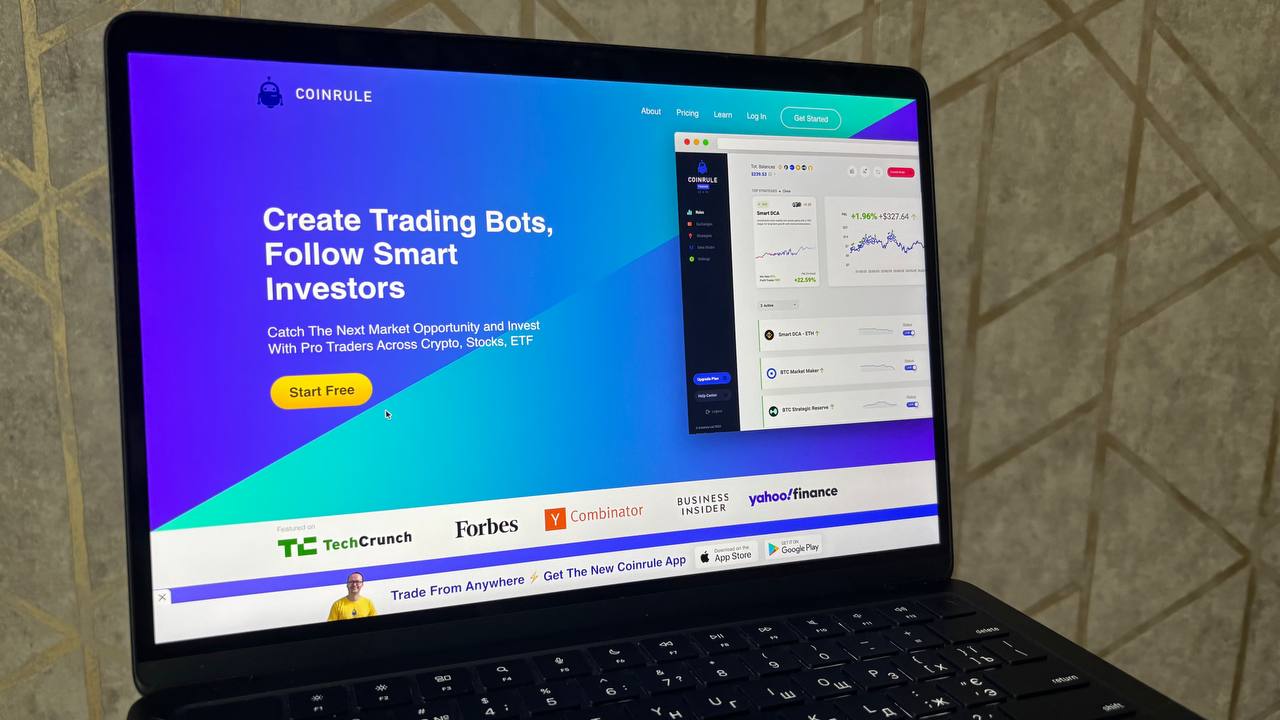
We tested Coinrule like a beginner would: connected Binance via API, launched DCA and ‘buy the dip’ templates, and watched what happened during a 3% ETH drop. The biggest advantage? No-code rule builder launches strategies in under 20 minutes. The trade-off? Free plan limits you to 2 live rules and $3,000 monthly volume – hit those caps fast if testing multiple strategies.
We went through the full end-to-end flow as a regular user: registered an account, connected the exchange via API, enabled IP whitelisting and 2FA, and then ran several live and demo strategies.
We tested prebuilt templates (DCA, “buy the dip,” range trading), built a couple of rules from scratch in the builder, and checked how stop-losses and take-profits behave, how quickly the bot places and cancels orders, what happens during sharp price moves, and how closely backtests match live market conditions.
As the test went on, it became clear that Coinrule is a beginner-friendly builder, but any mistake in a rule’s conditions quickly turns into extra trades and fees.
What Is Coinrule and How Does It Work?
Coinrule is a non-custodial platform for automating crypto trading. You connect an exchange (Binance, KuCoin, Coinbase, Bybit, etc.) via API, choose which coins to trade and what size, then use the builder to create logic like “if price/volume/indicator does X, buy/sell Y.”
The platform monitors the market 24/7 and sends orders to your exchange when conditions trigger. Your funds always stay on the exchange, not on Coinrule – this is the main answer to the question is Coinrule legit.
Instead of one “super bot,” you run several small playbooks: weekly BTC DCA, buying ETH dips, taking profit on alts after a move of N%, and so on. You get ready-made strategy templates, indicator filters, and backtests. Logs show when and why each condition fired, so fine-tune the strategy quickly or pause it at any time.
Core Features and Automation Tools
Coinrule trading bot is built from “if/then” blocks and runs on connected exchanges. At its core is a scenario builder: you pick an exchange, a pair, position size, entry and exit conditions (price, volume, indicators, time), and the bot trades 24/7, sending orders via API.
There is a paper-trading mode and a sandbox on Binance testnet.
Coinrule’s main value is its toolkit for launching simple strategies at scale. The platform supports major CEXs (Binance, KuCoin, Coinbase, etc.), offers ready-made templates for DCA, trend strategies, buying dips, and taking profit, and lets you manage risk with stop-losses, take-profits, and position-size limits.
The interface is fully visual, so it feels more like setting up scenes in a no-code tool than programming.
Test Results (14 days, $200 capital across 3 strategies)
Setup & Connection:
- Account registration: 2 min
- API key setup (Binance): 8 min (generated key, configured permissions: read + spot trading only, no withdrawals)
- IP whitelisting: 3 min
- First rule creation from template: 5 min
- Total time to first live strategy: ~18 min
DCA Template Test (BTC/USDT on Binance, $100 allocated, weekly buys, 14 days):
- 2 buy orders executed ($50 each)
- Average BTC price: $65,400
- +$1.20 unrealized gain (BTC rose to $66,200 by end of test)
- -$0.10 fees (0.1% Binance trading fee)
- Observation: Orders executed exactly on schedule (Sundays 10:00 UTC); no delays or missed triggers
“Buy the Dip” Template Test (ETH/USDT on Bybit, $80 allocated, trigger on 3% drop, 7 days):
- 1 trigger detected (ETH dropped 3.2% in one day)
- Buy order: $80 at $2,580
- +$4.20 unrealized gain
- -$0.08 fees
- Observation: Trigger fired within 30 sec of 3% threshold; order filled at market with 0.15% slippage
Custom Range Trading Rule (SOL/USDT on KuCoin, $20 allocated, buy and sell, 5 days):
- 0 triggers (SOL stayed in $142-$143 range, didn’t hit buy threshold)
- Strategy paused manually after 5 days
- Observation: Backtesting showed 8 profitable cycles over past 30 days, but live test caught consolidation period
Friction Points:
- Free plan limited to 2 live rules (hit limit immediately, had to pause DCA to test range strategy)
- Monthly trading volume cap on Free plan: $3,000 (would have hit cap after 15 DCA buys)
- Backtesting showed hypothetical $12 profit on range strategy, but live conditions differed (consolidation vs volatility)
- No mobile app: had to VPN into laptop from phone to pause rule during volatility spike
Coinrule Pros and Cons
How Сoinrule compares to other trading bots in daily use:
Strengths:
- No-code if/then rules: dozens of ready-made templates and a builder for custom strategies.
- Cloud + demo mode: strategies run on Coinrule’s servers, with a sandbox available.
- Support for top exchanges and plans: Binance, Coinbase, Kraken, KuCoin, and more, with a free tier and several paid levels offering more rules and higher trading volume.
Weaknesses:
- No mobile app: you can only manage the bot in a browser.
- Limited analytics: no advanced backtesting or visualization.
- High pricing on upper tiers: the Pro plan costs noticeably more than many competitors and only pays off with larger capital and active trading.
- No licensing or investor protection: the service operates as a SaaS and only stores API keys.
Overall, Coinrule offers an easy entry into automation for beginners and busy traders, and in this Coinrule review we valued it for its simplicity. But you have to accept the lack of licensing and a mobile client.
Final Verdict: Is Coinrule Worth It?
The platform suits busy traders with mid-size and larger deposits who trade on exchanges like Binance or Kraken and value a simple interface more than deep backtesting and fine-grained risk controls.
If you plan to read other Coinrule reviews, focus first on plan pricing, the list of supported exchanges, and whether you’re willing to validate strategies yourself – then you’ll know whether the subscription makes sense for you.
Who Should Use Coinrule (And Who Shouldn’t)
Coinrule makes sense if you want cloud-based automation without coding and are willing to pay monthly subscriptions for convenience. Our testing showed the platform delivers on its promise – fast setup, visual rule builder, and reliable order execution – but only if you accept subscription costs and limited customization.
Use Coinrule if:
- You’re running simple automation (DCA, buy-the-dip, range trading) and don’t want to learn Python or manage VPS infrastructure
- You’re comfortable with monthly subscription fees ($29.99-$449.99 depending on tier) instead of self-hosted alternatives
- You trade on supported exchanges (Binance, Coinbase, Kraken, KuCoin) and don’t need cross-platform arbitrage
- You prefer cloud-based bots (strategies run 24/7 on Coinrule’s servers, no local machine required)
Avoid Coinrule if:
- You’re trading small capital (<$500) where monthly subscription ($29.99+) eats into returns
- You need mobile app for on-the-go monitoring (Coinrule browser-only; had to VPN into laptop from phone during our test)
- You want deep backtesting or advanced analytics (Coinrule’s backtest showed $12 profit, but live test caught consolidation period with 0 triggers)
- You need fully custom strategies with low-level API control (visual builder prioritizes simplicity over programmability)
Our safe start approach: begin with Free plan (2 live rules, $3,000 monthly volume cap), test DCA or buy-the-dip templates on liquid pairs (BTC/USDT or ETH/USDT), allocate $100-200, and run for 7-14 days. If you hit the 2-rule limit or $3,000 volume cap, upgrade to Hobbyist ($29.99/month, 5 rules, $10k volume). If you can’t justify the subscription cost based on time saved, stick to exchange-native bots (like Bybit or Pionex).
Security reminder: Never grant withdrawal permissions on API keys. Our test used read + spot trading only (no withdrawals), and funds stayed on Binance throughout. Enable 2FA on both Coinrule account and exchange, whitelist API IPs, and keep only working capital on connected exchanges.
Trustworthiness Check
Coinrule runs on a non-custodial model: the bot connects to your exchange accounts via API keys, while funds remain on the exchange (Binance, Bybit, Kraken, etc.). By default, the platform requests only balance-read and order-placement permissions; API withdrawals are neither required nor needed – we verified this separately when linking an account.
External reviews also emphasize that, for security, users should not grant bots withdrawal permissions so funds stay on the exchange.
From a security standpoint, Coinrule uses AES-256 encryption for keys and TLS 1.2 for secure connections, with infrastructure hosted on AWS and protected at the Cloudflare layer. This is standard for fintech services and reduces the risk of API-key and personal-data exposure. We confirmed that the account login supports two-factor authentication, that password resets require email confirmation, and that active sessions can be ended manually.
The company is based in London and has operated since 2018, raising venture funding from European funds and angel investors. That does not make it a “regulated broker” – Coinrule has no banking or brokerage license and operates as a SaaS layer on top of exchanges. Still, the project’s age and public funding rounds reduce the risk that the team disappears overnight along with the product.
While preparing this review, we found no public reports of major Coinrule hacks or funds being stolen specifically through the service. The risk remains on the user’s side: if an API key is compromised, an attacker can place trades and drain the balance through bad orders even without withdrawal access.
GNcrypto’s Overall Coinrule Trading Bot Rating
| Criterion | Score (out of 5) |
|---|---|
| Automation Quality & Execution | 4.0 |
| Strategy Performance & Backtesting | 3.5 |
| Risk Management & Controls | 3.5 |
| Costs & Fee Transparency | 4.0 |
| Exchange Coverage & Asset Support | 3.5 |
| User Experience & Setup | 4.0 |
| Customer Support & Documentation | 3.5 |
| TOTAL | 3.71 |
How We Test Crypto Trading Bots
At GNcrypto, every trading-bot review follows our crypto trading bots methodology. For each product, we deposit real funds, set a fixed capital allocation, and launch several strategies in parallel: spot and futures grids, DCA, arbitrage, and signal-driven bots. We measure order execution quality, slippage during volatile moves, uptime, reactions to sharp price swings, and how straightforward it is to configure the bot without writing code.
We don’t predict long-term profitability or promise any returns. Our scores focus on automation reliability, fee transparency, the clarity of risk controls, and how honestly a platform reports performance. GNcrypto works independently: we do not take payment to boost ratings or soften conclusions. This review is for information only and is not investment advice.
Categories & Weights
We evaluate crypto trading bots across seven criteria. Automation quality, robustness of strategies, and risk management have the highest weight, because any bot that crashes, misfires, or neglects risk remains dangerous no matter what its past results look like.
- Automation Quality & Execution – 30%
- Strategy Performance & Backtesting – 25%
- Risk Management & Controls – 15%
- Costs & Fee Transparency – 10%
- Exchange Coverage & Asset Support – 10%
- User Experience & Setup – 5%
- Customer Support & Documentation – 5%
Latest News





Recommended Articles/Reviews



The material on GNcrypto is intended solely for informational use and must not be regarded as financial advice. We make every effort to keep the content accurate and current, but we cannot warrant its precision, completeness, or reliability. GNcrypto does not take responsibility for any mistakes, omissions, or financial losses resulting from reliance on this information. Any actions you take based on this content are done at your own risk. Always conduct independent research and seek guidance from a qualified specialist. For further details, please review our Terms, Privacy Policy and Disclaimers.