
Bybit Bot Review 2026: Native Trading Bots, Costs, and Beginner Risks
Affiliate Disclosure:
GNCrypto editors review services independently. If you click on affiliate links, we may earn commissions, which help support our testing. The goal of our reviews is to provide our readers with the most objective and unbiased overviews of available platforms for spot crypto trading.
Bybit Trading Bot

Bybit is a strong first bot venue if you want native bots that run inside the exchange with no API setup. Our team would be more cautious if you plan early futures automation or if you need multi exchange, API driven workflows.
GNcrypto's Verdict

In our workflow review, Bybit felt like an exchange native automation layer: we found the Trading Bot section quickly, launched a basic Spot Grid and a small DCA test, then checked how easy it was to pause, stop, and review bot history. The environment is beginner friendly, but you are locked to one venue, and futures bots add funding and liquidation risk.
- Native bots inside Bybit with fast setup and no external dashboards
- No separate bot subscription on top of normal trading fees
- Clear pause and stop controls plus readable bot history for beginners
- Single venue automation only, no multi exchange execution
- Futures bot modes add funding and liquidation risk fast
- Limited depth for advanced, fully custom automation workflows
On this page

Fees & Funding
4.5/5
Leverage & Margin
4.5/5

Fees & Funding
4.2/5
Leverage & Margin
4.2/5

Fees & Funding
4.2/5
Leverage & Margin
4.3/5

Fees & Funding
4.4/5
Leverage & Margin
4.2/5

Fees & Funding
4.5/5
Leverage & Margin
4/5
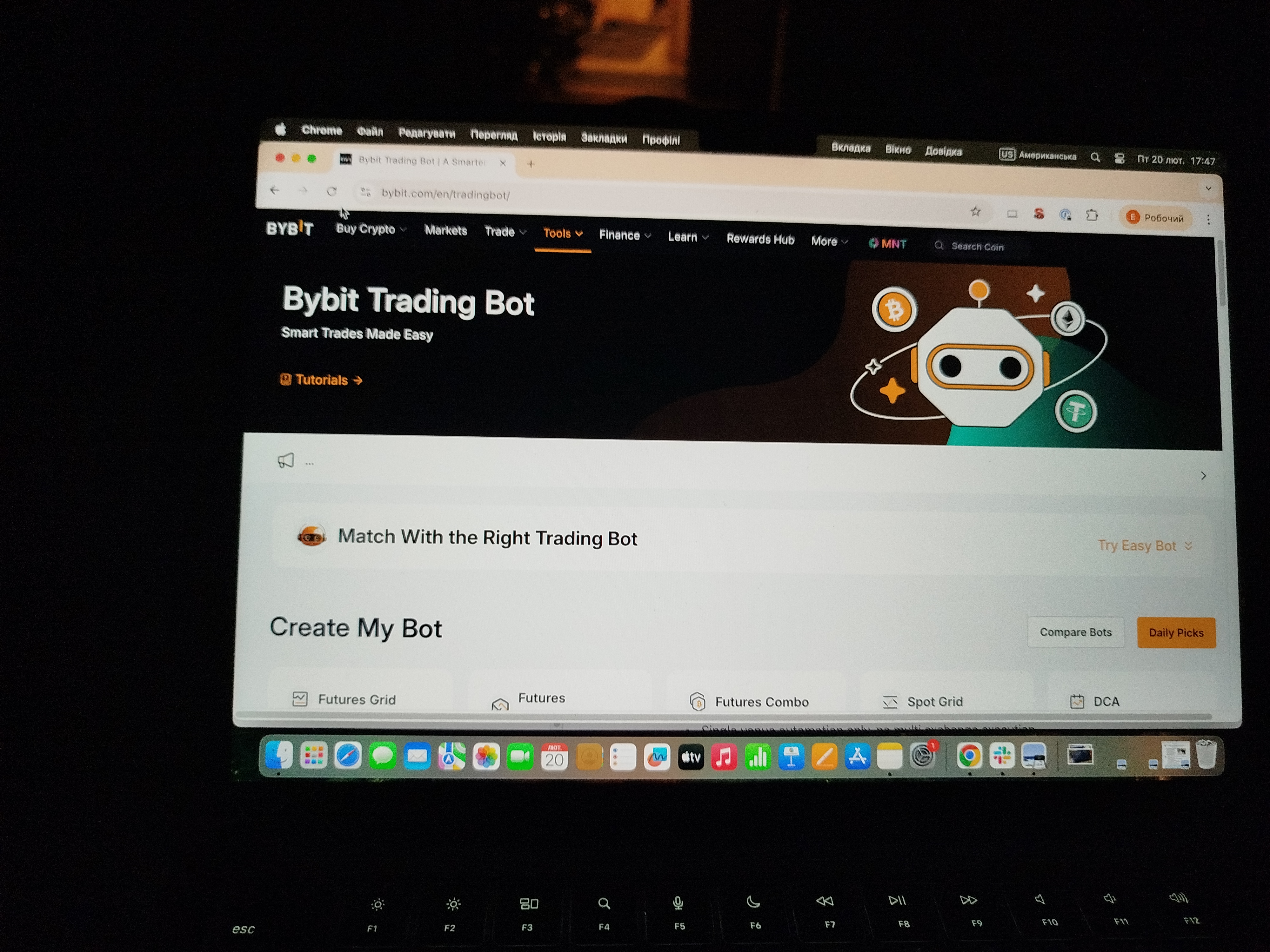
In this Bybit trading bot review, GNcrypto tests Bybit bots from a beginner view: find the bot suite, launch a small Spot Grid or DCA, pause or stop, then read the history screens. Bybit bots run inside the exchange, so setup is simple, but market risk remains.
What is the Bybit Trading Bot?
In this Bybit trading bot review, our GNcrypto team treats Bybit Trading Bot as part of the exchange itself, not a separate third party service you have to wire up. That sounds like a small detail, but in practice it changes the beginner experience a lot. During our workflow test, we did not create API keys, whitelist IPs, or juggle an external dashboard. We simply found the Trading Bot section inside Bybit, picked a bot mode, allocated a small budget, and started.
The other critical point is that Bybit still sets the rules. Trading fees, order limits, available markets, and access conditions are all exchange level constraints. The bot is just a way of executing inside those constraints, which means automation can make you faster and more consistent, but it cannot remove market volatility or turn a bad setup into a safe one.
If you are new, we would start like this: allocate around $200, run a conservative Spot Grid on a liquid pair, and spend the first week watching behavior rather than chasing returns. What matters is how quickly you can pause or stop, what the history screens show, and whether you feel in control when price exits the range.
Bot Types and Their Features
When we read Bybit trading bot reviews online, they often turn into a long menu of strategies. Our testers tried to keep this section practical: which bot types matter for a beginner on day one, what each one is trying to do, and what we noticed you can easily misconfigure.
In the Bybit suite, the two most beginner friendly starting points are Spot Grid and DCA. Spot Grid is the classic range tool: you define a price corridor, and the bot buys low and sells high inside that corridor. In our workflow test, the key learning for beginners is that the range choice is the whole game. If your range is too tight, you trade too often and feel fees more. If it is too wide, the bot can look “inactive” and beginners get tempted to over tweak.
DCA feels calmer for many newcomers because it is built around structured entries and a defined take profit plan rather than constant grid fills. Bybit also positions DCA as a portfolio style option, letting you run a basket approach with up to five coins. For beginners, we think the practical value is psychological as much as technical: you are less likely to chase candles if your plan is “small entries over time, then exit on target.”
The step up in complexity is Futures Grid and other derivatives focused modes. This is where the Bybit environment changes: funding costs exist, liquidation becomes a real risk, and the bot behavior can look smooth right until a sharp trend forces the position into stress. We noticed that futures bots can feel deceptively similar to spot in the UI, so our advice is to treat them as a separate skill level. If you cannot explain what liquidation means in one sentence, it is too early.
Across all bot types, the easiest mistakes we saw traders make are parameter related. The first is over aggressive settings that create too many trades. The second is picking a range or a take profit that does not match the asset’s volatility. And the third is running a bot on a pair you do not actually want to hold if things go wrong. Our safe first week approach is boring on purpose: one liquid pair, conservative parameters, and the goal of learning control and behavior, not maximizing returns.
Benefits and Trade-Offs
In this Bybit trading bot review, we treat benefits and trade offs as everyday decisions a beginner actually makes. In our workflow testing, the biggest advantage of Bybit bots was the low friction start: everything lives inside the exchange, so you can launch, monitor, pause, and stop without jumping between apps. The compromise is that native bots are designed for Bybit first, so you get convenience and tighter integration, but less flexibility than a true multi exchange bot platform.
Strengths:
- Low friction first bot: native bots run inside Bybit, so you start without API keys or a separate dashboard – practical for small budget testing.
- Clear cost model: no separate bot subscription on top of trading activity – you mainly pay standard trading fees, and derivatives modes can add funding costs.
- Quick risk control: pause and stop sit inside the same Bybit interface – in our test, we could exit fast when price left the planned range.
Weaknesses:
- Limited customization layer: native bots are not a TradingView webhook or multi exchange automation stack – advanced workflows usually require third party tools.
- Futures raises the difficulty: funding and liquidation risk become part of the strategy – one sharp trend move can break a bot faster than beginners expect.
- Tight grids can become fee heavy: small grid steps generate lots of trades – on smaller accounts, fees can eat the edge.
Test Results (14 days, $200 capital)
Registration & Setup:
- Account creation: 2 min
- KYC Level 1: 18 min
- Bot section discovery: <30 sec (visible on homepage after login)
Spot Grid Test (BTC/USDT, $100, 0.5% spacing, $65,000-$67,000 range, 7 days):
- 12 cycles completed
- +$3.20 gross profit
- -$0.36 fees (0.1% maker/taker)
- +$2.84 net
- Observation: range held during sideways consolidation; when BTC spiked 4% above range, bot auto-stopped (good UX)
DCA Test (ETH/USDT, $100 total, 5 safety orders, $10 base, 48h):
- 3 of 5 orders triggered
- +$2.10 gross
- -$0.30 fees
- +$1.80 net
- Observation: take-profit hit faster than expected in volatile session
Friction Points:
- Futures Grid required additional KYC verification (Level 2, ~35 min)
- Grid spacing UI defaulted to “Auto” – manual override buried in Advanced settings
- Bot history showed order fills but not cumulative P&L (had to calculate manually)
Is Bybit Trading Bot Good?
For this Bybit bot review, our conclusion is less about finding a perfect strategy and more about whether Bybit creates a comfortable environment for your first automation runs. In our testing, the answer is yes for spot beginners: native bots are easy to start, controls are easy to find, and the “stop the bot” moment is not buried behind API settings or third party dashboards.
Bybit is a good fit if you want to run simple Spot Grid or DCA experiments, keep the workflow inside one app, and learn how bots behave in sideways vs trending markets. We would be more cautious recommending it as a bot venue if your plan is futures automation from day one, if you need multi exchange execution, or if you are optimizing fees at scale.
Our safe start playbook is simple: one liquid pair, small budget, conservative parameters, and a clear exit rule. If you cannot explain why you picked your range or take profit, pause the bot and simplify before you scale.
Trustworthiness Check
We keep this section separate on purpose: even a conservative bot can still be exposed to exchange level risk.
- Feb 2025 hack headlines: multiple major outlets reported a large security incident involving Bybit. Whether you trade manually or via bots, this is a reminder that platform risk can be bigger than strategy risk.
- Regulatory context (Ontario, Canada): the Ontario Securities Commission has published public enforcement materials related to Bybit. For beginners, the practical point is that access rules can change by region.
- Proof of Reserves is a transparency signal, not a guarantee: Bybit publishes PoR style reporting. We treat it as useful disclosure, but not the same thing as a full balance sheet audit.
Beginner takeaway: in our view, keep only the capital you need to run your bots, enable 2FA and strong account security, and treat bots as tools, not protection. If the venue has downtime or a security event, the best risk control is being able to stop and reduce exposure quickly.
Bybit Trading Bot Rating Breakdown
Our 3.9/5.0 score is less about “magic profitability” and more about how usable Bybit is as a bot environment for beginners. The 3.2 for Exchange Coverage & Asset Support reflects a practical limit we saw right away: everything runs inside Bybit only. You cannot use the same native bot setup across multiple exchanges, and bot modes are tied to specific Bybit markets (spot vs futures), which matters if you spread capital across platforms or want one universal automation stack.
On the upside, our higher marks for Automation Quality & Execution (4.2) and User Experience (4.2) come from the low-friction workflow we tested: no API wiring, fast launch, and clear pause/stop and history controls. Costs & Fee Transparency (4.1) scores well because there is no separate bot subscription on top of trading fees, while futures bots still introduce funding and liquidation realities that keep Strategy and Risk scores more moderate.
| Criteria | Rating (out of 5) |
|---|---|
| Automation Quality and Execution | 4.2 |
| Strategy Performance and Backtesting | 3.6 |
| Risk Management and Controls | 3.8 |
| Costs and Fee Transparency | 4.1 |
| Exchange Coverage and Asset Support | 3.2 |
| User Experience and Setup | 4.2 |
| Customer Support and Documentation | 3.8 |
| Overall rating (weighted) | 3.9 |
Methodology – Why You Should Trust Us
We use a weighted, category-based model and hands-on testing with real capital. We score each bot from 1.0 to 5.0 in 0.1 increments based on execution quality, real-world performance, and usability.
How We Test:
– First-hand testing: we run at least two strategies (one default, one customized) over a 2–4 week period and track order fills, delays, errors, drawdowns, and net results after fees.
– Platform review: we check risk controls, required API permissions, pricing clarity, supported markets and assets, and how easy setup is for a first-time user.
– Support check: we review documentation quality and test at least one support request.
We do not guarantee profits. Our rating reflects practical trading experience and product quality, not a financial audit.
Categories and Weights
– Automation Quality and Execution – 30%
– Strategy Performance and Backtesting – 25%
– Risk Management and Controls – 15%
– Costs and Fee Transparency – 10%
– Exchange Coverage and Asset Support – 10%
– User Experience and Setup – 5%
– Customer Support and Documentation – 5%
Latest News





Recommended Articles/Reviews




The material on GNcrypto is intended solely for informational use and must not be regarded as financial advice. We make every effort to keep the content accurate and current, but we cannot warrant its precision, completeness, or reliability. GNcrypto does not take responsibility for any mistakes, omissions, or financial losses resulting from reliance on this information. Any actions you take based on this content are done at your own risk. Always conduct independent research and seek guidance from a qualified specialist. For further details, please review our Terms, Privacy Policy and Disclaimers.