
Phemex or Binance: Side-by-Side Comparison for Spot Trading in 2026
Affiliate Disclosure:
GNCrypto editors review services independently. If you click on affiliate links, we may earn commissions, which help support our testing. The goal of our reviews is to provide our readers with the most objective and unbiased overviews of available platforms for spot crypto trading.
Phemex vs Binance

Binance (4.4/5) is superior for most traders seeking the deepest liquidity and regulatory stability, while Phemex (4.3/5) fits high-frequency scalpers looking for zero-fee spot trading via the Premium membership.
The Bottom Line

As a result of testing two major global crypto exchanges for spot trading, we can say that if you value elite liquidity, regulatory assurance (post-2023), and a massive ecosystem, Binance is the superior pick. If you care more about eliminating trading fees entirely via a subscription model and prioritizing raw execution speed, Phemex is the better fit.
- Phemex: Zero-fee spot trading (via Premium membership)
- Phemex: High-speed “CrossEngine” (300k TPS) and customizable UI
- Binance: Unmatched global liquidity (41% market share)
- Binance: Massive ecosystem (Earn, Web3, Launchpad)
- Phemex: Weaker fiat rails (higher deposit fees)
- Phemex: History of security incidents (Jan 2025 hot wallet hack)
- Binance: Stricter KYC and regulatory limits in specific regions
- Binance: Customer support can be slow due to user volume
On this page


We tested both platforms under real market conditions to settle the debate. Binance dominates with elite liquidity and a massive user base, while Phemex challenges the status quo with a “zero-fee” subscription model and high-speed execution. Which one fits your strategy? We investigate.
After running a live test on both platforms, we found a clear distinction. Choose Binance if you need a “financial super-app” where you can trade $100k+ with zero slippage. However, if your strategy relies on high-frequency scalping where every basis point of commission eats your profit, Phemex’s subscription model is the clear mathematical winner.
Binance vs Phemex at a Glance
| Category | Binance | Phemex | Winner |
|---|---|---|---|
| Overall GNcrypto rating | 4.4 / 5 | 4.3 / 5 | Binance (overall) |
| Daily spot turnover (approx.) | ≈$30B+ | ≈$700M | Binance |
| Tradable assets (spot) | 500+ | 600+ | Phemex |
| Liquidity & volume rating | 5 / 5 | 4 / 5 | Binance |
| Fees & total cost rating | 5 / 5 | 4 / 5 | Binance |
| Asset selection rating | 5 / 5 | 4 / 5 | Binance |
| Tools & order controls | 5 / 5 | 5 / 5 | Draw |
| Fiat access & minimum trade size | 4 / 5 | 3 / 5 | Binance |
| Reliability & transparency rating | 4 / 5 | 3 / 5 | Binance |
Platform Overviews
When people search for exchange comparisons, they are usually weighing the market leader against a specialized challenger. We have done the research to see how their reputations stack up in 2026.
Binance is the “Amazon of Crypto.” Handling over $30 billion in daily spot volume, it is the deepest market in the world. Following its 2023 settlement with the U.S. DOJ and the 2025 presidential pardon of founder CZ, it has pivoted toward compliance while maintaining its dominance. It is the default choice for more than 250 million users. For more context, see the Binance review.

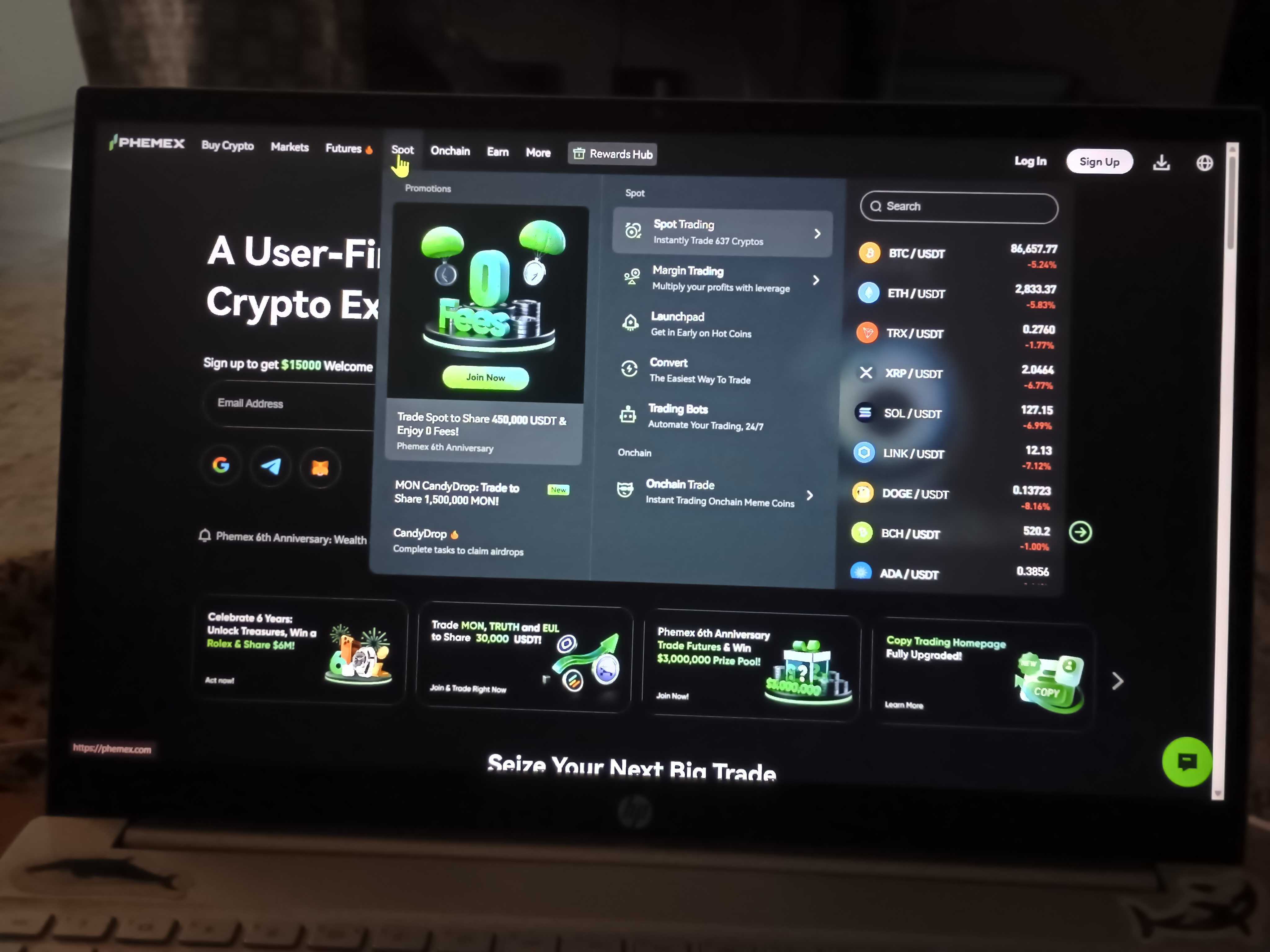
Phemex is a “Speed Demon.” Founded in 2019 by ex-Morgan Stanley executives, it carved a niche by offering institutional-grade derivatives execution to retail traders. It differentiates itself with a hybrid model: a Web2 interface with Web3 soul. However, a hot wallet hack in early 2025 and a lack of tier-1 regulation mean it requires a higher risk tolerance than Binance. The Phemex review covers the platform layout, fees, and pro-level tools.
Asset Variety and Pairs
- Binance: Lists 500+ cryptocurrencies and over 1,400 trading pairs. Its listing standards are rigorous; getting listed here is considered a “blue-chip” stamp of approval, often triggering the “Binance Effect” price surge.
- Phemex: Offers 600+ cryptocurrencies. Phemex is more aggressive in listing early-stage tokens, particularly in the “Innovation Zone.” If you are hunting for newer narrative plays (like specific AI or GameFi tokens) before they hit the major tier-1 exchanges, Phemex is often the faster venue.
Binance functions as a comprehensive ecosystem. Beyond Binance vs Phemex spot trading, it offers margin, peer-to-peer (P2P) markets, a dedicated “Earn” suite, and a fully integrated Web3 wallet. Phemex focuses heavily on its “CrossEngine” performance for derivatives, supporting 150+ perpetual contracts with up to 100x leverage, designed specifically to handle high volatility without system overloads.
Our Verdict: Binance wins for ecosystem depth and liquidity; Phemex wins for accessing a wider array of speculative assets early.
Overall Cost Breakdown
Every trader wants to save money. In the battle of Phemex or Binance fees, the models are completely different.
Binance uses a standard Maker/Taker model starting at 0.10% / 0.10%. This is already very low. You can reduce this by 25% if you pay fees with BNB. It is simple, cheap, and effective for 99% of traders.
Phemex uses a subscription model. Standard fees are 0.10%, but if you buy a Premium Membership, your spot trading fees drop to 0.00%. This is a game-changer for high-volume traders. However, if you are a casual trader, the subscription cost might exceed your potential savings.
Our Verdict: Binance is better for casual traders; Phemex is unbeatable for high-volume traders who utilize the Premium membership.
Final Summary
Binance is the safe, all-rounder choice. It offers the deepest liquidity in the world, a massive ecosystem of products (Earn, Web3, Launchpad), and a regulatory standing that has improved significantly since 2023. We believe it is ideal for 90% of traders who just want a reliable place to buy and sell without worrying about slippage.
Phemex is the specialist’s tool. If you are a high-volume scalp trader or a derivatives pro, the “Premium” zero-fee membership can save you thousands of dollars a year. While it lacks the fiat banking rails of its larger competitor, its raw execution speed and cost-efficiency make it a powerful weapon for those who know how to wield it properly.
Making the final call between Binance or Phemex comes down to your trading style and volume.
If you are a beginner or first-time buyer
Choose: Binance
With a cleaner interface, better fiat gateways, and massive liquidity on major pairs, Binance is the safer and easier entry point. It feels like a global financial super-app rather than a niche trading desk.
If you are a high-frequency scalper
Choose: Phemex
Phemex’s “Premium” membership allows you to trade spot pairs with 0% fees. If you trade frequently, the subscription cost is negligible compared to the thousands you save on commissions.
If you are seeking maximum liquidity
Choose: Binance
Binance processes ~41% of global spot volume. If you are moving a large size (>$100k), Binance’s order books will absorb your trade with virtually zero slippage, whereas Phemex might show price impact.
If you are a derivatives trader
Choose: Phemex
While Binance is bigger, Phemex was built by ex-Morgan Stanley executives specifically for speed. Its “CrossEngine” boasts 300k TPS and is designed to handle extreme volatility without system overloads.
How We Tested Binance vs Phemex
We evaluated both exchanges using the same GNcrypto methodology, which is why a Binance vs Phemex comparison is consistent. GNcrypto employs a standardized rating framework with 7 major categories: liquidity & volume, fees & total cost, asset selection & trading pairs, execution quality, tools & order controls, fiat access & minimum trade size, reliability & transparency.
Scores are normalized into a 1.0–5.0 star rating in 0.1-point steps, and then rolled into an overall rating (4.4 for Binance, 4.3 for Phemex). For both exchanges, we looked at public data: fee schedules, supported pairs/asset lists, status pages, proof-of-reserves and security documentation, regulatory filings. And then we evaluated it against our first-hand testing, which included: opening accounts, completing KYC, funding balances and placing spot trades.
Latest News





Recommended Articles/Reviews




The material on GNcrypto is intended solely for informational use and must not be regarded as financial advice. We make every effort to keep the content accurate and current, but we cannot warrant its precision, completeness, or reliability. GNcrypto does not take responsibility for any mistakes, omissions, or financial losses resulting from reliance on this information. Any actions you take based on this content are done at your own risk. Always conduct independent research and seek guidance from a qualified specialist. For further details, please review our Terms, Privacy Policy and Disclaimers.