
OKX Exchange Review 2026
Affiliate Disclosure:
GNCrypto editors review services independently. If you click on affiliate links, we may earn commissions, which help support our testing. The goal of our reviews is to provide our readers with the most objective and unbiased overviews of available platforms for spot crypto trading.
OKX

We liked that OKX offers strong spot liquidity, low global base fees, and a trading-terminal style interface. However, legal overhang and uneven regional pricing keep it below top-tier rivals.
GNcrypto's Verdict

OKX is a global crypto exchange with strong spot liquidity and a trading-terminal style interface. Our tests found fast order execution and competitive base fees, especially with limit orders or VIP/OKB discounts. Access and pricing vary by region, with higher fees and some product limits in the EEA. It suits casual and active spot traders, but fee minimalists may still prefer alternatives on other platforms.
- Low global spot fees
- Good liquidity on major pairs
- Pro tools, bots and regular reserves checks
- Higher spot fees for users in the EEA
- Legal and regulatory issues in some regions
- Uneven regional access and product limits
On this page


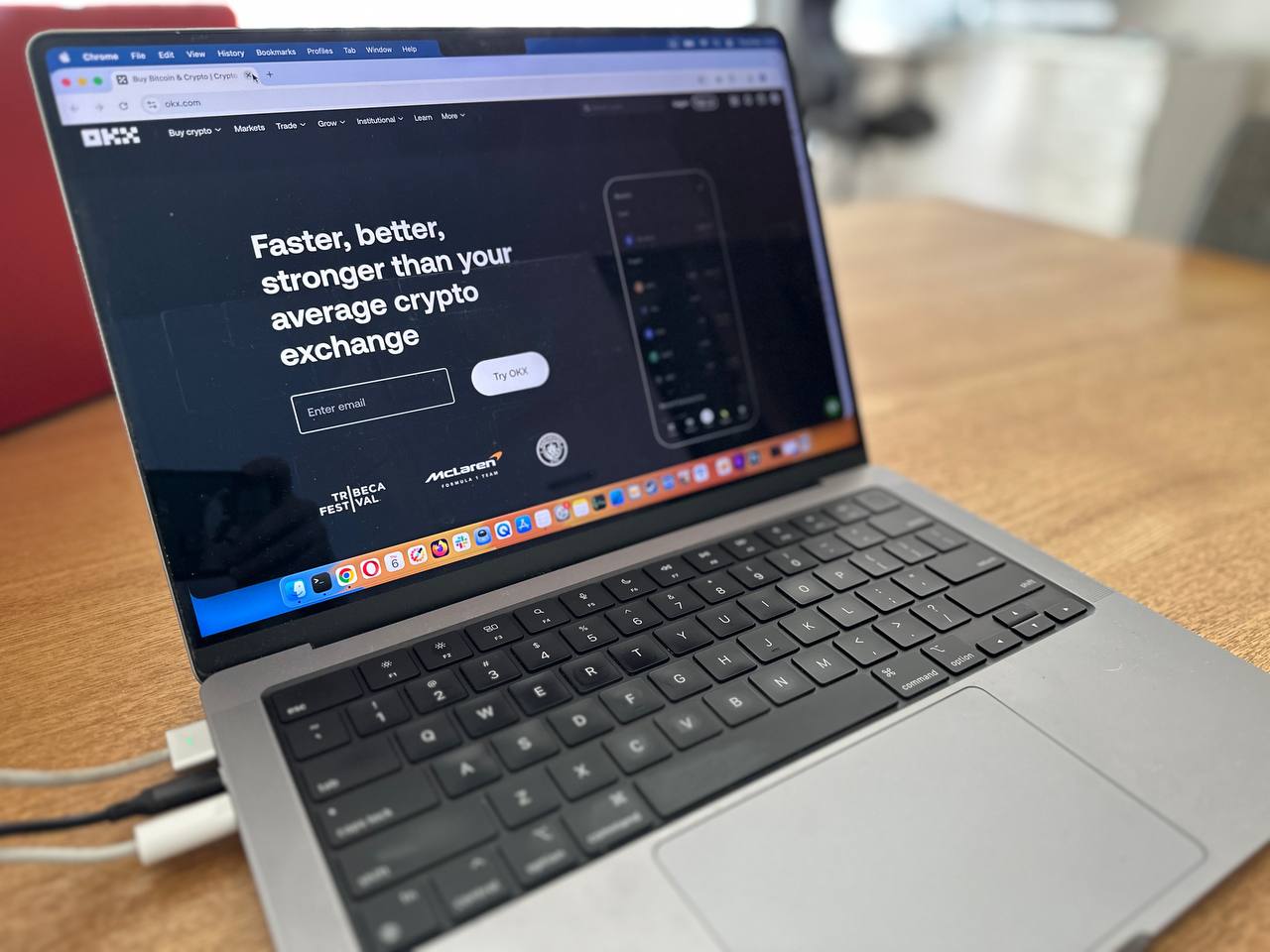
Our OKX exchange review offers a clear, neutral look at fees, liquidity, safety, and regional availability. We focus on spot trading, with a brief note on derivatives, and highlight both strengths and limitations so readers can decide if OKX fits their needs.
Our test focused on OKX’s spot trading quality – liquidity, fees, usability, and security. However, reputational risks and inconsistent regional availability prevent us from awarding this platform a score higher than average.
In this review, we evaluate the real cost of transactions, liquidity, interface usability, security of fund storage, and regulatory standing.
Key Features and Services That Define OKX
A brief look at what is OKX in practice. It is a centralized exchange focused on spot trading and high liquidity, where base fees start at 0.08%-0.10% and can be further reduced for VIP clients and users who pay fees using the platform’s native token, OKB.
The platform offers advanced order types and trading bots, monthly Proof-of-Reserves snapshots, fiat deposit and withdrawal channels (including SEPA for the EEA and ACH/wire for the US), as well as a P2P marketplace with hundreds of local payment methods.
Clients also have access to derivatives (futures/perpetual swaps and options on BTC and ETH). The maximum leverage for margin trading is 10x.
Some products are restricted in certain countries, so regional availability – especially in Europe – should be considered.
OKX: Pros and Cons
Within OKX crypto reviews, here are the main strengths and weaknesses:
Strengths:
- Low baseline spot fees on the global schedule: 0.08% maker / 0.10% taker; additional discounts via VIP tiers and when paying in OKB.
- High liquidity on top pairs (BTC/USDT, ETH/USDT) and a broad lineup of assets.
- Regular Proof‑of‑Reserves (monthly snapshots; “primary assets” expanded in 2025).
- VARA in the UAE: in 2025 – a pilot for retail derivatives in a regulated environment.
Weaknesses:
- Legal risk (US and parts of the EU). In February 2025, the OKX operator pleaded guilty to AML violations; an external compliance monitor is appointed through 2027.
- Geographic unevenness: Exit from Canada (2023), limited CeFi services in India (2024), local restrictions in the EEA. OKX US rolls out gradually with a reduced product set.
- EEA fees above global baseline: Since 01.10.2025, the Regular spot tier is 0.20% maker / 0.35% taker with no volume discounts; VIP and OKB fee rules differ from the global schedule.
Bottom line on cons: OKX’s key weakness is geographic fragmentation: availability, limits and even pricing vary by jurisdiction; in some markets certain products are unavailable altogether.
Is OKX Good?
If you’re wondering how good OKX is for spot trading, the short answer is: it’s a strong pick for those who value liquidity, a familiar interface and a flexible fee ladder. At entry level, 0.08%-0.10% is competitive; depth on major pairs is high; and the toolset (order types, bots, TradingView) covers typical beginner scenarios.
On the downside, the EEA entry‑level fee increase (from Oct. 1 2025), geographic restrictions and the US legal overhang. Our take: suitable for regular spot trading, but users with low tolerance for regulatory risk should factor these in.
Who OKX Is Best For?
– Beginners and occasional traders who want straightforward onboarding for spot.
– Active spot traders using limit orders/bots (benefiting from depth + low baseline).
– Users in the UAE / selected EU countries with local support and regulatory presence.
Who should not choose OKX
- Those who prioritize minimal legal/regulatory risk and prefer platforms without recent enforcement actions.
- Residents of restricted jurisdictions: the US (on the global site; OKX US has limited coverage and a reduced product set), Canada, India, mainland China, and sanctioned jurisdictions – Cuba, Iran, North Korea, Syria, and the regions Crimea, Donetsk and Luhansk. Trading on OKX in these countries/regions is unlikely to be possible.
Additionally: following the expansion of “crypto” sanctions related to Russia in 2025, Russian users should expect tightened access – primarily affecting fiat payments, withdrawals, and some CeFi services.
Fees and the True Cost of Trading
Global spot fees start at 0.08% maker / 0.10% taker and can be further reduced via VIP tiers or by paying with OKB. EEA rates are higher (0.20% / 0.35%), and derivative fees range 0.02%–0.05%.
Deposits/Withdrawals (Fiat & Crypto): Crypto deposits are free; withdrawals incur standard network fees. EEA users can use SEPA Instant (bank fees may apply) or PayPal for crypto purchases (not on P2P). US users can use ACH/wire transfers. Bank cards are limited to certain countries via third-party processors. Revolut SEPA transfers work, but card payments to crypto are often restricted by the bank/provider.
User Experience (UX)
The web and mobile interface follows standard CEX layouts with charts, order books, and trade forms. After a brief adjustment, users can navigate effectively, though some panels may be hidden in menus.
The platform supports 22 languages, but some translation inaccuracies are noted.
Registration on OKX requires email/phone and identity verification (ID + selfie). KYC is usually instant but may take 24+ hours for manual review (see OKX Help). Spot trading is available immediately after approval, with additional documents needed for higher limits.
The platform also offers a separate, non-KYC OKX DEX within the OKX Wallet, but this operates under different conditions than the centralized spot market.
GNсrypto’s Overall OKX Rating
| Criteria | Rating (out of 5) |
|---|---|
| Fees (Spot) | 3.5 |
| Liquidity & Volume | 4.2 |
| Spot Asset Range | 4.5 |
| Tools & Execution | 3.4 |
| Fiat Access & Onboarding | 3.5 |
| Reliability & Transparency | 3.0 |
Methodology – Why You Should Trust Us
We use a weighted, category-based model, collect standardized data from each platform (open data + hands-on testing), and convert that into a 1.0–5.0 star score in 0.1 increments.
Our focus is around spot trading quality. We evaluate real fees, minimum trade size, crypto availability, customer-facing experience, etc., which are “core features that matter most to the average investor.”
How We Collect Data
– Public data: fee schedules, supported pairs, proof-of-reserves statements, status pages.
– First-hand testing: we place test trades, measure slippage and spreads, check UI features and speed.
We do not rate solvency or make any guarantees about financial stability. Our ratings reflect user experience rather than solvency.
Categories & Weights
– Liquidity & Volume – 25%
– Fees & Total Cost to Trade – 25%
– Asset Selection & Trading Pairs – 15%
– Execution Quality (Market Quality) – 10%
– Tools & Order Controls – 10%
– Fiat Access & Minimum Trade Size – 5%
– Reliability & Transparency – 10%
Latest News





Recommended Articles/Reviews


The material on GNcrypto is intended solely for informational use and must not be regarded as financial advice. We make every effort to keep the content accurate and current, but we cannot warrant its precision, completeness, or reliability. GNcrypto does not take responsibility for any mistakes, omissions, or financial losses resulting from reliance on this information. Any actions you take based on this content are done at your own risk. Always conduct independent research and seek guidance from a qualified specialist. For further details, please review our Terms, Privacy Policy and Disclaimers.