
Kraken Or KuCoin: Which Crypto Exchange To Choose?
Affiliate Disclosure:
GNCrypto editors review services independently. If you click on affiliate links, we may earn commissions, which help support our testing. The goal of our reviews is to provide our readers with the most objective and unbiased overviews of available platforms for spot crypto trading.
Kraken Or KuCoin

KuCoin (4.1/5) won our comparison. Lower fees (0.10% vs Kraken’s 0.16%/0.26%), 700+ coins vs 562, and built-in trading bots make it better for most traders. Kraken (3.6/5) works if you prioritize regulatory clarity and simpler spot-only trading.
The Bottom Line

We tested both with $200 deposits and spot trades on majors and mid-caps. KuCoin dominated: spreads on BTC/USDT stayed around 0.01-0.02% during evening tests, grid bots ran without manual setup, and we moved between spot and futures margin instantly. Kraken felt cleaner for beginners – simpler layout, fewer tabs – but costs more per trade and lacks automation.
- KuCoin: Low trading fees (0.1% base). We would save approximately $3-4 per $1,000 traded compared to Kraken Pro.
- KuCoin: 700+ assets, futures up to 100x, and bonuses/discounts via KCS.
- Kraken: Fast verification and a clean, beginner-friendly interface. KYC cleared in under 2 hours during our test – faster than KuCoin’s 4-hour wait.
- Kraken: Strong security (90% rating on CER.live) and a wide asset selection (562).
- KuCoin: No U.S. license and limited access in key markets.
- KuCoin: Limited customer support; we waited 8+ hours for a ticket response on a weekend.
- KuCoin: Experienced a 2020 hack (full compensation claimed).
- Kraken: Higher base fees, especially in the “instant buy” mode.
- Kraken: Risk of small losses on deposits below the minimum threshold. We deposited $45 via bank transfer – Kraken’s $50 minimum meant $5 just vanished without warning.
On this page


KuCoin or Kraken – comparing fees, coin selection, tools, and usability. We break down which exchange offers cheaper trading and which is better for beginners and active traders.
After testing both platforms, KuCoin won decisively. Lower fees ($1 vs $1.60-$2.60 per $1K trade), wider coin selection (700+ vs 562), and built-in bots save time and money. Kraken works better if you prioritize regulatory clarity, simpler UX, and don’t need altcoin depth.
Kraken vs KuCoin at a Glance
| Category | Kraken | KuCoin | Winner |
|---|---|---|---|
| Overall GNcrypto rating | 3.6 / 5 | 4.1 / 5 | KuCoin (overall) |
| Daily spot turnover (approx.) | ≈$1.5B | ≈$3.8B | KuCoin |
| Tradable assets (spot) | 562 | 700+ | KuCoin |
| Liquidity & volume rating | 3.5 / 5 | 4.5 / 5 | KuCoin |
| Fees & total cost rating | 3 / 5 | 5 / 5 | KuCoin |
| Asset selection rating | 4 / 5 | 4.5 / 5 | KuCoin |
| Tools & order controls | 4 / 5 | 4.5 / 5 | KuCoin |
| Fiat access & minimum trade size | 4 / 5 | 3.5 / 5 | Kraken |
| Reliability & transparency rating | 4.5 / 5 | 3.5 / 5 | Kraken |
Features and Trading Tools Compared
The main difference in the Kraken vs KuCoin comparison comes down to trading philosophy. KuCoin caters to active traders with more modes and advanced features, while Kraken focuses on spot trading and precise order control without unnecessary complexity.
Kraken is primarily a spot exchange built around the Kraken Pro terminal. It supports standard order types for manual trading (limit, market, stop, and OCO), offers a clean interface, and provides an API for those using trading software. The platform lists 562 coins. Staking and earn options are available, but their terms and accessibility vary by region, so they’re not always universal.

KuCoin, on the other hand, is an all-in-one trading hub – combining spot, margin, and futures markets, with leverage on derivatives up to 100x. We tested a grid bot on the ETH/USDT pair – it placed 15+ orders automatically over 3 days without manual intervention. Base spot fees are 0.10% for both maker and taker, which can be reduced through VIP tiers or KCS. The exchange lists over 700 assets. Its main advantage is its suite of built-in Trading Bots (grid, DCA, and others) and a broader range of tools for both active and passive strategies.

So Kraken or KuCoin – which platform fits your style? If you need automation and futures access, KuCoin is the obvious pick.
Our verdict: KuCoin leads, but Kraken stands out as a simpler, more controlled spot platform for traders who prefer a hands-on approach.
Fee Structure Breakdown
Everyone wants to pay less – and in the kraken vs KuCoin comparison, the fee difference is noticeable from your very first trades.
KuCoin wins on price: its base spot fees are 0.10% for both maker and taker orders, with further reductions available through VIP tiers and KCS discounts. On a $1,000 trade, you pay $1 total. Kraken Pro charges $1.60-$2.60 on the same trade (0.16% maker / 0.26% taker). Deposit costs depend on the payment method, while card purchases usually include an extra fee from the provider.
Kraken is pricier by default but offers a clearer structure. On Kraken Pro, fees range from 0%–0.25% for makers and 0.10%–0.40% for takers – the higher your trading volume, the lower your rate. The instant or convert mode is more convenient but typically carries higher overall costs due to markups and fixed fees.
Our verdict: KuCoin costs less for most retail traders – the 0.10% flat rate beats Kraken unless you’re trading $500K+ monthly to hit Kraken’s lowest VIP tiers. Kraken makes sense if reliability is your priority and you use Kraken Pro, where fees decrease as your volume increases.
User Experience and Platform Performance
When choosing between KuCoin or Kraken, convenience often outweighs fees. The key factors are interface, mobile usability, navigation, and how quickly you can place a trade.
KuCoin is busy but highly functional. For active traders, it’s convenient to have spot, derivatives, earn products, and trading bots all in one place. We counted 6 main tabs and 12+ sub-sections on the first login – overwhelming at first, but useful once you learn the layout.
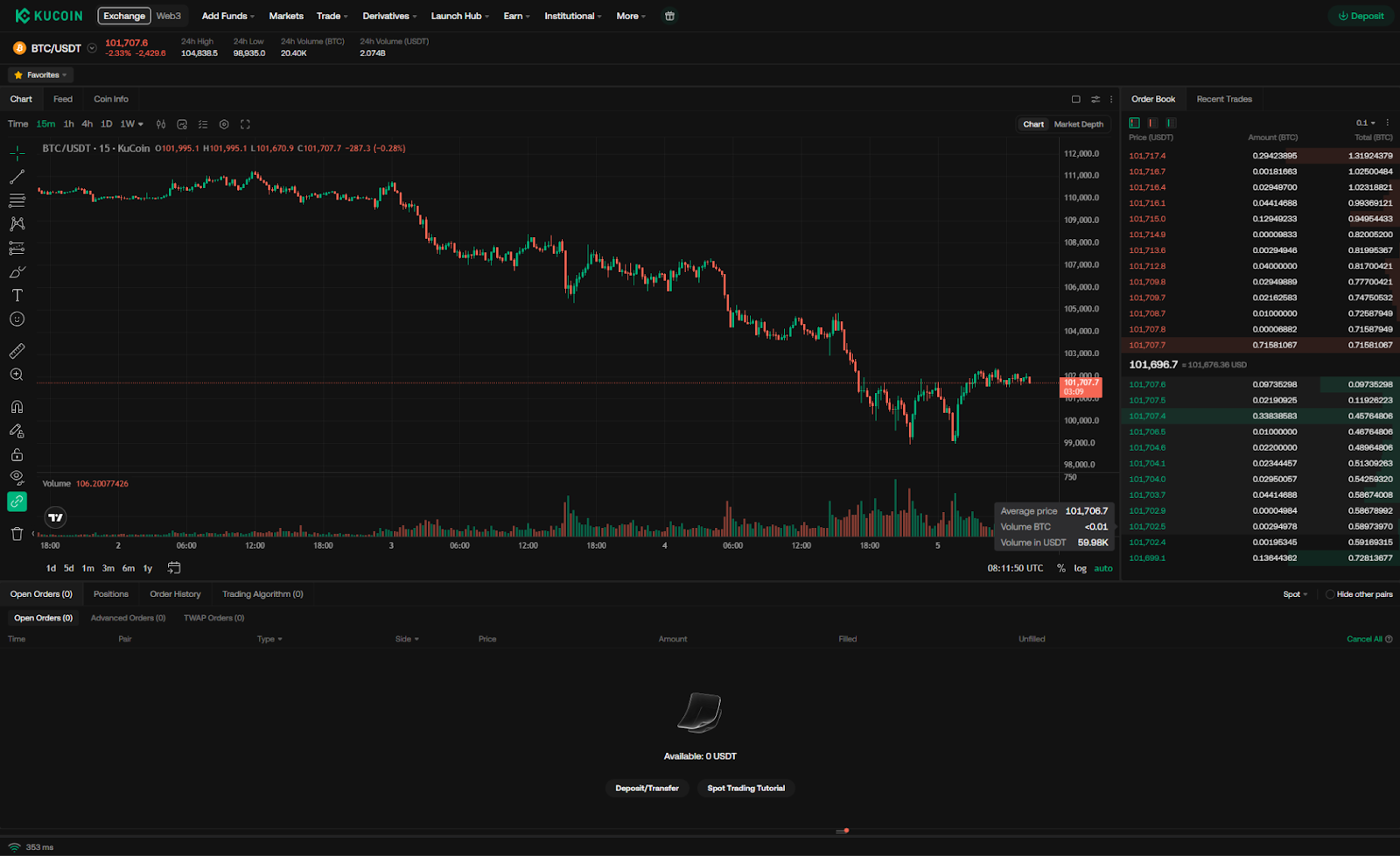
Kraken is simpler and more focused. The platform follows a “trading first” design – fewer distractions and quicker access to essential tools. We found the buy/sell buttons in under 5 seconds on Kraken Pro; on KuCoin, it took 20+ seconds to navigate past promotional banners. Kraken Pro offers a familiar trader layout: order book, chart, orders, and history. It’s ideal if you prefer straightforward manual trading without wading through dozens of extra features.
Our verdict: KuCoin wins for its “all-in-one” functionality but requires an adjustment period. Kraken stands out for its clean interface and consistent trading experience, especially on Kraken Pro.
Kraken vs KuCoin – Which Should You Choose?
If you’re a beginner or first-time buyer
Choose: Kraken
Kraken is easier to start with and feels like a calmer, more beginner-friendly exchange. If you value security and a straightforward spot market without unnecessary features, it’s the more predictable option.
If you’re an active, fee-conscious spot trader
Choose: KuCoin
KuCoin is typically cheaper for active trading, offering lower base fees, VIP tiers, and KCS-based discounts. It also provides more tools and strategic options for frequent traders.
If you mainly want a curated selection of major assets
Choose: Kraken
Kraken’s listings are more selective, avoiding obscure or high-risk tokens. It’s a solid choice if you trade primarily large-cap cryptocurrencies and prefer a cleaner, more focused market.
If you want the widest range of assets and global access
Choose: KuCoin
KuCoin supports more coins and gives greater access to altcoins and early listings. It’s best suited for traders who value market variety over a conservative, security-first approach.
How We Tested Kraken vs KuCoin
We evaluated both exchanges using the same GNcrypto methodology to ensure the Kraken vs KuCoin comparison meets a consistent standard.
The framework covers seven categories: liquidity and volume, fees and total trading cost, asset and pair selection, order execution quality, tools and order types, fiat options and minimum trade size, and reliability and transparency.
Scores are normalized on a 1.0–5.0 scale in 0.1 increments and combined into a final rating (3.6 for Kraken and 4.1 for KuCoin). Our assessment relied on public data – including fees, asset and pair lists, status pages, proof-of-reserves, security reports, and regulatory filings – and was verified manually through registration, KYC, deposits, and test spot trades.
Latest News





Recommended Articles/Reviews



The material on GNcrypto is intended solely for informational use and must not be regarded as financial advice. We make every effort to keep the content accurate and current, but we cannot warrant its precision, completeness, or reliability. GNcrypto does not take responsibility for any mistakes, omissions, or financial losses resulting from reliance on this information. Any actions you take based on this content are done at your own risk. Always conduct independent research and seek guidance from a qualified specialist. For further details, please review our Terms, Privacy Policy and Disclaimers.