
BitMEX Review: Our 2026 Independent Look at the Crypto Derivatives Pioneer
Affiliate Disclosure:
GNCrypto editors review services independently. If you click on affiliate links, we may earn commissions, which help support our testing. The goal of our reviews is to provide our readers with the most objective and unbiased overviews of available platforms for spot crypto trading.
BitMEX

We reviewed BitMEX via a $200 spot trading test. It’s a derivatives-focused crypto exchange with deep liquidity on leveraged products. A strong pick for experienced traders seeking advanced derivatives tools.
GNcrypto's Verdict

In this BitMEX review, we combined desk research with our own live test. We opened and closed a real BTC spot trade of roughly $200, watched the order book, checked for slippage, and measured what actually landed in our account after fees. Based on that experience and a broader look at the platform, we came to the conclusion that BitMEX is a powerful but niche platform: excellent for experienced leverage traders, but not a one-stop shop for beginners or fiat-heavy users.
- Industry-leading derivatives liquidity
- Competitive fees with maker rebates
- Advanced order controls and risk tools
- Trading bots and copy trading
- Limited spot pairs and thin liquidity
- No fiat on-ramps
- Complex interface for beginners
- U.S. residents blocked
On this page
- Platform Overview
- Key Features, Markets and Tools on BitMEX
- BitMEX Pros and Cons
- Fees and Rates
- Spot trading fees
- Derivatives trading fees
- Funding rates and holding costs
- Deposits, withdrawals and token discounts
- Trust, Regulation and Jurisdictional Risks
- GNcrypto’s Overall BitMEX Rating
- Summary: Who BitMEX Is Best For
- Methodology – How We Tested BitMEX
- Categories & Weights


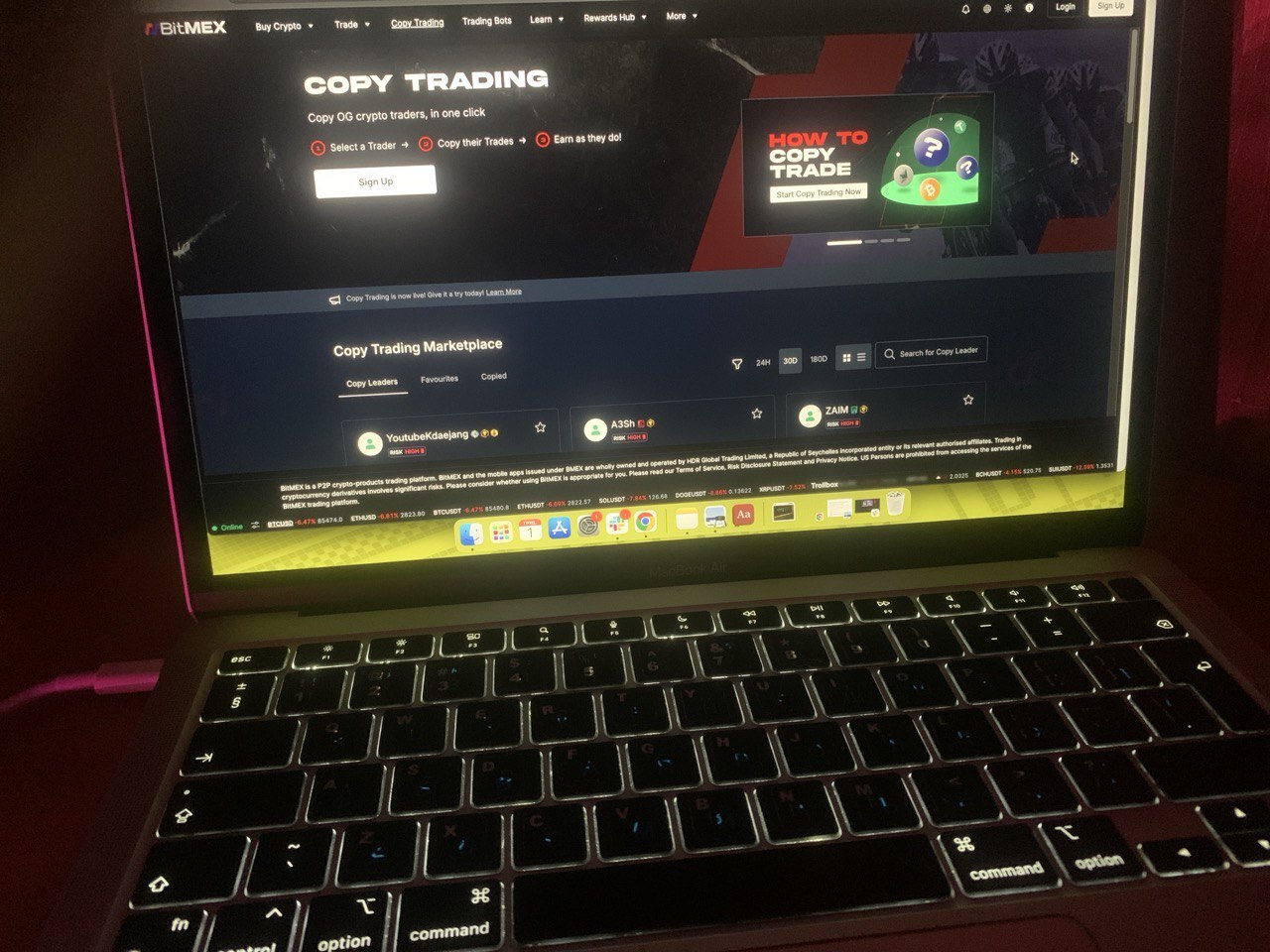
BitMEX remains one of the oldest names in leveraged crypto trading – the exchange that popularized the Bitcoin perpetual swap – and still targets a very specific audience: active, risk-tolerant traders who care more about deep derivatives liquidity than about buying coffee with their crypto.
Platform Overview
BitMEX is a Seychelles-incorporated crypto exchange launched in 2014 and best known for its Bitcoin perpetual futures with very high leverage. Over time it has expanded into a multi-product platform: perpetual swaps, dated futures, pre-launch futures, and a relatively small but growing spot market.
The platform is clearly built for active traders who already understand margin and liquidation risk. From the first login, it’s clear that BitMEX expects users to be comfortable with trading interfaces: depth-of-market views, advanced order types, and cross vs isolated margin are front and center. Newcomers may find the layout dense, but for power users this is part of the appeal.
Today, BitMEX offers 100+ crypto derivatives markets and dozens of underlying assets, with leverage up to 250x on some BTC contracts. The spot side is modest by comparison, with just over a dozen spot pairs and a focus on BTC, ETH and a handful of majors. That product mix confirms what many BitMEX reviews point out: this is a derivatives-first venue, not a broad retail brokerage.
For less experienced users, BitMEX also offers trading bots and a built-in copy trading feature that lets beginners mirror the strategies of more seasoned traders.
In our own $200 BTC spot test, we tested how the platform handles a small retail-sized trade: how quickly orders fill, how tight spreads are, and whether slippage or hidden costs show up once you account for fees.
Key Features, Markets and Tools on BitMEX
BitMEX’s core strength is its derivatives engine and order-book quality.
- Derivatives variety: Perpetual swaps and futures on BTC and a range of altcoins, with different collateral options. High leverage and advanced risk parameters give active traders a lot of flexibility, but also amplify risk.
- Spot trading: A compact list of BTC, ETH and other majors traded against USDT and a few other quote assets. Liquidity is decent on flagship pairs but clearly thinner than on the largest global spot exchanges.
- Order types: Market, limit, stop, take-profit, post-only, reduce-only, and advanced conditional orders help active traders manage entries and exits precisely.
- Trading tools: Built-in charting (with TradingView-style indicators), depth charts, funding-rate data and a rich derivatives analytics section.
- Automation: API access for quants, plus support for trading bots and copy-trading strategies via third-party or partner tools.
In our $200 BTC spot test, we placed a limit buy close to the mid-price. The order filled almost instantly with negligible visible slippage. For modest ticket sizes, the platform shows solid execution on major pairs, BitMEX offers solid execution – though the experience is clearly tuned to traders who already understand order books and margin settings, not to first-time crypto buyers.
BitMEX Pros and Cons
Strengths:
- Strong derivatives liquidity and narrow spreads on major contracts.
- Competitive taker and maker fees, especially for high-volume or maker flow.
- Advanced order controls and risk tools suited to active traders.
- Trading bots and copy trading options for users who prefer to follow experienced traders.
- Long operating history with no major publicized hacks of customer funds.
- Deep research content and derivatives reports for more sophisticated users.
Weaknesses:
- Limited spot market with relatively few trading pairs.
- No seamless fiat on-ramps; funding is primarily via crypto.
- Interface and terminology can overwhelm beginners.
- Strict geo-restrictions, including no service for U.S. residents.
- Regulatory history in the U.S. may concern risk-averse users.
Overall, BitMEX works best as a specialized tool, not as a universal exchange for everyone.
Fees and Rates
Fees are a core part of any BitMEX exchange reviews, and BitMEX positions itself as competitively priced for both spot and derivatives – especially for users who provide liquidity or trade in size.
Spot trading fees
BitMEX charges percentage-based maker and taker fees on spot trades, with tiered discounts based on 30-day trading volume. After recent updates, baseline fees for regular users are around 0.05%–0.10% per side, which is competitive with or better than many large exchanges.
In our $200 BTC spot test, we bought and then sold BTC/USDT using a mix of limit and market orders. The effective round-trip cost aligned closely with the posted fee schedule. There were no surprise surcharges or hidden spreads beyond the visible bid–ask.
Derivatives trading fees
On derivatives, BitMEX still uses the classic maker–taker structure: makers often pay lower or even rebate-like fees for providing liquidity, while takers pay a modest fee for immediate execution. Exact rates depend on the contract type and your volume tier, but in practice they are in line with other tier-one derivatives venues.
For active intraday traders, the fee structure clearly rewards consistent maker flow and higher volumes, while casual traders using mostly market orders will see average, but not punitive, costs.
Funding rates and holding costs
Perpetual swaps on BitMEX use funding payments between longs and shorts to keep contract prices anchored to spot. Funding rates move with market conditions and can be positive or negative; in trending markets, funding can significantly add to or reduce your effective trading cost.
BitMEX surfaces funding information clearly in the interface, but newer traders can still underestimate how much these periodic payments matter to P&L. That is less a BitMEX-specific issue and more a structural feature of perpetual swaps.
Deposits, withdrawals and token discounts
Crypto deposits are typically free, while withdrawals incur standard network fees. There are no broad-based card or bank deposit options on par with mainstream retail exchanges; this reinforces that BitMEX is built for crypto-native traders.
BitMEX also incentivizes activity with its BMEX token, which can unlock fee discounts, rewards and promotions if you opt into the token ecosystem. These perks are useful for committed users but not essential for committed users rather than a deciding factor for occasional traders.
Trust, Regulation and Jurisdictional Risks
Trust is the most sensitive part of any derivatives-focused exchange, and BitMEX’s regulatory history is well known. U.S. regulators have pursued the platform and its founders for operating an unregistered derivatives venue and for failing to implement adequate anti-money-laundering and know-your-customer controls (KYC) in the platform’s early years.
Those cases culminated in substantial civil penalties and, more recently, a large criminal fine and probation order for violations of the Bank Secrecy Act. BitMEX and its principals have settled the major U.S. cases, paid significant fines, and the platform now emphasizes its compliance program, mandatory KYC for all users, and tighter jurisdictional controls.
Because of this history, BitMEX does not allow U.S. residents to use the platform, and geo-fencing measures are more robust than in the past. The platform now operates with a noticeably more compliance-focused approach compared with its early, more permissive years, but the legacy of those enforcement actions still matters for risk-averse users.
Notably, BitMEX has not suffered any widely reported catastrophic hacks of customer funds, and it operates a security model centered on multi-signature cold storage and strict withdrawal procedures. For a derivatives exchange with large open interest, that track record is meaningful, though as always in crypto there are no guarantees.
From a risk-management standpoint, BitMEX now operates as a more mature, compliance-heavy derivatives venue with a serious U.S. regulatory history, not a lightly scrutinized offshore wildcard.
GNcrypto’s Overall BitMEX Rating
Combining our $200 test trade with market checks and regulatory review, market quality checks, fee structure, product range and regulatory background – we assign BitMEX an overall rating of 4.1 / 5.
| Criteria | Rating (out of 5) |
|---|---|
| Liquidity & Volume | 4.5 |
| Fees & Total Cost to Trade | 4.3 |
| Asset Selection & Trading Pairs | 3.4 |
| Execution Quality / Market Quality | 4.4 |
| Tools & Order Controls | 4.5 |
| Fiat Access & Minimum Trade Size | 3.0 |
| Reliability, Security & Transparency | 4.0 |
We were convinced that BitMEX deserves high marks for derivatives liquidity, execution, and professional-grade tools. Its lower scores come from a narrow spot offering, lack of mainstream fiat channels, and the lingering weight of past regulatory actions.
Summary: Who BitMEX Is Best For
So, is BitMEX good?
Yes – if you’re an experienced, high-risk trader who knows how to navigate leveraged products. For that audience, BitMEX offers strong liquidity, advanced tools, and solid security.
BitMEX is best suited for:
- Experienced derivatives traders who understand leverage, funding rates and liquidation risk.
- Crypto-native users who fund accounts with crypto rather than fiat.
- Active intraday or swing traders who value tight spreads and advanced order controls.
BitMEX is probably not ideal if:
- You are a complete beginner looking for a simple on-ramp from bank card to crypto.
- You need a wide selection of spot tokens and fiat pairs in one place.
- You prefer exchanges with a clean regulatory slate and full availability in the U.S.
Based on our testing, we came to the conclusion that BitMEX can be an excellent specialist venue to keep in your toolkit if you trade derivatives or hedge positions actively. For most users, it works best as a secondary, purpose-built exchange rather than as your only crypto platform.
Methodology – How We Tested BitMEX
We use a weighted, category-based model, collect standardized data from each platform (public pages + hands-on testing), and convert that into a 1.0–5.0 star score in 0.1 increments.
To keep this BitMEX reviews article independent and practical, we combined:
- A real-money test (~$200 BTC spot buy and sell) to observe spreads, execution quality, slippage and realized fees.
- Order book checks on major pairs during normal market conditions.
- A line-by-line review of the published fee schedules, funding-rate mechanics and BMEX token incentives.
- A review of public regulatory actions, enforcement outcomes and the platform’s current compliance posture.
- Comparison of product range, tools and UX with other major derivatives-focused exchanges.
We wrote this review from the perspective of active traders who care about costs, reliability and risk as much as about headline leverage. Our goal is not to tell you what to trade, but to help you understand what trading on BitMEX actually feels like in 2026.
Categories & Weights
- Liquidity & Volume – 25%
- Fees & Total Cost to Trade – 25%
- Asset Selection & Trading Pairs – 15%
- Execution Quality (Market Quality) – 10%
- Tools & Order Controls – 10%
- Fiat Access & Minimum Trade Size – 5%
- Reliability & Transparency – 10%
Latest News




Recommended Articles/Reviews




The material on GNcrypto is intended solely for informational use and must not be regarded as financial advice. We make every effort to keep the content accurate and current, but we cannot warrant its precision, completeness, or reliability. GNcrypto does not take responsibility for any mistakes, omissions, or financial losses resulting from reliance on this information. Any actions you take based on this content are done at your own risk. Always conduct independent research and seek guidance from a qualified specialist. For further details, please review our Terms, Privacy Policy and Disclaimers.