
Kraken vs Binance: Which Crypto Exchange Is Better for Spot Trading Now?
Affiliate Disclosure:
GNCrypto editors review services independently. If you click on affiliate links, we may earn commissions, which help support our testing. The goal of our reviews is to provide our readers with the most objective and unbiased overviews of available platforms for spot crypto trading.
Kraken vs Binance

Binance is the strongest all‑rounder for spot trading. Kraken usually makes more sense as a primary exchange for U.S. residents.
The Bottom Line

Based on GNcrypto’s testing of these two major spot exchanges, Binance stands out for global traders who prioritize deep liquidity, low fees and a huge asset list. Kraken, meanwhile, is the stronger choice for users who value strict regulation, security and full-featured access in the U.S. and other tightly supervised markets.
- Binance: Outstanding spot liquidity and market depth on major pairs
- Binance: Very low effective trading fees with VIP tiers and BNB discounts
- Kraken: Strong regulatory footprint and licensing in the U.S. and Europe
- Kraken: Security‑first reputation backed by regular Proof-of-Reserves audits
- Binance: Not available to U.S. users; Binance.US offers a reduced product set and lower volumes
- Binance: Higher perceived regulatory/headline risk in some jurisdictions
- Kraken: Higher trading fees on average than Binance, especially outside Kraken Pro
- Kraken: Lower raw liquidity and shallower order books than Binance on many pairs
On this page
- Binance vs Kraken: Quick Overview of Both Exchanges
- Core Features Compared
- Interface and Order Types
- Tools, Automation, and APIs
- Which Platform Fits Your Trading Style?
- Key Features and Trading Experience Compared
- Trading interfaces and order types
- Automation, APIs and extras
- Supported Assets and Market Access
- Asset coverage
- Geographic reach and restrictions
- Fees and Pricing
- Binance fee structure
- Kraken fee structure
- U.S. fee context
- Kraken vs Coinbase – Which Should You Choose?
- How We Tested Binance vs Kraken


If you are choosing between Binance and Kraken for spot trading, the short answer is this:
- Globally, Binance is the stronger all‑rounder for spot trading: deeper liquidity, lower average trading costs, and excellent tools. GNcrypto rates Binance 4.4/5 overall.
- For U.S. residents, Kraken usually makes more sense as a primary exchange. Binance.com is not available in the United States, Binance.US runs with a reduced product lineup and much lower volumes, while Kraken operates as a fully regulated U.S. platform with a broader, more mature feature set.
In other words: for most international spot traders, Binance is the primary choice for global spot traders. For American users who want a regulation‑first venue with serious tooling, Kraken provides more practical options for daily trading.
Binance vs Kraken: Quick Overview of Both Exchanges
Here is how Binance vs Kraken stack up on headline ratings and core spot-trading metrics.
| Category | Binance | Kraken | Winner |
|---|---|---|---|
| Overall GNcrypto rating | 4.4 / 5 | 3.6 / 5 | Binance (overall) |
| Daily spot turnover (approx.) | ≈$31B | ≈$1.6B | Binance |
| Tradable assets (spot) | 500+ | 562 | Kraken |
| Liquidity & volume rating | 5 / 5 | 3.5 / 5 | Binance |
| Fees & total cost rating | 5 / 5 | 3 / 5 | Binance |
| Asset selection rating | 5 / 5 | 4 / 5 | Binance |
| Tools & order controls | 5 / 5 | 4 / 5 | Binance |
| Fiat access & minimum trade size | 4 / 5 | 4 / 5 | Draw |
| Reliability & transparency rating | 4 / 5 | 4.5 / 5 | Kraken |
Bottom line: Binance clearly wins on pure market depth, pricing, and overall rating. Kraken, however, scores better on reliability/security and is the more realistic long‑term “home base” for users who want a fully regulated U.S. exchange.
Core Features Compared
This Kraken vs Binance comparison highlights how each platform performs in functionality and trading experience.
Interface and Order Types
- Binance: Multiple trading views from simple to professional; supports market, limit, stop-limit, trailing stop, and OCO orders; advanced charting powered by TradingView.
- Kraken: Two modes – main interface and Kraken Pro. Standard version focuses on clean buy/sell flow; Pro version adds full-depth order books, stop/limit/OCO types, and better fee tiers.
Tools, Automation, and APIs
- Binance: Offers grid bots, copy trading, and powerful APIs (REST/WebSocket/FIX) for algorithmic strategies.
- Kraken: Provides strong APIs and institutional-grade connections but focuses more on execution quality and security than retail extras.
Verdict: Binance leads on tools and automation; Kraken offers a more stable, regulation-friendly experience.
Which Platform Fits Your Trading Style?
For newcomers, Binance (outside the U.S.) is easier to start with: intuitive buy/sell panels and deep liquidity for major pairs.
For U.S. users, Kraken is the practical choice: compliant, licensed, and easy to scale from instant buys to advanced orders.
Active traders: Binance’s 0.10% base maker/taker fees and fee discounts when paying with BNB make it cheaper for high-volume trading. Kraken Pro’s 0–0.25% maker and 0.10–0.40% taker range remains competitive but higher overall.
Security-focused users: Kraken excels with consistent Proof-of-Reserves audits, U.S. oversight, and a conservative risk profile. Binance has improved transparency but carries more historical regulatory noise.
Global vs U.S. accessibility: Binance offers unrivaled global depth, while Kraken dominates the regulated U.S. and EU segments.
Final verdict: For pure market depth and pricing, choose Binance. For a licensed, security-first environment (especially in the U.S.) Kraken is the safer, regulation-approved option.
Key Features and Trading Experience Compared
This section looks at Kraken vs Binance from a day‑to‑day trading perspective: how it feels to place spot orders, what tools you get, and how flexible the interface is.
Trading interfaces and order types
Binance
- Offers multiple layouts, from a simplified spot screen to a full professional terminal.
- Supports a wide range of order types: market, limit, stop‑limit, trailing stops, and OCO tickets.
- Integrates rich TradingView‑style charting, multi‑pane layouts, adjustable order books and depth charts.
- Lets users toggle quickly between spot, margin and derivatives desks while keeping funds inside the same ecosystem.

Kraken
- Splits the experience into the main Kraken interface and Kraken Pro.
- The standard interface focuses on clean buy/sell flows and basic order tickets.
- Kraken Pro adds advanced charts, full order‑book depth, multiple order types (including stop‑limit and OCO), and better fee tiers.
- Switching between standard and Pro is seamless – the same account and balances are used for both.
Automation, APIs and extras
- Binance leans heavily into automation and power‑user workflows. Grid bots, copy trading, and a full suite of REST/WebSocket/FIX APIs make it easy to plug in algorithmic strategies or third‑party tools.
- Kraken offers robust APIs and institutional‑grade connectivity, but it is less “retail‑gamified”: there’s less emphasis on copy‑trading widgets and promo campaigns, more on execution and security.
Our verdict: For feature depth and automation, Binance is ahead – especially for high‑frequency, API‑driven or copy‑trade users. Kraken’s trading experience is simpler and extremely solid, but feels more conservative and slightly less flexible than Binance’s all‑in‑one ecosystem.
Supported Assets and Market Access
If you’re trying to decide Binance or Kraken based on “what can I trade, and from where?”, the numbers help clarify the picture.
Asset coverage
- Binance lists 500+ crypto assets and thousands of spot pairs, with frequent listings (and delistings) of new tokens. GNcrypto scores Binance 5/5 for “Asset Selection & Trading Pairs,” reflecting both breadth and strong liquidity on majors. A fuller overview can be found in the section titled Binance reviews.
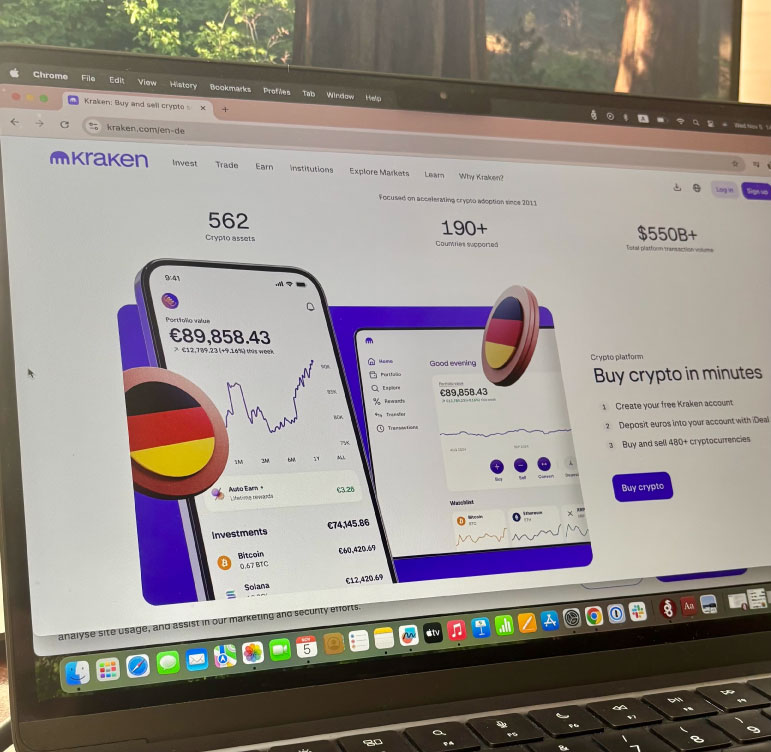
- Kraken offers 562 trading assets across multiple markets. GNcrypto rates it 4/5 on asset selection, acknowledging robust coverage but slightly less breadth in certain long‑tail alt segments compared with Binance. You can find a more in-depth take over in the Kraken review section.
In raw asset count, Kraken actually edges ahead, but Binance’s overall mix of majors, mid‑caps and well‑traded smaller assets – plus its role as the deepest global venue – is what drives its higher score.
Geographic reach and restrictions
- Binance (global) supports users in many countries but is restricted or partially restricted in several key jurisdictions, including the United States. In some markets it operates via localized brands like Binance.US with a trimmed product set and much lower trading volumes.
- Kraken is available in roughly 190 countries and holds licenses or registrations in major regulatory regimes, including the U.S., Canada, Cyprus and the EEA. It explicitly blocks a short list of high‑risk or sanctioned jurisdictions but otherwise aims for broad, regulated coverage.
Our verdict: Globally, Binance offers the most compelling combination of depth and breadth, particularly if you care about new listings and niche pairs. Kraken wins on formal market access in highly regulated regions (especially the U.S. and EU) and still provides a very strong asset lineup for spot trading.
Fees and Pricing
If you’re asking about Binance fees vs Kraken, the headline story is straightforward: Binance is cheaper for most spot trading patterns, especially at scale. GNcrypto’s category scores (5/5 vs 3/5) capture the gap.
Binance fee structure
- Standard maker/taker fees on spot start at 0.10% / 0.10%.
- Fees drop with higher 30‑day trading volume. Additional discounts apply if you pay fees with BNB.
- Binance frequently runs 0‑fee or rebate promotions on flagship pairs like BTC/USDT and ETH/USDT.
In practical terms, this means:
- Small, occasional spot trades are already inexpensive.
- Active users who climb VIP tiers or use BNB are very competitive – sometimes near‑zero – effective trading costs.
Kraken fee structure
- The main Kraken interface charges a flat $1 fee on simple instant buys/conversions, which can be relatively expensive for small tickets.
- Kraken Pro uses a maker‑taker schedule: maker fees range from 0–0.25% and taker fees from 0.10–0.40%, with discounts available for higher volumes.
The result:
- Occasional retail users who rely on instant trades may overpay relative to exchanges with lower fees.
- Frequent traders who switch to Kraken Pro get a much more competitive fee profile, but it still generally sits above Binance’s optimal trading conditions.
U.S. fee context
- Binance.US advertises low base fees and sometimes zero‑fee promos but runs on much thinner liquidity, which can increase effective costs on larger or less liquid pairs.
- Kraken’s U.S. platform combines a transparent fee schedule with deeper, more consistent liquidity, particularly on major crypto‑fiat pairs.
Our verdict: On global spot pricing, Binance is the clear winner. Kraken Pro can be a good deal, especially versus other high‑cost U.S. platforms, but it rarely undercuts Binance’s combination of tiers, discounts and liquidity.
Kraken vs Coinbase – Which Should You Choose?
If you’re a beginner or first-time buyer
Choose: Coinbase
Very clean interface, strong fiat on/off ramps, and deep liquidity on majors make it easier to get comfortable with your first BTC, ETH or blue-chip altcoin purchases. It feels closer to a traditional fintech app than a “pro trader terminal.”
If you’re an active, fee-sensitive spot trader
Choose: Kraken (Kraken Pro)
The maker–taker schedule on Kraken Pro is generally more competitive than Coinbase’s base tiers. If you place many trades, use limit orders and care about your effective cost per trade, Kraken tends to be kinder to your P&L over time.
If you mainly want a curated list of majors
Choose: Coinbase
You don’t necessarily need 500+ assets – you just want reliable access to the big names. Coinbase gives you that, wrapped in a regulation-first, public-company package.
If you want maximum asset variety and global reach
Choose: Kraken
With more listed assets and broad country coverage, Kraken is better suited if you like exploring a wide range of spot markets from one account.
How We Tested Binance vs Kraken
This comparison relies on GNcrypto’s standardized spot‑trading methodology, applied separately to each exchange and then brought together for a head‑to‑head view.
For both Binance and Kraken, GNcrypto’s editors:
- Opened live accounts and completed identity verification (KYC).
- Funded balances and placed real‑money spot trades of around $200 on major pairs.
- Measured realized trading fees, spreads and slippage on those test trades.
- Evaluated asset coverage, order‑entry UX, charting and order‑book tools.
- Reviewed public information such as fee schedules, status pages, proof‑of‑reserves hubs and official regulatory disclosures.
Each category is scored on a 1.0–5.0 scale in 0.1‑point increments, then combined into an overall rating. That’s how we arrive at Binance’s 4.4/5 and Kraken’s roughly mid‑3s overall score for spot trading and why this Binance vs Kraken comparison stays consistent with GNcrypto’s individual exchange reviews.
Latest News





Recommended Articles/Reviews




The material on GNcrypto is intended solely for informational use and must not be regarded as financial advice. We make every effort to keep the content accurate and current, but we cannot warrant its precision, completeness, or reliability. GNcrypto does not take responsibility for any mistakes, omissions, or financial losses resulting from reliance on this information. Any actions you take based on this content are done at your own risk. Always conduct independent research and seek guidance from a qualified specialist. For further details, please review our Terms, Privacy Policy and Disclaimers.