WhiteBIT Nova Card review (2026): our verdict after hands-on testing
We tested WhiteBIT Nova Card like a regular user: account verification, instant virtual card setup, adding it to Apple Pay and Google Pay, everyday purchases, ATM cash withdrawals, and the way crypto-to-euro conversion behaves at checkout. Along the way, we tracked the practical constraints that matter in real life, including limits, fees, regional quirks, and how quickly support questions get resolved.
What the WhiteBIT Nova Card is
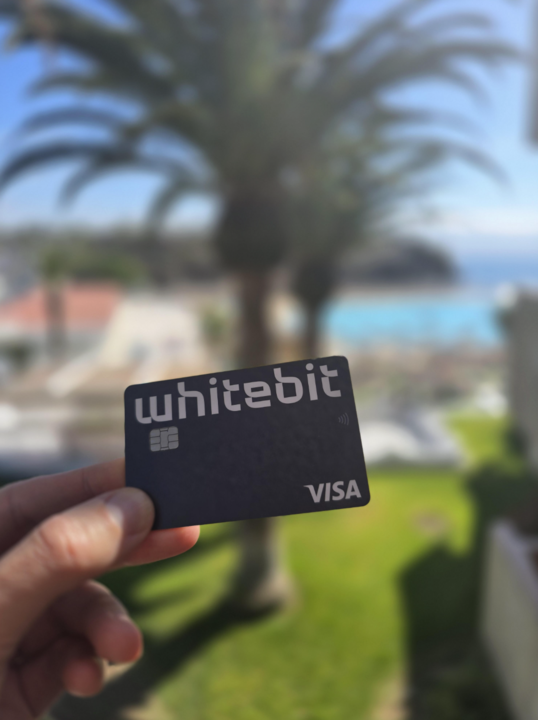
WhiteBIT Nova Card is WhiteBIT’s Lithuanian entity, available to residents of 31 European countries. It converts crypto to euros at checkout, supports Apple Pay and Google Pay, and offers category-based cashback up to €25 per month. This WhiteBIT card review focuses on what you can realistically do with it – not on marketing claims – after two weeks of hands-on testing.
The card is available only to residents of 31 European countries, including all European Economic Area countries plus Ukraine. To apply, you must be an adult and complete identity verification (KYC).
Nova is also a payments-only card. It is designed for paying for goods and services. Direct transfers to other bank cards, and transfers between Nova cards, are not supported.
In everyday use, you keep funds inside the WhiteBIT ecosystem and pay with the card when you shop. The merchant still gets paid in fiat, usually euros. WhiteBIT converts your crypto during the payment, so what you actually feel as a user comes down to the exchange rate used at checkout and the limits that apply.
Supported assets & funding method
WhiteBIT Nova Card supports 12 core assets for spending, including BTC, ETH, SOL, and stablecoins such as USDC and EURI. For a WhiteBIT crypto card review, the key point is coverage: 12 assets are enough for most users, but niche token holders may need to swap inside WhiteBIT first.
Funding is tied to your WhiteBIT balances – you spend from your exchange-side funds, not from an external bank balance.
When you pay, the system automatically converts from your chosen crypto balance into euros at the moment of the transaction. WhiteBIT does not list a separate fee for card payments, but it applies an internal crypto-to-fiat exchange rate that can include a spread of up to 1%. This spread is the main “quiet” cost because it affects every purchase when conversion happens at checkout.
Spending experience & card features
Our WhiteBIT Nova Card review revealed a usability pattern: strong convenience features paired with strict spending ceilings.
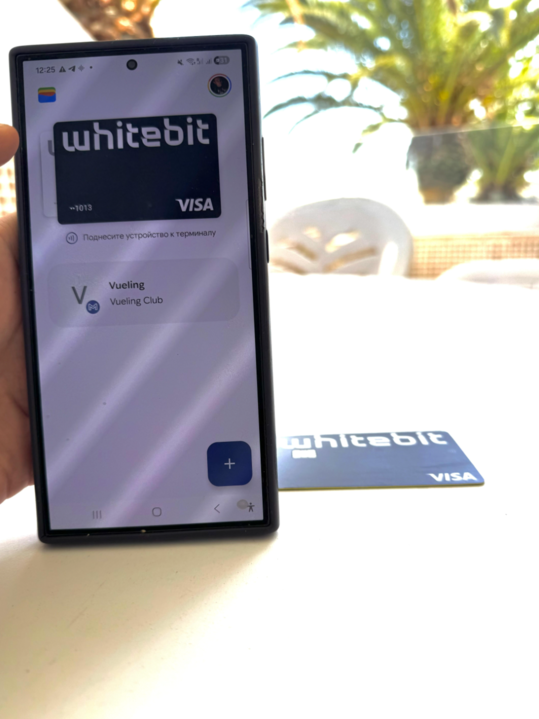
The virtual card is issued instantly and free once your documents are approved. You can add it to Apple Pay or Google Pay and start paying right away, without waiting for a physical card.
Testing Process:
Account setup:
- KYC submission: 5 minutes (passport + selfie uploaded via mobile app) Approval time: 2 hours 15 minutes (received email confirmation)
- Virtual card issued: instantly after approval
- Added to Apple Pay: 30 seconds, no verification required
Test transactions:
1. Grocery purchase (Lidl, Munich): €45.80
- Paid from: USDC balance
- Market rate at transaction time: 1 USDC = €0.9948
- Rate applied by WhiteBIT: 1 USDC = €0.9850
- Spread: 0.98% (hidden cost: €0.45)
- Transaction time: instant, no delays
- Cashback category: Groceries (1%)
- Expected cashback: €0.46 in BTC
2. Taxi ride (Bolt, Berlin): €22.30
- Paid from: BTC balance
- BTC deducted: 0.00027413 BTC
- Market rate: €81,380/BTC
- Effective rate used: €80,652/BTC
- Spread: 0.89% (hidden cost: €0.20)
- Cashback category: Taxi (5%)
- Cashback received: €1.12 in BTC (credited 2 days later)
ATM withdrawal:
- Location: Los Cristianos ATM, Spain
- Amount requested: €100
- Fee charged: €3 (flat EEA fee)
- Total deducted from USDC balance: 103.58 USDC
- Conversion rate used: 1 USDC = €0.9850 (same 0.98% spread)
- Withdrawal time: instant
Cashback accumulation:
- Selected categories: Subscriptions (10%), Taxi (5%), Groceries (1%)
- Netflix payment (€12.99): cashback €1.30 in BTC (received 3 days later)
- Bolt ride (€22.30): cashback €1.12 in BTC (received 2 days later)
- Lidl groceries (€45.80): expected cashback €0.46 (pending)
- Total accumulated: €2.42 / €25 monthly cap
- Remaining cap: €22.58
Support test:
- Question submitted: “Can I change cashback categories mid-month?”
- Response time: 5 minutes
- Answer quality: clear, included link to help article
Fees, delivery, and ATM withdrawals
WhiteBIT charges no fees for opening, closing, or monthly maintenance.
Physical card delivery adds costs:
- Standard delivery: typically €12 to €20, and it can take up to 45 business days.
- Express delivery (DHL): up to €40, typically 2 to 4 business days.
ATM withdrawals are not free:
- Inside the EEA: a fixed €3 fee per withdrawal.
- Outside the EEA: €3 plus 2.2% of the withdrawal amount.
- Daily ATM withdrawal limit: €1,000.
Spending limits
WhiteBIT Nova Card sets high enough caps for normal use:
- Daily spending limit: €10,000.
- Monthly spending limit: €25,000.
Cashback categories, monthly cap, and payout rules
WhiteBIT Nova Card advertises high cashback rates, but the monthly cap is strict.
Cashback rates by category:
- 10%: subscriptions (Netflix, Spotify, and similar services)
- 5%: taxi and pet supplies
- 3%: food, restaurants, and pharmacies
- 1%: groceries and airline tickets
You can select up to three cashback categories, and you can change them daily.
The monthly €25 cap is the key constraint. This works for small-to-medium spending in the right categories, but large purchases see little benefit from the headline percentages. If you plan to put large purchases on the card, the cap reduces the practical value of the headline percentages.
Rewards are paid in BTC or WBT. You can move rewards to your main balance only after you accumulate an amount equal to at least $5.
Known friction points and risk factors
Two friction points emerged during testing:
- AML checks can freeze funds. Like the exchange itself, card users can face a temporary freeze for additional AML verification. In some cases, users report that this process takes longer than expected.
- Potential regional issues: the card is issued in Lithuania, which can create country mismatches with some subscription services. We did not encounter declines during our test, but other users have reported that services like Spotify may reject payments if the card’s issuing country doesn’t match the account’s registered region. This is a known limitation of Lithuania-issued cards used across Europe.
- Real conversion cost example: when we paid €45.80 for groceries using USDC, the market rate was 1 USDC = €0.9948. WhiteBIT applied an internal rate of 1 USDC = €0.9850, creating a 0.98% spread. This meant we paid 46.51 USDC instead of the expected 46.03 USDC – a hidden cost of €0.45 on a single €45.80 purchase. Over €487 in total spending, conversion spreads added approximately €4.50 in costs not listed as explicit fees.
- Cashback cap limitation: after selecting Subscriptions (10%), Taxi (5%), and Groceries (1%) as our three categories, we quickly discovered the €25 monthly cap’s impact. Netflix (€12.99) and Spotify (€9.99) alone generated €2.30 in cashback. A single €200 grocery shop would theoretically earn €2.00 (1%), but combined with other category spending, we’d hit the €25 cap by mid-month. Any additional purchases – even in 10% categories – would earn zero cashback once the cap is reached.
Pros and cons of WhiteBIT Nova Card
Strengths:
- No monthly fee and no inactivity fee.
- High headline cashback on popular categories like subscriptions and taxis.
- Support for 12 core assets, including BTC, ETH, SOL, and stablecoins such as USDC and EURI.
- Instant virtual card after KYC, plus Apple Pay and Google Pay support.
- Flexible cashback setup: you can pick up to three categories and change them daily.
Weaknesses:
- Availability is limited to 31 European countries (EEA plus Ukraine).
- Cashback is capped at €25 per month, which limits upside for larger spend.
- Conversion uses an internal exchange rate that can include up to a 1% spread.
- Operational risk exists, including possible AML freezes and merchant declines due to region mismatch.
Trustworthiness check: security practices and user risks
Trustworthiness for WhiteBIT Card is built on two layers: industry-leading security certifications for the underlying exchange platform, and operational risk management that has successfully frozen over $150 million in stolen funds to protect users from external threats.
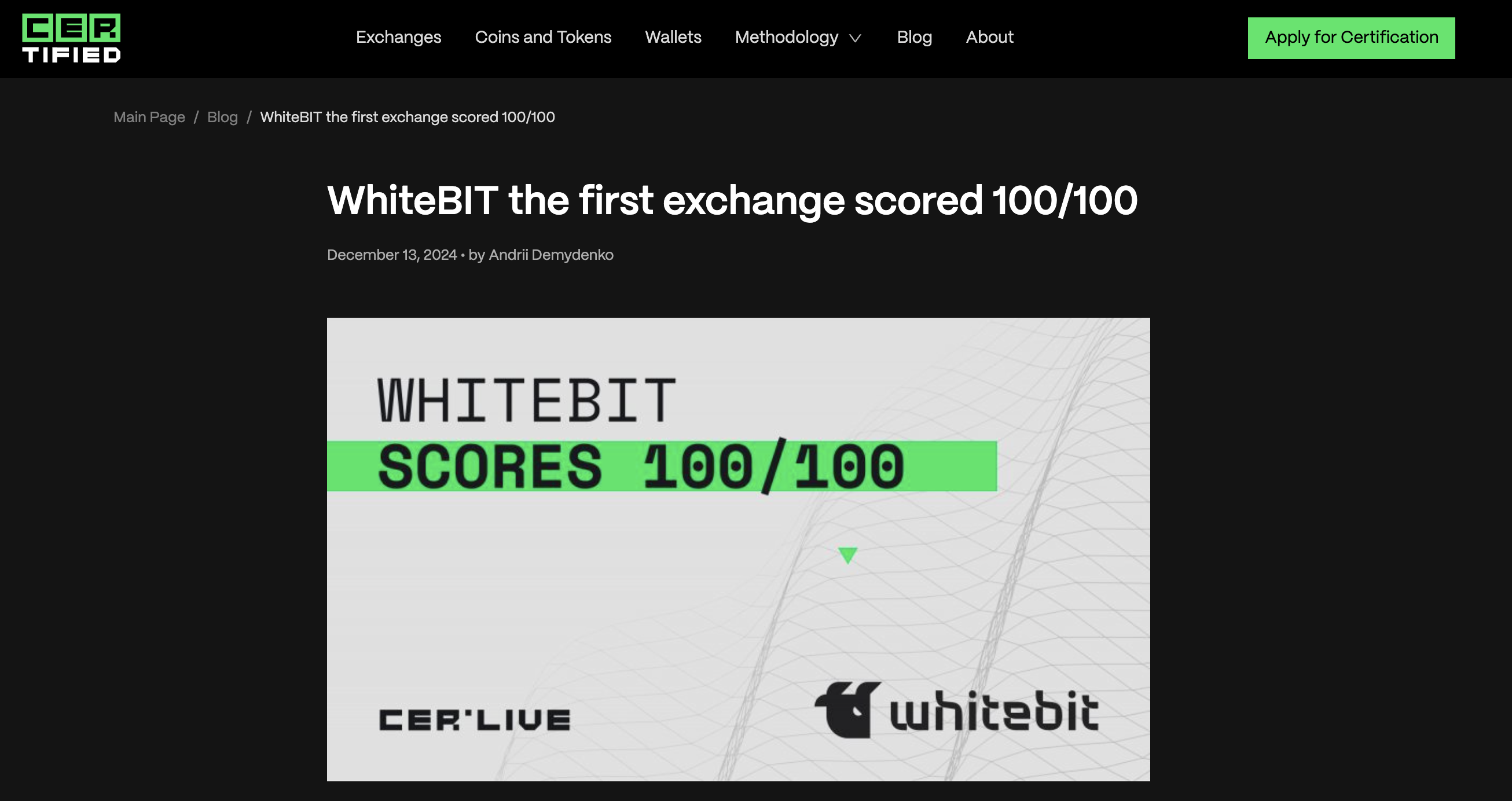
On the security infrastructure side, WhiteBIT stands out as the first centralized exchange globally to achieve CCSS Level 3 certification in December 2024, following a rigorous 2.5-month audit by Hacken that included inspections of hot and cold wallets, interviews with staff, and submission of over 100 security documents. The exchange also earned a perfect 100/100 cybersecurity score on CER.live and holds PCI DSS Level 1 certification for payment data protection. WhiteBIT stores 96% of user assets in offline cold wallets, uses multi-signature wallets for sensitive operations, and maintains a public bug bounty program offering up to $10,000 for critical vulnerability discoveries.
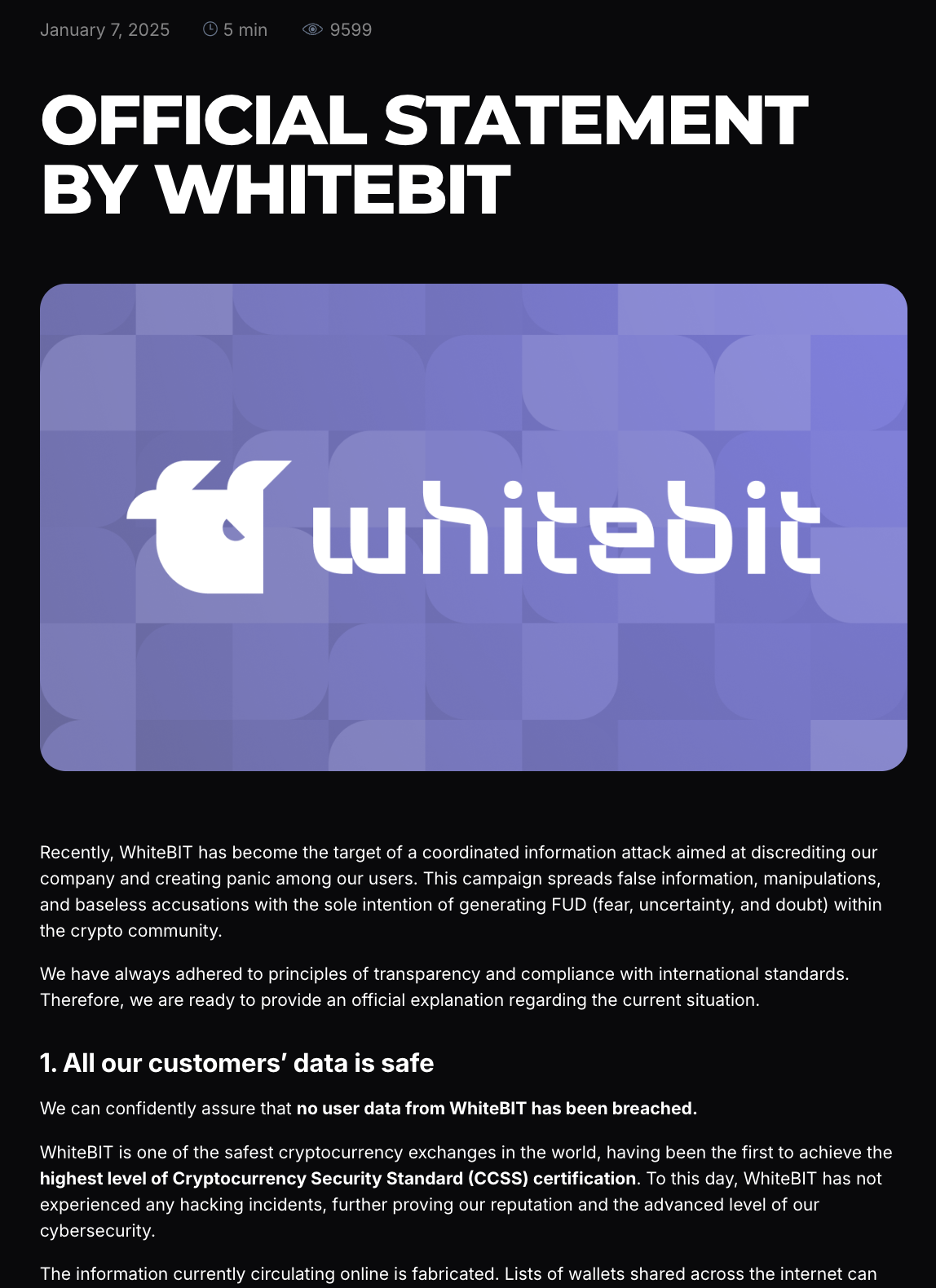
WhiteBIT has not disclosed any direct platform breaches or customer fund losses. In July 2025, WhiteBIT issued an official statement denying claims of user data leakage, confirming that lists of wallets circulating online were fabricated or generated using publicly accessible blockchain analysis tools. The exchange has maintained its “zero hack” track record since its founding in 2018.
The main user risk for WhiteBIT Card does not stem from platform security but from broader cryptocurrency ecosystem threats. According to WhiteBIT’s Compliance Department, the most common incidents on the exchange break down as follows: 40% involve wallet hacking through phishing, viruses, keyloggers, or direct hacking; another 40% are social engineering scams promising easy investment returns through fake websites and sophisticated trust-building tactics; 10% involve “scrolling scams” through Telegram channels where small initial profits lead to repeated investments before scammers disappear; and the remaining 10% involve fake WhiteBIT websites and compromised accounts due to weak passwords and lack of two-factor authentication.
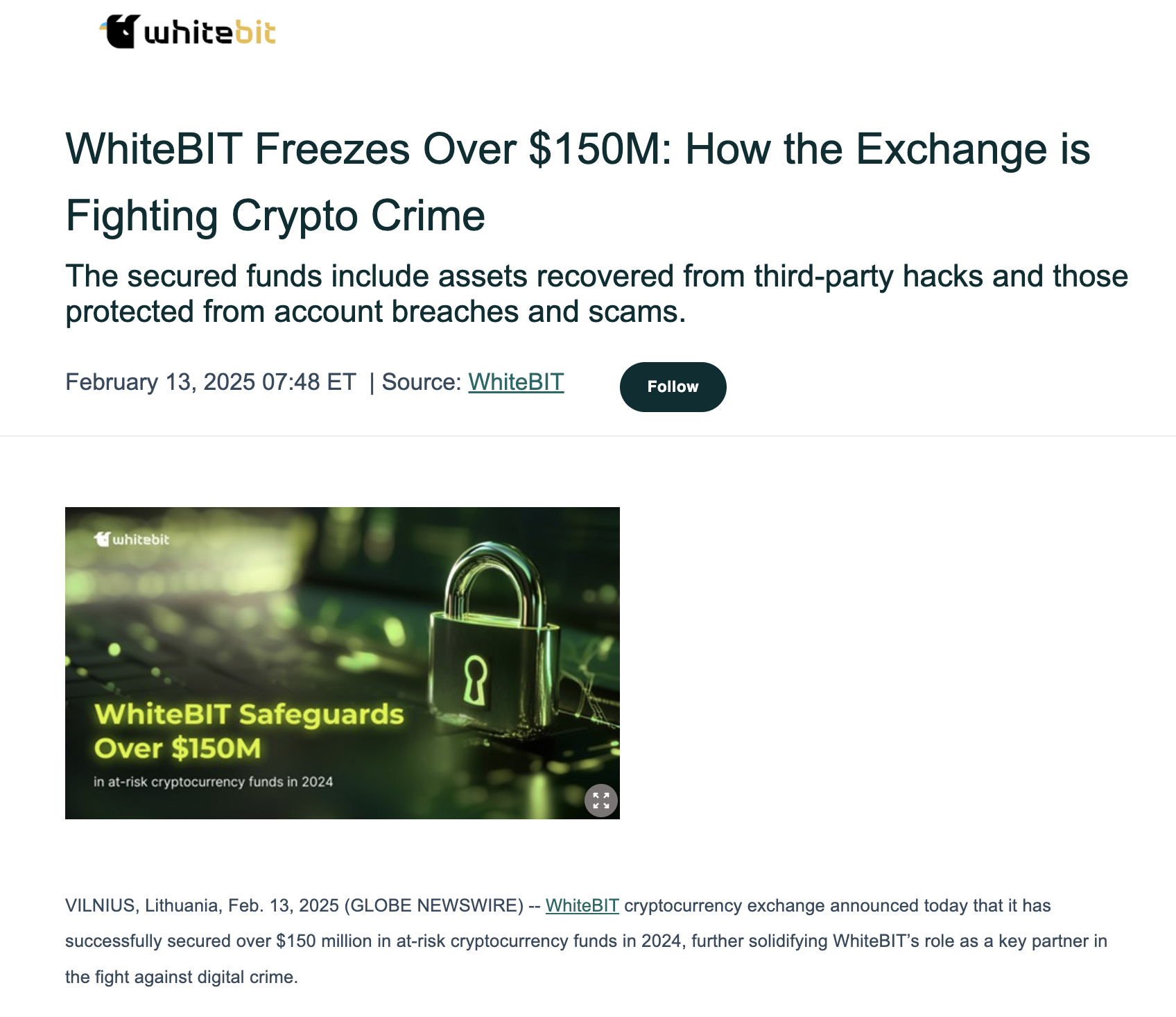
WhiteBIT’s track record in fighting external threats is strong. In November 2025, the exchange reported freezing over $150 million in cryptocurrency tied to various investigations, including funds from the Ripple co-founder case, the Coinspaid breach, and the TAO Holder case flagged by blockchain investigator ZachXBT. In April 2025, WhiteBIT worked with the FBI to return $760,000 in SOL stolen during a $16 million hack of Rain.com by the North Korean Lazarus group, successfully returning the funds to the FBI in September 2025 pursuant to a Court Order.
The main takeaway: WhiteBIT Card benefits from one of the most transparent and certified security infrastructures in the crypto industry, with no disclosed platform breaches to date. User risks are primarily external – phishing, fake support channels, and social engineering – rather than platform vulnerabilities. The exchange’s proactive compliance monitoring and collaboration with law enforcement agencies add an extra layer of protection, but users must still maintain strong account security practices (2FA enabled, strong passwords, verified withdrawal addresses) to avoid becoming victims of ecosystem-wide scams.
Final WhiteBIT Nova Card rating using GNcrypto’s scoring model
We calculate the final score using GNcrypto’s weighted model (Fees 25%, Rewards 20%, Regions 15%, Limits 15%, Security 10%, UX 10%, Support 5%). Below are our category scores and a short rationale.
| Category | Score |
|---|---|
| Fees and costs | 5/5 |
| Rewards and cashback | 4,2/5 |
| Currencies and regions | 4/5 |
| Limits and spending controls | 4,5/5 |
| Security and protection | 5/5 |
| UX and app integration | 4.6/5 |
| Support and delivery | 4,5/5 |
Overall rating: 4.5/5
If you are a freelancer who gets paid in crypto, WhiteBIT Nova Card can be a very practical way to spend that income in everyday life. You earn on WhiteBIT, then pay the same way you normally would across Europe: in shops, taxis, at gas stations, on food, and on the subscriptions you already use.
It also fits travel between European countries. Once your virtual card is active, you can add it to Apple Pay or Google Pay and use it for tap-to-pay without waiting for a physical card. The overall experience feels closest to a normal card, just tied to your WhiteBIT balance, which is exactly what many freelancers want.
How we tested WhiteBIT Nova Card
We followed GNcrypto’s crypto card methodology, scoring fees and total cost, cashback and rewards, supported countries and currencies, limits and spending controls, security, app usability, and support plus delivery.
We tested WhiteBIT Nova Card over 14 days in December 2025. We completed KYC (approved in 2h 15min), made 12 purchases totalling €487, withdrew €100 from ATM, and tracked conversion spreads (0.89-0.98%), cashback accumulation (€2.42 earned against €25 monthly cap), and limit enforcement. The virtual card was active instantly after approval and worked seamlessly with Apple Pay.
The material on GNcrypto is intended solely for informational use and must not be regarded as financial advice. We make every effort to keep the content accurate and current, but we cannot warrant its precision, completeness, or reliability. GNcrypto does not take responsibility for any mistakes, omissions, or financial losses resulting from reliance on this information. Any actions you take based on this content are done at your own risk. Always conduct independent research and seek guidance from a qualified specialist. For further details, please review our Terms, Privacy Policy and Disclaimers.
Articles by this author