White House: Stablecoin yields unlikely to threaten banks
White House economists conclude yields from dollar-backed stablecoins are unlikely to trigger large-scale deposit outflows from U.S. banks in the near term.
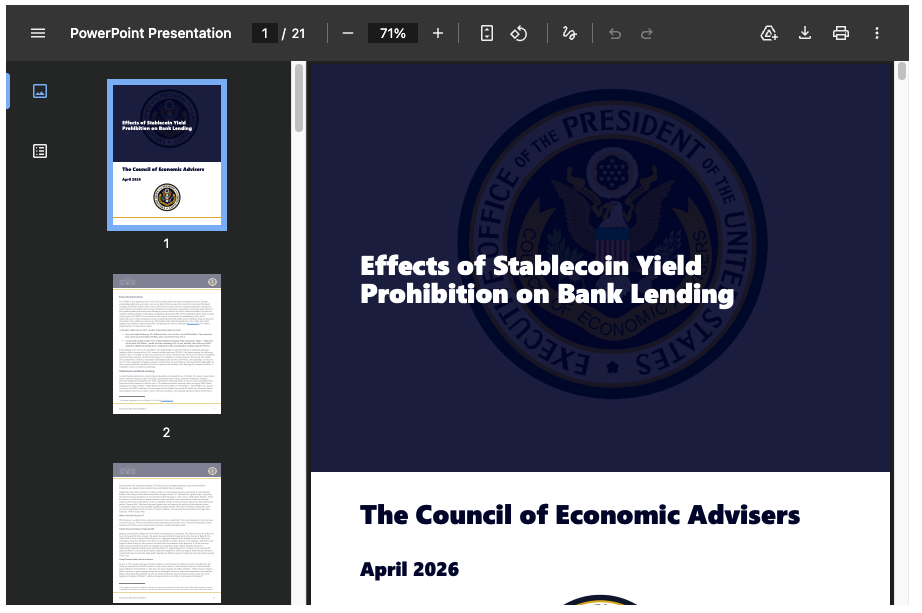
White House economic staff concluded in a report that yields offered by dollar-pegged stablecoins are unlikely to pose a direct threat to the U.S. banking system and are not expected to prompt widespread shifts of bank deposits in the near term.
The assessment finds most stablecoin returns stem from short-term cash investments and money-market instruments rather than from sustained higher-risk lending. Economists wrote those return sources are constrained by the supply of safe assets and by issuers’ need to meet redemptions, which limits how consistently stablecoin yields can exceed bank deposit rates at scale. The report notes stablecoin market growth has been concentrated among a few large issuers.
The analysis lists three factors that reduce the likelihood of immediate pressure on banks: federal deposit insurance and an established regulatory framework that support depositor confidence; banks’ diversified funding and lending models, including stable retail deposits; and stablecoin issuers’ typical use of short-term assets that cap how much yield they can sustainably offer without raising liquidity risk.
Economists identified channels through which stablecoins could affect banks. Higher stablecoin yields could push banks to raise deposit rates and funding costs. Stress in the crypto sector could spread to nonbank financial firms that provide services to both stablecoin market and traditional banks. The report judges those channels manageable given current market sizes and with timely regulatory action.
The report examines how redemption mechanics and reserve transparency influence risk. Issuers that keep clear, highly liquid reserves are less likely to face runs that force asset fire sales and threaten broader markets. White House economists recommended stronger disclosure standards and routine audits of reserves, and closer oversight of nonbank entities involved in stablecoin operations.
The assessment warns the risk landscape could change if stablecoin adoption accelerates or if issuers shift reserves into longer-dated or higher-risk assets to chase yield. In those scenarios, rapid withdrawals could expose counterparties and liquidity providers, including banks that provide services to crypto firms. The report urges coordination between banking regulators and agencies that oversee securities and payments to align standards for reserves, custody and operational resilience.
On policy, the report describes legislative and regulatory options under consideration. Proposals include requiring stablecoin issuers to hold safe, liquid assets and to submit to enhanced supervision. Economists recommend that any new rules target reserve quality, transparency and oversight while leaving room for payment innovation.
The report defines stablecoins as digital tokens pegged to a fiat currency, commonly the U.S. dollar, used for trading and payments and as a bridge between traditional finance and crypto markets. The market has expanded in recent years and remains concentrated among several large issuers that back tokens with cash equivalents, Treasury bills, commercial paper or similar assets. Past failures of algorithmic tokens and sudden crypto losses are cited as reasons reserve composition and issuer structure matter for stability.
The material on GNcrypto is intended solely for informational use and must not be regarded as financial advice. We make every effort to keep the content accurate and current, but we cannot warrant its precision, completeness, or reliability. GNcrypto does not take responsibility for any mistakes, omissions, or financial losses resulting from reliance on this information. Any actions you take based on this content are done at your own risk. Always conduct independent research and seek guidance from a qualified specialist. For further details, please review our Terms, Privacy Policy and Disclaimers.
Articles by this author