Uphold Wallet Review 2026: how the mobile crypto platform handles multi-asset management
Uphold is a centralized crypto platform and wallet supporting cryptocurrencies, fiat, precious metals, and select securities. We tested account setup, deposits and withdrawals, buying and swapping tokens, staking, and “anything-to-anything” conversions. This review highlights key advantages, such as unified mobile and web management, as well as potential limitations, including verification delays, withdrawal timing, and customer support responsiveness.
We put Uphold to the test as a full-fledged mobile and web crypto platform: we installed the app, created a new account, explored fiat and crypto deposits, tried buying, selling, and swapping tokens, tested staking options, and used the “anything-to-anything” conversion feature directly from the interface. Special attention was given to how the platform handles multiple asset types – cryptocurrencies, fiat, and precious metals – and how well its portfolio management and transaction tools perform.
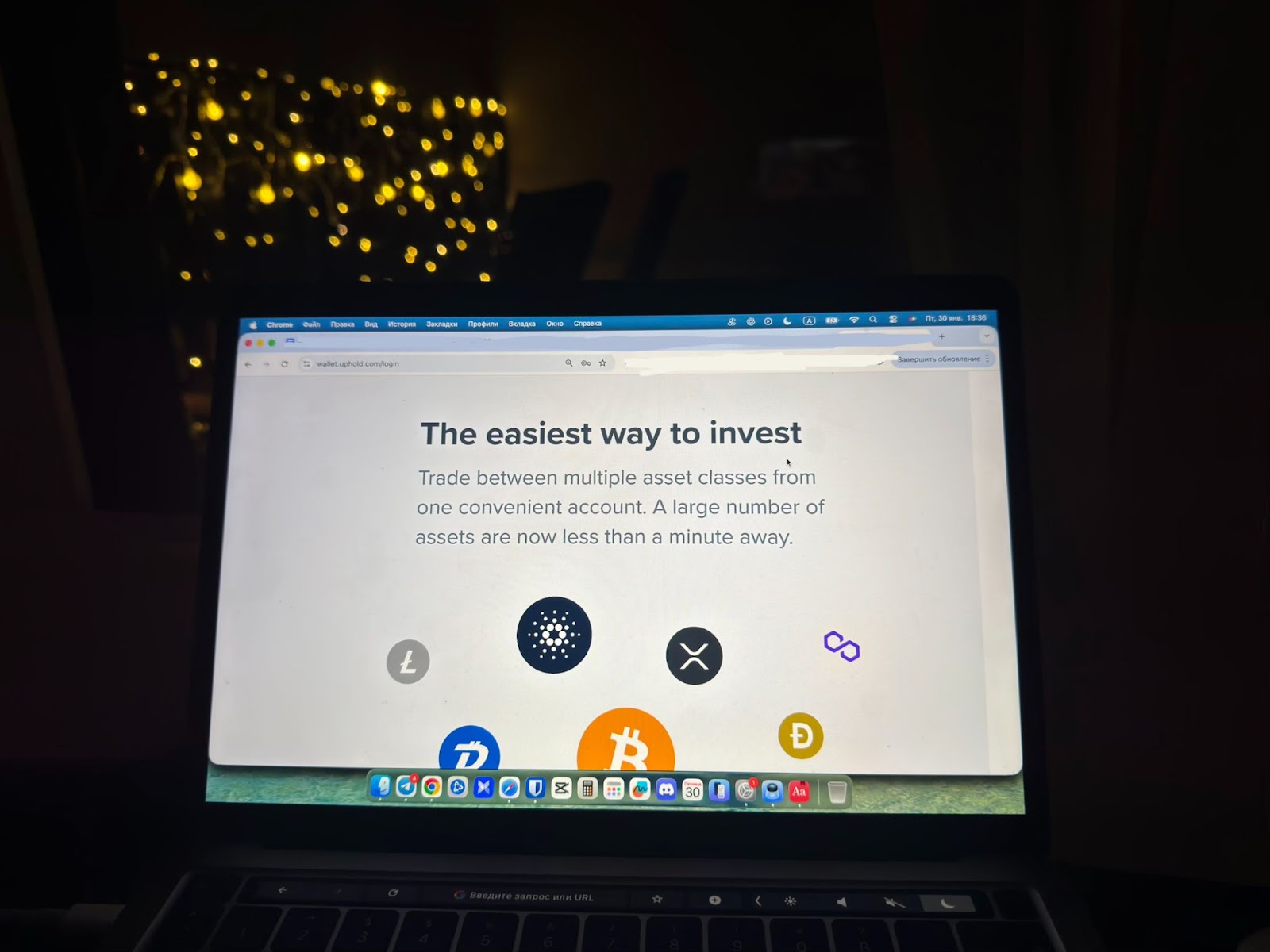
The main practical advantage of Uphold is its centralized, unified interface, which allows users to manage crypto, fiat, and other digital assets in one place, perform direct conversions between any supported assets, stake tokens, and even use a debit card with crypto cashback. Its primary limitations stem from its centralized design: account verification can be lengthy, withdrawal times may vary, and customer support is limited compared to dedicated trading or DeFi platforms. Overall, the platform is optimized for mobile-first daily management rather than advanced analytics or professional trading.
What Uphold wallet is
Uphold wallet is a cryptocurrency platform founded in 2014, operating as both a mobile and web wallet for managing cryptocurrencies, fiat, precious metals, and select securities. According to multiple Uphold reviews, the platform is centralized: users create an account and manage their funds through Uphold, while the keys and control over asset custody remain with the platform. This simplifies usage but differs from self-custody wallets.
According to numerous Uphold reviews, the platform stands out due to its “anything-to-anything” conversion support, allowing direct swaps between any assets without intermediaries. A key feature is the integration of DeFi-style tools, including automated purchases (AutoPilot) and cryptocurrency staking.
As a centralized platform, Uphold holds custody of user assets and manages private keys on their behalf. The platform publishes Proof of Reserves to demonstrate that user funds are backed 1:1, and implements two-factor authentication to secure accounts. While users do not control private keys directly, Uphold cannot move funds without user authorization through the account interface.
Uphold is available as a mobile app for iOS and Android, as well as through a web interface. Special emphasis is placed on user-friendly design, fast asset conversion, and integration with external services, including a debit card that offers cryptocurrency cashback. The platform follows a mobile-first approach, enabling users to manage assets and interact with DeFi tools from anywhere.
In everyday use, Uphold functions as a comprehensive hub for managing cryptocurrencies, fiat, and other digital assets, rather than merely a storage solution. As a centralized platform, Uphold holds the keys and ensures the security of users’ funds, mitigating the risk of losing access due to token management errors. Primary threats remain phishing attacks, account compromise, or vulnerabilities on the platform side.
Pros, cons & restrictions
In summary, here’s what we found to be the most important aspects of Uphold – and what to consider before deciding to use it. This overview, based on multiple Uphold Vault reviews, highlights both the strengths and limitations, giving you a clear idea of what to expect.
Strengths:
- Intuitive interface: from the moment we first opened the app, we immediately understood how to buy and sell assets, as well as execute transfers and conversions in just a few clicks. This is especially valuable for beginners who don’t want to spend time navigating complex menus.
- Convenient mobile and web access: we frequently switched between the browser and the app, and in both cases, everything worked smoothly and predictably, with no unnecessary delays or confusing navigation.
- Seamless Brave Browser integration: when we connected the wallet to Brave and started earning BAT tokens, it was satisfying to see the rewards automatically appear in our balance, making them easy to withdraw or hold.
- Wide range of assets: we appreciated that it’s possible to manage not only cryptocurrencies but also fiat and other assets within a single account, without needing to register on multiple platforms.
- Fast internal operations: swaps and conversions executed instantly (anything-to-anything took under 2 seconds). However, crypto withdrawals to external wallets took much longer (our $15 USDT withdrawal took 18 hours).
Weaknesses:
- Phone number required for registration: when we created our account, a valid phone number was mandatory. For users who value privacy or prefer email registration, this felt restrictive.
- Lengthy and complex verification process: setting up the account required uploading extensive personal information: passport details, proof of address, photos, and sometimes additional documents. In our experience, the verification process took longer than expected, especially when manual review was involved.
- Delays in withdrawals: our $15 USDT withdrawal to the external wallet took 18 hours, spending 14 hours in “processing” status. Fiat withdrawals took 4 business days. This was frustrating when we needed to move funds quickly.
- Slow and limited customer support: when we encountered issues, such as temporary account blocks, responses from support were slow and often automated. There is no phone support or live chat, which makes resolving urgent issues more cumbersome.
- High fees and spreads: during our trades, we noticed that exchange and withdrawal fees were sometimes higher than expected, which reduced the overall profitability of active trading.
- Geographical restrictions: while using the platform, we had to verify whether our region was supported. Uphold can restrict access in certain countries, and we found this could be disruptive if the service suddenly became unavailable.
Asset coverage & use cases
Uphold supports a wide range of assets, making the platform convenient for managing almost an entire portfolio in one place. According to several Uphold crypto reviews, users can hold and trade major cryptocurrencies such as BTC, ETH, and SOL, as well as numerous altcoins and stablecoins.
Beyond cryptocurrencies, Uphold also supports popular fiat currencies – USD, EUR, GBP, and others. In daily use, this proved very convenient: it’s easy to top up an account, buy crypto, or withdraw funds back into a familiar currency without complex procedures or additional exchanges.
We also explored the ability to purchase precious metals like gold and silver. We bought 10g of digital gold for $25 (swapped from BTC with 1.8% spread). This was useful for portfolio diversification, allowing part of the funds to be held outside the crypto market while managing everything through a single interface. Staking supported tokens was a simple way to earn passive income: we staked $20 worth of ETH (0.006 ETH) at 3.5% APY directly in the app. Rewards began accruing immediately, with payouts scheduled monthly.
The “anything-to-anything” feature is particularly convenient, allowing users to convert any supported assets directly into each other. We tried converting crypto to fiat, fiat to metals, and vice versa, and the process was fast and transparent. Additionally, U.S. users can use the Uphold debit card with cryptocurrency cashback, turning their platform balance into a tool for everyday spending.
Overall, the variety of assets and use cases makes Uphold more than just a wallet – it functions as a full-fledged financial ecosystem for managing cryptocurrencies, fiat, and other digital assets on a daily basis.
Testing process
We created an Uphold account via the mobile app (iOS). Registration required phone number, email, and full KYC verification (passport photo, selfie, proof of address). Verification took 4 days – longer than expected due to manual review.
Deposit test (fiat): we deposited $200 USD via bank transfer. Funds appeared in account in 3 business days. No deposit fee charged.
Deposit test (crypto): we sent $50 USDT (Ethereum ERC-20) from an external wallet to Uphold. Funds appeared in 8 minutes (15 confirmations). Network gas: $1.90. Uphold charged no deposit fee.
Buy test: we bought $30 worth of Bitcoin using USD balance. Spread: approximately 1.2% ($0.36 markup on $30 purchase). Transaction executed instantly.
Swap test (anything-to-anything): we swapped $25 USD for 0.0003 BTC. Spread: ~1.5% ($0.38). Execution: instant. Then swapped 0.0003 BTC for 10g of digital gold. Spread: ~1.8% ($0.45). Total cost for two conversions: $0.83 (3.3% of $25).
Staking test: we staked $20 worth of ETH (0.006 ETH). Process: select “Earn” → choose ETH → confirm. Staking activated instantly. Estimated APY: 3.5% (displayed in app). Rewards began accruing immediately but are paid monthly.
Withdrawal test (crypto): we withdrew $15 USDT (Ethereum) to an external wallet. Withdrawal fee: $2.50 (16.7% of withdrawal amount). Processing time: 18 hours (much longer than expected). Status showed “processing” for 14 hours before execution.
Withdrawal test (fiat): we withdrew $50 USD to our bank account via ACH. Fee: $0 (free withdrawal). Processing time: 4 business days.
Card test: we applied for an Uphold debit card (Essential tier). Approval took 7 days. The physical card arrived 12 days after approval.
Customer support: we submitted a ticket via web portal asking about staking rewards. Response received in 52 hours (automated reply first, then human follow-up 26 hours later).
Trustworthiness check
Uphold is a centralized cryptocurrency platform and wallet, founded in 2014. The platform supports cryptocurrencies, fiat, precious metals, and certain securities, as well as conversion and staking features.
Legally, Uphold is regulated in multiple jurisdictions and publishes Proof of Reserves, although the platform’s code has not undergone a public audit. Access to the service may be restricted in countries with strict crypto regulations or under sanction regimes.
To protect accounts, Uphold employs two-factor authentication and biometric verification, while all operations are processed through the platform’s internal protocols. This ensures transactions are executed correctly and reduces the risk of user errors.
GNcrypto’s overall Uphold Wallet rating
After testing Uphold wallet with account creation (4-day KYC verification), deposits ($200 USD via bank in 3 days, $50 USDT in 8 minutes), swaps ($25 anything-to-anything with 3.3% total spread), staking ($20 ETH at 3.5% APY), and withdrawals ($15 USDT with $2.50 fee and 18-hour delay), the platform delivered on unified asset management (crypto, fiat, metals in one interface), instant swaps (anything-to-anything executed in seconds), and mobile convenience (smooth app and web experience). We rated it 3.9/5 overall, with 4.6/5 for UX (intuitive interface, fast navigation), 4.5/5 for asset support (crypto + fiat + metals), but 3.2/5 for support (52-hour ticket response, no live chat) and 3.8/5 for costs (1.2-1.8% spreads, $2.50 withdrawal fee). Strong for mobile-first users managing diverse assets with infrequent trades, weaker for active traders needing low fees and fast withdrawals.
| Criterion | Score |
|---|---|
| Security & Key Management | 4.0 |
| Supported Assets & Networks | 4.5 |
| Transaction Costs & Speed | 3.8 |
| User Experience & Interface | 4.6 |
| DeFi & dApp Integration | 3.5 |
| Recovery & Backup Systems | 4.2 |
| Customer Support & Documentation | 3.2 |
| Total | 3.9 / 5.00 |
How we test hot crypto wallets
At GNcrypto, we put transparency first when evaluating hot cryptocurrency wallets. Our reviews are based on hands-on testing and thorough analysis across all key dimensions that matter for self-custody and daily crypto use.
We do not audit wallet code or guarantee security against all attack vectors. Instead, our scores reflect usability, feature completeness, and observable security practices. We do not accept payment for ratings or modify scores based on partnerships.
Categories & weights
We rate hot wallets on seven criteria. Security and Asset Support are weighted heaviest because a wallet that isn’t safe or can’t hold your coins is useless, regardless of how pretty the UI is.
- Security & Key Management – 25%
- Supported Assets & Networks – 20%
- Transaction Costs & Speed – 15%
- User Experience & Interface – 15%
- DeFi & dApp Integration – 10%
- Recovery & Backup Systems – 10%
- Customer Support & Documentation – 5%
The material on GNcrypto is intended solely for informational use and must not be regarded as financial advice. We make every effort to keep the content accurate and current, but we cannot warrant its precision, completeness, or reliability. GNcrypto does not take responsibility for any mistakes, omissions, or financial losses resulting from reliance on this information. Any actions you take based on this content are done at your own risk. Always conduct independent research and seek guidance from a qualified specialist. For further details, please review our Terms, Privacy Policy and Disclaimers.
Articles by this author