Gemini CEO Tyler Winklevoss: how he built his crypto career

As the CEO of Gemini, Tyler Winklevoss has become one of the most visible voices in crypto. This profile looks at how he moved from Harvard and Olympic rowing into Bitcoin, built Gemini, and shaped his place in the industry.
Profile
Name: Tyler Winklevoss
Nationality: American
Born: August 21, 1981
Education: Harvard University; Christ Church, Oxford
Occupation: Entrepreneur, investor, Gemini co-founder and CEO
Known for: Gemini, early Bitcoin investing, ConnectU, Olympic rowing
Estimated net worth: About $3.5 billion
Who Tyler Winklevoss is
Tyler Winklevoss is an American entrepreneur, investor and former Olympic rower best known as the co-founder and CEO of Gemini, the cryptocurrency exchange he launched with his twin brother, Cameron Winklevoss. To understand who is Tyler Winklevoss, it helps to see how his career developed across sports, startups, and crypto long before Gemini made him a major industry figure. Born on August 21, 1981, in Southampton, New York, and raised in Greenwich, Connecticut, Winklevoss comes from a family with strong academic roots: his father, Howard Winklevoss, taught actuarial science at the Wharton School.
He first came to national prominence at Harvard, where he and Cameron co-founded HarvardConnection, later renamed ConnectU, a social networking project that became central to a high-profile legal dispute with Mark Zuckerberg over the origins of Facebook. The case made the Winklevoss brothers widely known and established Tyler as an early internet entrepreneur well before his entry into digital assets.
Before crypto, Winklevoss also built an elite athletic career. He and Cameron represented the United States in the men’s coxless pair at the 2008 Beijing Olympics, a chapter that helped shape the disciplined, long-horizon mindset he would later bring to investing and business.
As Winklevoss put it:
I think our path to the Olympics is a good metaphor for how you build a company. Our skill and commitment grew over time, day by day, stroke by stroke. So, sports are tied well with our entrepreneurial pursuits because you train for a few years, but there is no guarantee that you will succeed.
After their early work in technology and investing, Tyler and Cameron Winklevoss moved into Bitcoin in the early 2010s, becoming two of the first well-known U.S. entrepreneurs to back the asset publicly. They argued that Bitcoin could evolve into both a new form of money and a long-term store of value, with Tyler later describing it as “gold 2.0.”
In 2013, the brothers invested $11 million from the $65 million they received in their settlement with Zuckerberg. At the time, Bitcoin was trading at roughly $120, and the twins were widely reported to own nearly 1% of all Bitcoin in circulation.
We see bitcoin as potentially the greatest social network of all,
he told the Financial Times in 2016.
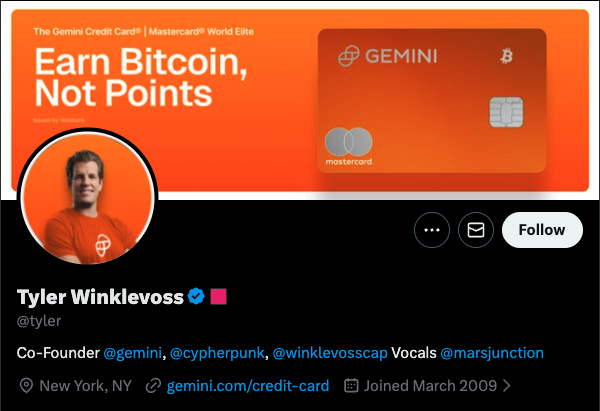
That belief led to Gemini, the crypto exchange the brothers founded in 2014 and launched in 2015. Any Gemini exchange review of its early years would note that, from the beginning, Gemini was positioned differently from many early exchanges. Rather than pursue growth at any cost, Tyler and Cameron built the company around compliance, security and regulated access to digital assets, with Tyler as CEO and Cameron as president.
How Gemini was built
Gemini was built on a simple premise: crypto needed a more credible on-ramp. Instead of competing solely on speed or aggressive expansion, Tyler and Cameron Winklevoss focused on trust, licensing and infrastructure, aiming to create a platform that could appeal to both retail users and institutions.
As the brothers later wrote on Reddit,
We began buying bitcoin, but quickly realized that there was no safe and easy way to buy, sell, and store bitcoin (or any cryptocurrency for that matter). So we founded Gemini as a solution to our own problem.
The company began as a regulated platform for buying, selling and storing digital assets, then expanded into custody, institutional services and consumer products. Over time, it added staking, wallet tools, a crypto rewards credit card and services aimed at more sophisticated investors.
The result was a clearer identity than many of Gemini’s peers. While other exchanges often emphasized rapid expansion, Gemini leaned harder into regulation, licensing and security. That helped it stand out in the U.S. market, where trust and compliance have played a major role in crypto adoption.
Tyler Winklevoss’ role in the crypto industry
Tyler Winklevoss has spent years arguing that crypto will only become a durable part of finance if the industry earns public trust and operates within clearer rules. Through Gemini and his public statements, he has consistently pushed for stronger infrastructure, broader adoption and a more regulated market structure.
In 2013, Tyler and Cameron Winklevoss backed one of the earliest U.S. Bitcoin ETF efforts through the Winklevoss Bitcoin Trust filing. In 2015, Gemini secured a trust charter from the New York State Department of Financial Services, giving it a regulated foothold in the U.S. market. In 2016, Gemini became the first licensed Ether exchange.
We want to be that bridge and that on-ramp that gets the big mutual funds, hedge funds, and pension funds … into the space. They are going to need a regulated bridge to do it.
More recently, Tyler and Cameron Winklevoss attended the White House signing of the GENIUS Act in July 2025, which created a federal framework for payment stablecoins. Throughout his career, Winklevoss was not just building another exchange. He was making the case that crypto needed rules, licenses, and stronger infrastructure if it wanted to attract mainstream users and institutions.
Gemini’s future strategy and vision
Under Gemini CEO Tyler Winklevoss, the company is moving beyond its identity as just a spot crypto exchange and trying to become a broader digital asset platform. Trading remains central to the business, but the company is putting more weight behind custody, payments, staking, wallets and onchain access.
The shift is already visible in the numbers. In 2025, Gemini reported $179.6 million in revenue, up 26% from a year earlier, while services revenue rose 115%. The company also reported $52.7 billion in annual trading volume and $15.9 billion in assets on the platform at year-end.
Product development is a major part of that strategy. Gemini has expanded support for new blockchain networks, rolled out Gemini Wallet and spot margin trading with up to 5x leverage. It also launched regulated prediction markets in all U.S. states. Consumer products are part of that push as well. The company said card sign-ups jumped about 15-fold in 2025.
Taken together, those moves point to a more disciplined strategy. Tyler Winklevoss is no longer trying to build Gemini into just a bigger exchange. He is trying to build a more resilient business – one with broader products, steadier revenue lines and a stronger position in the next phase of the digital asset industry.
The material on GNcrypto is intended solely for informational use and must not be regarded as financial advice. We make every effort to keep the content accurate and current, but we cannot warrant its precision, completeness, or reliability. GNcrypto does not take responsibility for any mistakes, omissions, or financial losses resulting from reliance on this information. Any actions you take based on this content are done at your own risk. Always conduct independent research and seek guidance from a qualified specialist. For further details, please review our Terms, Privacy Policy and Disclaimers.
Articles by this author