World Bank to begin selling shares of corporate loans

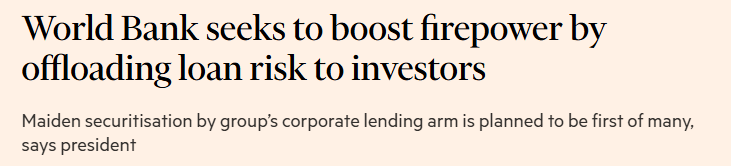
World Bank President Ajay Banga announced that its corporate arm, the International Finance Corporation (IFC), will regularly sell risk tranches of its corporate loans to private investors.
In September, IFC completed a pilot transaction, selling tranches on a $500M portfolio of corporate loans. The package included loans to 57 companies in developing countries, with Turkey, Mexico, Brazil, Bangladesh and Egypt together accounting for 42% of the portfolio.
Banga stressed that the program’s goal is not just to ease IFC’s balance sheet but to expand private capital participation in financing developing countries. “The trillions in flows we talked about years ago never materialized. We need to offer institutional investors a liquid and diversified instrument,” he said.
The backdrop to the deal is shrinking budgetary aid from major donors. The US and UK cut funding in 2024–2025, forcing the World Bank to look for new ways to raise capital.
While such securitizations are still rare for multilateral banks, IFC’s example could set a trend. Earlier, the Asian Infrastructure Investment Bank (AIIB) supported the development of this market by participating in Singapore’s Bayfront platform.
According to Banga, IFC may consider pooling portfolios with other institutions in the future if deal terms can be standardized. At the same time, traditional capital-raising channels such as bond issuance and donor contributions will remain in place.
You might also like: EU sets timeline to expand pensions and review crypto rules
Headline of Financial Times press release. Source: ft.com
The deal was structured as a collateralized loan obligation (CLO), a tool commercial banks typically use to offload credit risk. According to Moody’s, senior tranches yielded investors SOFR + 1.3 pp, drawing interest from banks, insurers, and funds.
Banga stressed that the program’s goal is not just to ease IFC’s balance sheet but to expand private capital participation in financing developing countries. “The trillions in flows we talked about years ago never materialized. We need to offer institutional investors a liquid and diversified instrument,” he said.
The backdrop to the deal is shrinking budgetary aid from major donors. The US and UK cut funding in 2024–2025, forcing the World Bank to look for new ways to raise capital.
While such securitizations are still rare for multilateral banks, IFC’s example could set a trend. Earlier, the Asian Infrastructure Investment Bank (AIIB) supported the development of this market by participating in Singapore’s Bayfront platform.
According to Banga, IFC may consider pooling portfolios with other institutions in the future if deal terms can be standardized. At the same time, traditional capital-raising channels such as bond issuance and donor contributions will remain in place.
You might also like: EU sets timeline to expand pensions and review crypto rules