Standard Chartered maintains $2T stablecoin market forecast as velocity doubles
Standard Chartered reports stablecoin turnover has doubled to six times per month and keeps its $2 trillion 2028 market-cap forecast, citing rising USDC use and early AI-agent payments via x402.
Standard Chartered reports that stablecoin velocity has doubled in two years to an average of six turns per month and keeps its projection for a $2 trillion market capitalization by the end of 2028. The update, published Tuesday, links faster turnover to growing USDC activity on Solana and Base and to early AI‑agent payments using Coinbase’s x402 protocol.
Geoff Kendrick, the bank’s global head of digital assets research, reviewed the model after observing the increase in turnover. The original forecast assumed stable velocity, which in theory would limit the number of coins needed for a given level of transactions. Kendrick wrote that the estimate remains unchanged because recent high-frequency uses appear to add on top of existing demand. “The good news is that these new use cases are, so far, additive to overall stablecoin transactions. Furthermore, the higher velocity of these use cases has not impacted the low-velocity emerging markets savings use case,” he noted. “As a result, our $2 trillion market estimate for end of 2028 remains intact, but we will watch stablecoin velocity more closely going forward, as we think it is a key input.”
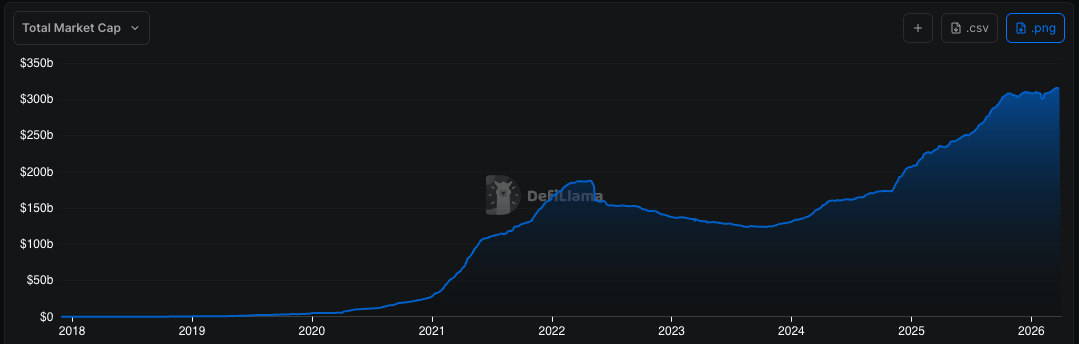
As of April 1, the total stablecoin market cap sits at $315,964b, according to defillama.
The bank’s analysis points to USDC as the main driver of changing usage patterns. The Circle-issued token, which represents roughly a quarter of the market, began to diverge from Tether’s USDT in mid-2024 as it increasingly replaced traditional banking rails for payments and settlement. That shift accelerated after the GENIUS Act set a federal framework for stablecoins in 2025.
A second leg of acceleration began in October 2025 on Solana and Base. Kendrick attributes the jump to early AI agent payments routed through x402, an open-source payments protocol developed by Coinbase to enable automated transactions. Reported volumes have since eased, and the research team plans to monitor whether AI-related flows resume.
USDT’s turnover has remained comparatively steady. According to the note, USDT activity is still led by lower-velocity uses such as emerging-market savings and cash management, while USDC has seen growing adoption in higher-frequency payments and settlement. The split points to distinct market segments for the two leading tokens.
Velocity measures how often a coin changes hands in a set period. An average of six times per month indicates more frequent use in payments, trading, or machine-to-machine transactions, which can raise transaction volumes without a proportional increase in outstanding supply.
Some investors have voiced long-term optimism about stablecoins’ role in payments. In a recent video interview, billionaire investor Stanley Druckenmiller called stablecoins “incredibly useful” and added, “I assume our whole payments systems will be stablecoins in 10 or 15 years,” citing efficiency and lower costs.
The material on GNcrypto is intended solely for informational use and must not be regarded as financial advice. We make every effort to keep the content accurate and current, but we cannot warrant its precision, completeness, or reliability. GNcrypto does not take responsibility for any mistakes, omissions, or financial losses resulting from reliance on this information. Any actions you take based on this content are done at your own risk. Always conduct independent research and seek guidance from a qualified specialist. For further details, please review our Terms, Privacy Policy and Disclaimers.
Articles by this author