Prosecutors oppose Cox ruling in bid to dismiss Tornado Cash co-founder case

Prosecutors urged Judge Katherine Polk Failla not to apply the Supreme Court’s Cox ruling to Tornado Cash developer Roman Storm, challenging his motion to dismiss.
Federal prosecutors told Judge Katherine Polk Failla in a letter filed on April 7 that the Supreme Court’s March decision involving internet service provider Cox should not factor into Roman Storm’s bid to dismiss charges tied to Tornado Cash.
In the filing, the government called the Cox ruling “inapposite” and argued Storm’s conduct “bears no resemblance to the conduct at issue in Cox.” Prosecutors contrasted Cox’s measures to deter infringement with what they described as a lack of meaningful steps by Tornado Cash’s operators to stop criminal use of the crypto mixing service.
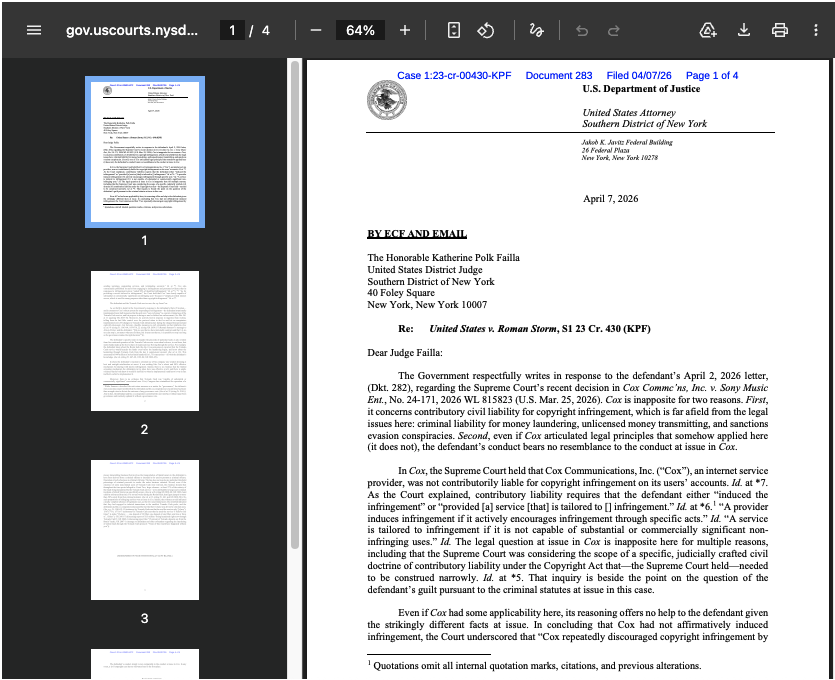
According to prosecutors, Storm misled victims by claiming he had little control over the protocol, while he and alleged co-conspirators made more than 250 changes to Tornado Cash during the charged period and discussed, but did not implement, measures to curb illicit activity. The letter described Storm’s response to illegal use as “window dressing at best and outright misdirection at worst,” unlike “Cox’s robust and 98% effective mechanism for dealing with known infringement.”
Storm’s counsel notified Judge Failla last week of the Supreme Court’s March decision, which found Cox could not be held responsible for users’ unlawful conduct in a music copyright case. The defense argued the ruling could support dismissing the criminal case against Storm. Prosecutors maintain the facts are different, asserting Tornado Cash’s operators had the ability to make changes and chose not to apply controls that would have limited illicit transactions.
Storm has been accused of facilitating the laundering of more than $1 billion through Tornado Cash. In August, a jury convicted him of operating an unlicensed money transmitting business. The jury did not reach a verdict on counts tied to money laundering and sanctions evasion. Prosecutors have asked the court to retry the unresolved charges and proposed beginning a retrial in October 2026, according to a recent court filing.
The case has drawn attention in the crypto sector. In January, Ethereum co-founder Vitalik Buterin wrote that he is “a believer in privacy and an active user of privacy tools,” including those developed by Storm, and praised the usability of Storm’s applications years after he stopped working on them.
The Justice Department has emphasized that software development itself is not at issue, while maintaining that those who facilitate crimes through technology can face prosecution. “Writing code” is not a crime, acting assistant attorney general Matthew J. Galeotti stated in August, adding that the department will continue to pursue cases involving fraud, money laundering and sanctions evasion.
Authorities have pursued related cases against other privacy-focused crypto services. The founders of Samourai Wallet pleaded guilty to money laundering charges and are serving prison sentences. Keonne Rodriguez received five years, and William Lonergan Hill received four years, after prosecutors said the service enabled criminals to “wash millions in dirty money.”
The material on GNcrypto is intended solely for informational use and must not be regarded as financial advice. We make every effort to keep the content accurate and current, but we cannot warrant its precision, completeness, or reliability. GNcrypto does not take responsibility for any mistakes, omissions, or financial losses resulting from reliance on this information. Any actions you take based on this content are done at your own risk. Always conduct independent research and seek guidance from a qualified specialist. For further details, please review our Terms, Privacy Policy and Disclaimers.
Articles by this author