Prediction markets vs sports betting differences: all you need to know
Looking to bet on the future or sports? Then, let’s find out what the key differences are.
How prediction markets work
Before we deep dive into prediction markets vs sports betting, let’s start with the fundamental definitions of what is what.
Prediction markets are platforms where people trade contracts tied to the outcome of future events. These are usually major events like elections, economic indicators, sports results, or major geopolitical developments. Users don’t place traditional bets. Instead, they buy and sell contracts that represent the likelihood of a specific outcome occurring.
At the core of prediction markets is the idea of pricing as a probability. Each contract typically trades between $0 and $1 (or an equivalent unit). If a contract is priced at $0.7, the market is effectively saying there is a 70% chance that the event will happen. Prices adjust as more info comes in. For example, polling data, economic reports, or breaking news.
Take Polymarket, one of the most famous blockchain-based prediction platforms where people place bets on certain outcomes, such as the 2024 U.S. presidential election that saw a standoff between former Vice President Kamala Harris and the then former President Donald Trump.
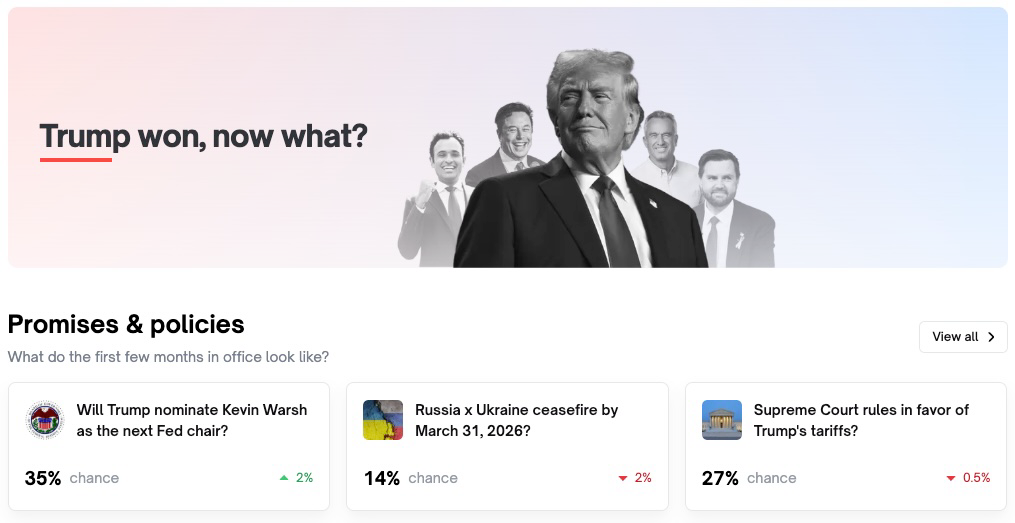
Liquidity plays a critical role in prediction markets. When many participants trade, prices become more accurate because they reflect diverse opinions and information sources. Some platforms rely on automated market makers, which use mathematical formulas to ensure there is always a price available, even when trading activity is low. Others rely more heavily on user-driven order books.
When the outcome of an event becomes known, contracts are settled. Winning contracts typically pay out a fixed amount (for example, $1), while losing contracts expire worthless. This structure incentivizes participants to seek accurate information rather than simply guess outcomes.
Because people are literally asked to put their money where their mouth is, prediction markets are often described as “information markets”.
How sports betting works
In the sports betting vs prediction markets analysis, it’s notable that the former operates on a different but related model.
Bettors don’t trade probability contracts. Instead, they place wagers against a sportsbook, which sets odds on specific outcomes such as game winners, point spreads, or player performance.
Sportsbooks use teams of oddsmakers and data models to estimate probabilities. These odds are designed not only to reflect expected outcomes but also to balance betting activity on both sides of a wager. This allows the sportsbook to minimize risk while earning revenue through a built-in margin known as the “vig” or “juice.”
When a bettor places a wager, in most cases they are not trading with other users. Instead, they’re betting directly against the bookmaker. The sportsbook adjusts odds as bets come in to manage exposure and maintain profitability. Unlike prediction markets, sportsbooks rarely aim to reflect the “true” probability of an event; instead, they aim to manage risk efficiently.
Payouts are determined by the odds at the time the bet is placed. Once the event concludes, winners are paid according to those odds, while losing bets are forfeited.
Sports betting is typically highly regulated and limited to specific jurisdictions. Operators must comply with licensing requirements, responsible gaming standards, and consumer protection rules, which vary widely by region.
Key differences between prediction markets and sportsbooks
When exploring prediction markets vs sports betting differences, it’s worth saying that both systems involve forecasting outcomes. But their structure and incentives differ significantly.
Here are the key 6 differences fleshed out:
1. Pricing mechanisms
In prediction markets, prices emerge from user activity and represent collective probability estimates. In sportsbooks, odds are set by operators and adjusted to manage risk, not necessarily to reflect the true likelihood.
2. Market incentives
Prediction markets reward accuracy. Participants profit when their prediction is correct relative to others. Sportsbooks, by contrast, profit regardless of outcomes as long as betting volume is balanced.
3. Role of the platform
Prediction market platforms act as facilitators, connecting buyers and sellers. Sportsbooks act as counterparties, directly taking the other side of a bet.
4. Risk exposure
In prediction markets, risk is distributed among participants. In sportsbooks, the operator assumes risk and actively manages it through odds adjustments.
5. Regulation
Sports betting is tightly regulated in many jurisdictions, often requiring licenses, taxation, and consumer protections. Prediction markets operate in a more complex regulatory environment, with rules varying significantly by country and use case.
6. User experience
Prediction markets tend to attract users interested in data, forecasting, and probability. Sportsbooks are designed for entertainment, with an emphasis on ease of use, promotions, and event-based engagement.
Before we wrap it up, let’s make something clear: Prediction markets and sportsbooks may appear similar on the surface, but in reality they serve fundamentally different purposes. Prediction markets focus on information discovery, using price signals to estimate the likelihood of future events. Meanwhile, sportsbooks focus on entertainment and risk management, offering structured betting experiences designed for broad consumer appeal. Both are viable and legit. However, if you plan to use them, do so with care and run a thorough research before using any amount of money on any platform of choice.
The material on GNcrypto is intended solely for informational use and must not be regarded as financial advice. We make every effort to keep the content accurate and current, but we cannot warrant its precision, completeness, or reliability. GNcrypto does not take responsibility for any mistakes, omissions, or financial losses resulting from reliance on this information. Any actions you take based on this content are done at your own risk. Always conduct independent research and seek guidance from a qualified specialist. For further details, please review our Terms, Privacy Policy and Disclaimers.
Articles by this author