Ian Freeman of Free Talk Live: how an early Bitcoin media story ended in court
In the early 2010s, Free Talk Live was one of the first radio shows to put Bitcoin in front of a broad U.S. audience. Years later, one of its best-known hosts, Ian Freeman, became the central figure in a federal case over unlicensed money transmission, money laundering conspiracy, and tax evasion.
Before Bitcoin had lobbyists, ETF narratives, and corporate treasury headlines, it had evangelists.
In the early 2010s, Bitcoin still sounded improbable to most Americans who encountered it for the first time. It was internet money, borderless money, money without a central bank. To skeptics, that made it unserious. To believers, it was the future. It spread not through institutions, but through message boards, local meetups, podcasts, and radio shows hosted by people eager to explain why this strange digital experiment mattered.
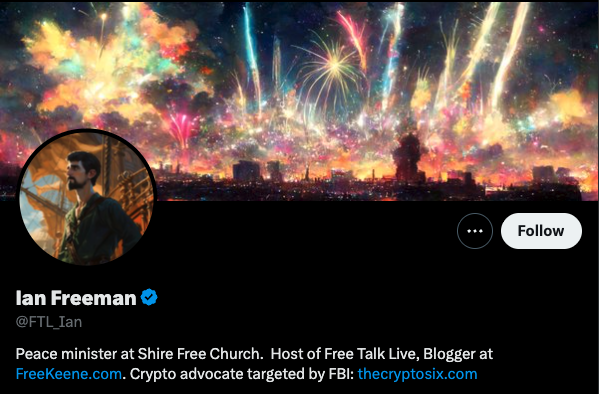
Among them was Ian Freeman, the libertarian broadcaster behind Free Talk Live.
When Bitcoin was still a fringe idea
At a time when most mainstream outlets barely covered Bitcoin, Free Talk Live helped bring it into the broader public conversation. Roger Ver later said he bought national radio ads on the program, calling it “the radio show that I first heard about Bitcoin” and saying it reached roughly 130 stations. In those years, that kind of exposure mattered. Bitcoin did not yet need polished branding or institutional validation. It needed airtime. It needed repetition. It needed people willing to describe it to audiences who had never encountered the idea before.
That was the moment Freeman belonged to: a period when Bitcoin felt as much like a political project as a financial technology. Many of its loudest advocates were not financiers or executives, but activists, hobbyists, ideologues, and broadcasters. The tone was missionary rather than managerial. Bitcoin was framed not simply as an asset, but as a tool for bypassing traditional power structures.
For a time, Freeman fit neatly into that world.
Then the story changed.
The case against Freeman
Federal prosecutors later argued that Freeman’s Bitcoin operation was not just an expression of early crypto idealism, but an unlicensed money-transmitting business that handled funds tied to fraud.
In December 2022, a jury convicted Freeman on charges that included conspiracy to commit money laundering, operating an unlicensed money transmitting business, and tax evasion. The Justice Department said the evidence showed he laundered more than $10 million in proceeds from pig butchering scams and other internet fraud by exchanging U.S. dollars for BTC. Prosecutors also said he failed to register the business with FinCEN and used church-linked financial structures to move customer funds.
The government’s language was blunt. In announcing the conviction, the U.S. Attorney’s Office said Freeman had built “a business that catered to fraudsters.” At sentencing in October 2023, prosecutors noted his conduct had harmed vulnerable victims and involved more than $10 million tied to scams. He was sentenced to 96 months in prison.
Freeman rejected that account. Before trial, he maintained his innocence and described the prosecution as politically motivated, calling the proceedings a “sham.”
From radio host to federal inmate
By the time the case reached the appeals stage, the contrast with Bitcoin’s early media culture had become difficult to ignore.
In a July 29, 2025 opinion, the U.S. Court of Appeals for the First Circuit described Freeman as “a radio talk show host and church founder” who began selling Bitcoin in 2014 and was later convicted on key federal charges involving unlicensed money transmission, money laundering, and tax evasion. The court left the core outcome intact.
Freeman then sought review from the U.S. Supreme Court. That effort ended on Feb. 23, 2026, when the Court denied his petition. With that, the legal fight was effectively over.
What remained was a striking reversal. A figure once associated with Bitcoin’s insurgent media culture had become defined, at least in the public record, by a criminal case and prison sentence.
A story larger than one man
Freeman’s rise and fall reflect something larger than a single legal case. The same anti-establishment culture that helped drive Bitcoin’s early growth also produced some of crypto’s most visible courtroom reckonings.
Sam Bankman-Fried, once one of the industry’s biggest stars, is now serving a 25-year sentence. Celsius founder Alex Mashinsky was sentenced to 12 years. Do Kwon also ended up in U.S. court after the collapse of Terraform Labs. Freeman’s case is different in scale and context, but it belongs to the same broader history: an industry shaped by idealism, rebellion, and, in some cases, criminal prosecution.
The material on GNcrypto is intended solely for informational use and must not be regarded as financial advice. We make every effort to keep the content accurate and current, but we cannot warrant its precision, completeness, or reliability. GNcrypto does not take responsibility for any mistakes, omissions, or financial losses resulting from reliance on this information. Any actions you take based on this content are done at your own risk. Always conduct independent research and seek guidance from a qualified specialist. For further details, please review our Terms, Privacy Policy and Disclaimers.
Articles by this author