OpenAI launches AI browser Atlas, Google stock falls

OpenAI has released ChatGPT Atlas, a web browser for macOS that integrates its chatbot into the browsing window, positioning the product against Google’s Chrome.
The Windows and mobile versions of ChatGPT Atlas are in development. OpenAI says Atlas includes a ChatGPT sidebar that can summarize, compare, and analyze web pages. It also lets users import bookmarks, passwords, and browsing history from other browsers.
With Atlas, ChatGPT can retain context from the websites visited to provide more relevant responses. The browser also includes an “agent mode,” which allows ChatGPT to assist with tasks such as research, analysis, planning, and automation while browsing. The feature is currently available in preview for Plus, Pro, and Business users.
ChatGPT added web search in October 2024, challenging Google Search. The service currently has 800 million weekly users. OpenAI is now the world’s most valuable private company, with an estimated valuation of $500 billion following a $6.6 billion funding round. The launch of its AI browser increases competition in the search space.
Alphabet (GOOGL) stock fell after the announcement, hitting $244 at one point before recovering; it is currently trading at $250.6. The reaction comes despite Google continuing to expand its AI features. Among the new tools, AI Overviews uses Google’s Gemini model to summarize search results and provide answers directly on the page. Google also introduced AI Mode, a chat-style interface that helps users refine searches.
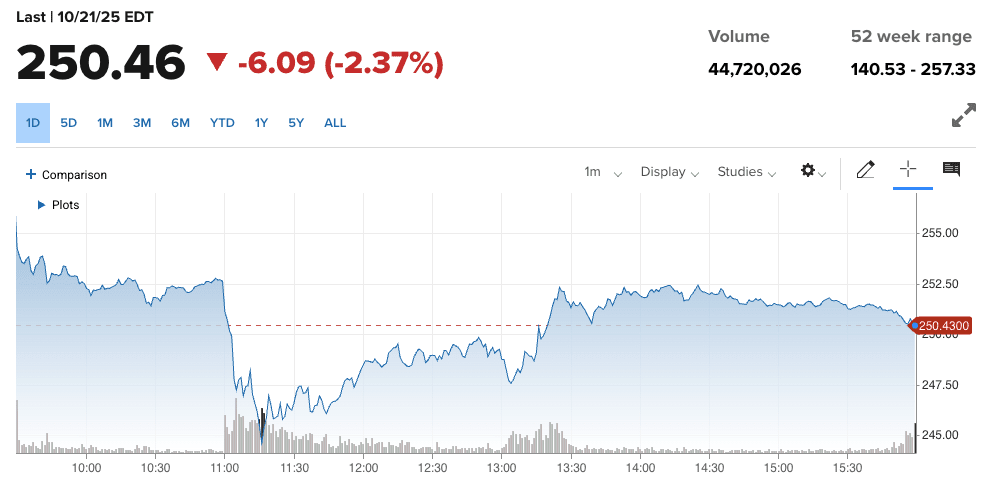
Google stock falls after OpenAI announces AI browser Atlas. Source: CNBC
Other startups and tech companies are adding AI features as well. Perplexity, a startup focused on AI answers, released the Comet browser in July 2025 to help users research the web, get summaries, and automate simple tasks. Privacy-focused browser Brave introduced the Leo AI assistant, and Microsoft added Copilot Search to Bing and Edge.
As AI-powered browsers gain popularity, researchers warn they may be vulnerable to prompt injection attacks. Previously, Brave reported a security vulnerability in Perplexity’s Comet browser. Investor @ecommerceshares wrote on X that such attacks could allow hackers to take control of computers and access users’ brokerage or banking credentials.

Author
Web3 writer and crypto HODLer with a keen interest in market trends and recent technologies.