Ohio grand jury indicts two Chinese firms in fentanyl precursor and crypto laundering case
An Ohio grand jury charged two Chinese drugmakers and six people with trafficking fentanyl precursors and laundering crypto tied to sales, in a case under the FBI’s Operation Box Cutter.
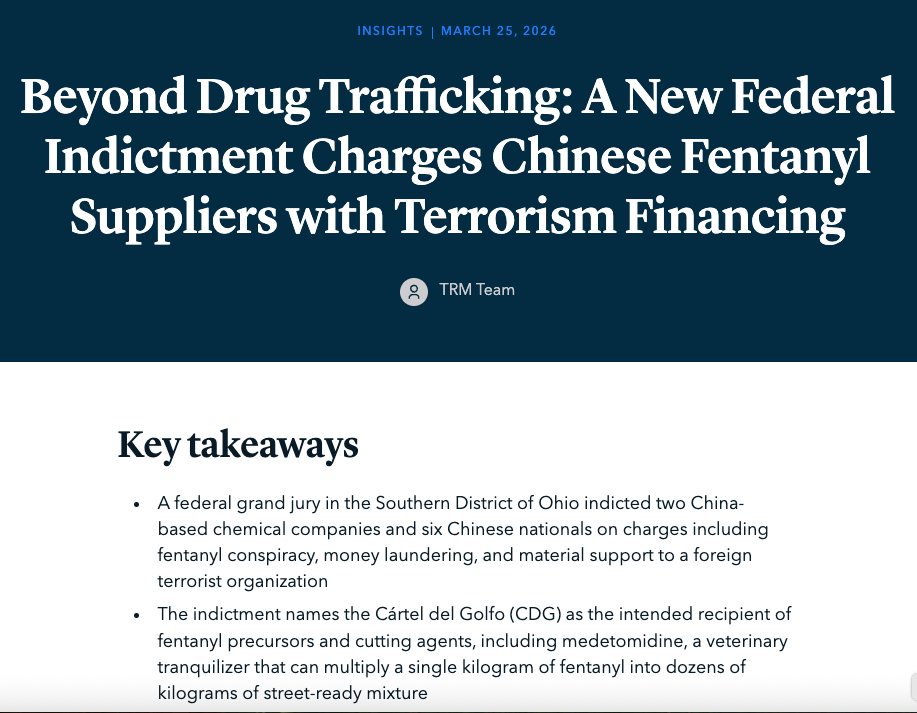
A federal grand jury in the Southern District of Ohio returned an indictment Wednesday charging Shandong Believe Chemical Company Pte Ltd., Shandong Ranhang Biotechnology Co. Ltd., and six Chinese nationals. The charges include trafficking fentanyl precursors and crypto laundering activity.
Prosecutors allege the companies supplied chemical precursors and cutting agents used to make fentanyl and directed customers to pay through crypto wallets under their control. The case falls under the FBI’s Operation Box Cutter, which targets international fentanyl supply networks.
The indictment points to medetomidine, an animal tranquilizer, as a cutting agent the companies marketed to customers they knew were engaged in drug trafficking. Officials assert that one kilogram of fentanyl can be diluted at least twentyfold with this compound, generating millions of street-level doses.
Three of the six individual defendants are also charged with attempting to provide material support to a Mexican drug cartel designated as a foreign terrorist organization. The support relates to chemical supplies and payment facilitation, according to the filing.
Authorities describe cryptocurrency as a key payment channel. Customers were instructed to send stablecoins and other digital assets to collection wallets controlled by the defendants, after which funds were split across multiple addresses and converted to fiat at cross-border off-ramps.
A report released on March 25 by TRM Labs outlines the pattern: “This layering pattern starts with stablecoins received at an initial collection address that are then fragmented and passed through a chain of pass-through wallets, then converted to fiat at a cross-border exit point.”
TRM Labs estimates that about 97% of China-based drug-precursor vendors now accept crypto. On-chain inflows to these vendors reached $39.1 million in 2025, up from $34.7 million in 2024 and $30.9 million in 2023, based on its analysis.
If convicted, the defendants face maximum penalties of up to life in prison on drug-trafficking counts and up to 20 years for money laundering and terrorism-related offenses. The case is being handled in the Southern District of Ohio.
U.S. Attorney Dominick S. Gerace II described the strategy behind the prosecution: “We are going after the entire chain of supply for these deadly drugs, from Mexican cartels and Chinese pharmaceutical companies to the high-level distributors on our streets in the Southern District of Ohio.”
Investigators contend the defendants offered guidance on shipping and payment practices designed to avoid detection. The inquiry remains active. No pleas have been entered, and the court has not set trial dates.
The material on GNcrypto is intended solely for informational use and must not be regarded as financial advice. We make every effort to keep the content accurate and current, but we cannot warrant its precision, completeness, or reliability. GNcrypto does not take responsibility for any mistakes, omissions, or financial losses resulting from reliance on this information. Any actions you take based on this content are done at your own risk. Always conduct independent research and seek guidance from a qualified specialist. For further details, please review our Terms, Privacy Policy and Disclaimers.
Articles by this author