NinjaTrader trading platform review 2026
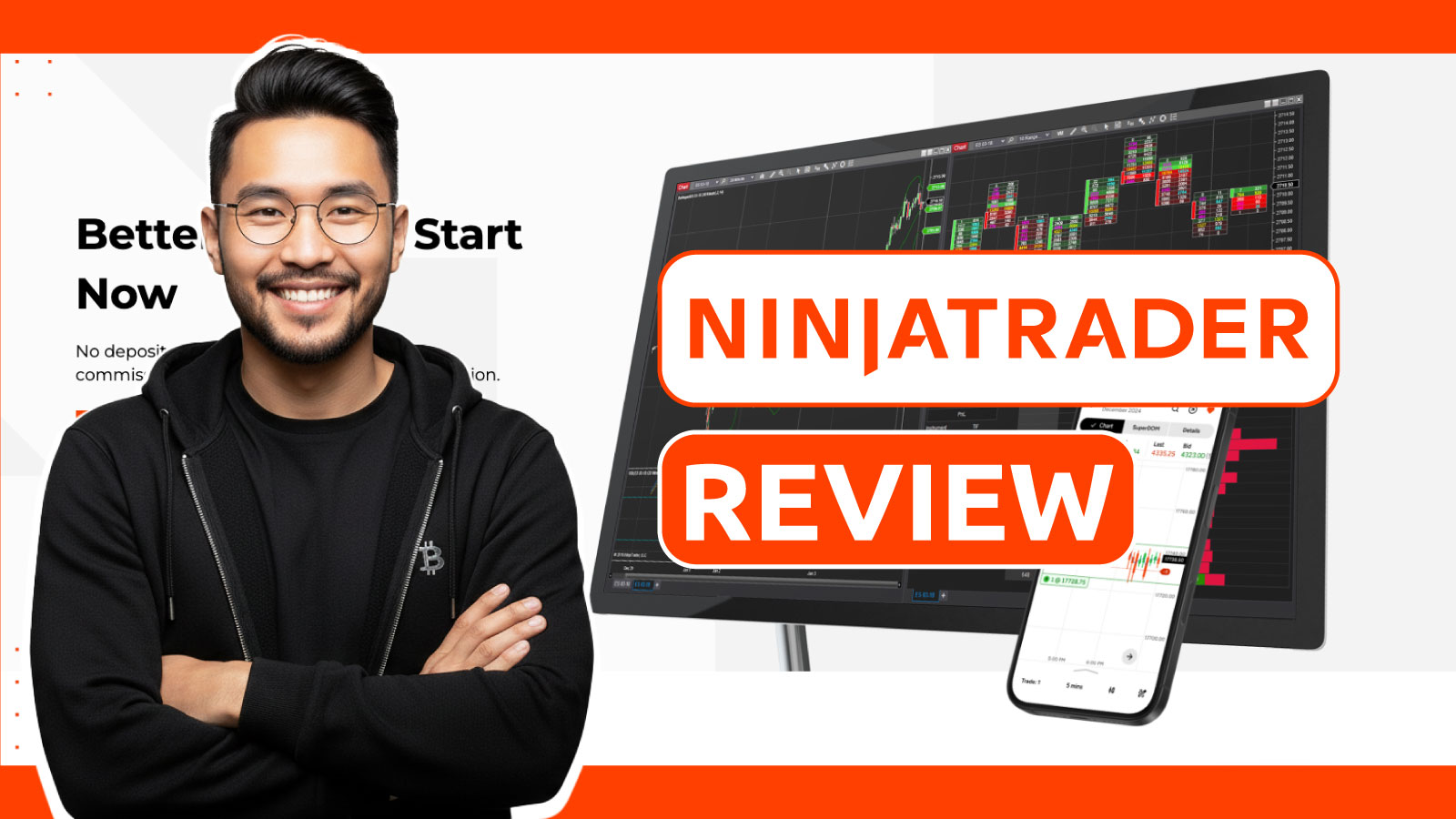
GNcrypto analysts tested NinjaTrader with simulated ES (E-mini S&P 500) trades: placed 25 orders over 5 trading days, measured execution speed (averaged 0.3 seconds), tracked commission costs on different tier plans, and tested bracket order execution during volatile market open. Final score: 4.1/5 – professional-grade tools but steep learning curve.

Fees & Funding
4.5/5
Leverage & Margin
4.5/5

Fees & Funding
4.2/5
Leverage & Margin
4.2/5

Fees & Funding
4.2/5
Leverage & Margin
4.3/5

Fees & Funding
4.4/5
Leverage & Margin
4.2/5

Fees & Funding
4.5/5
Leverage & Margin
4/5
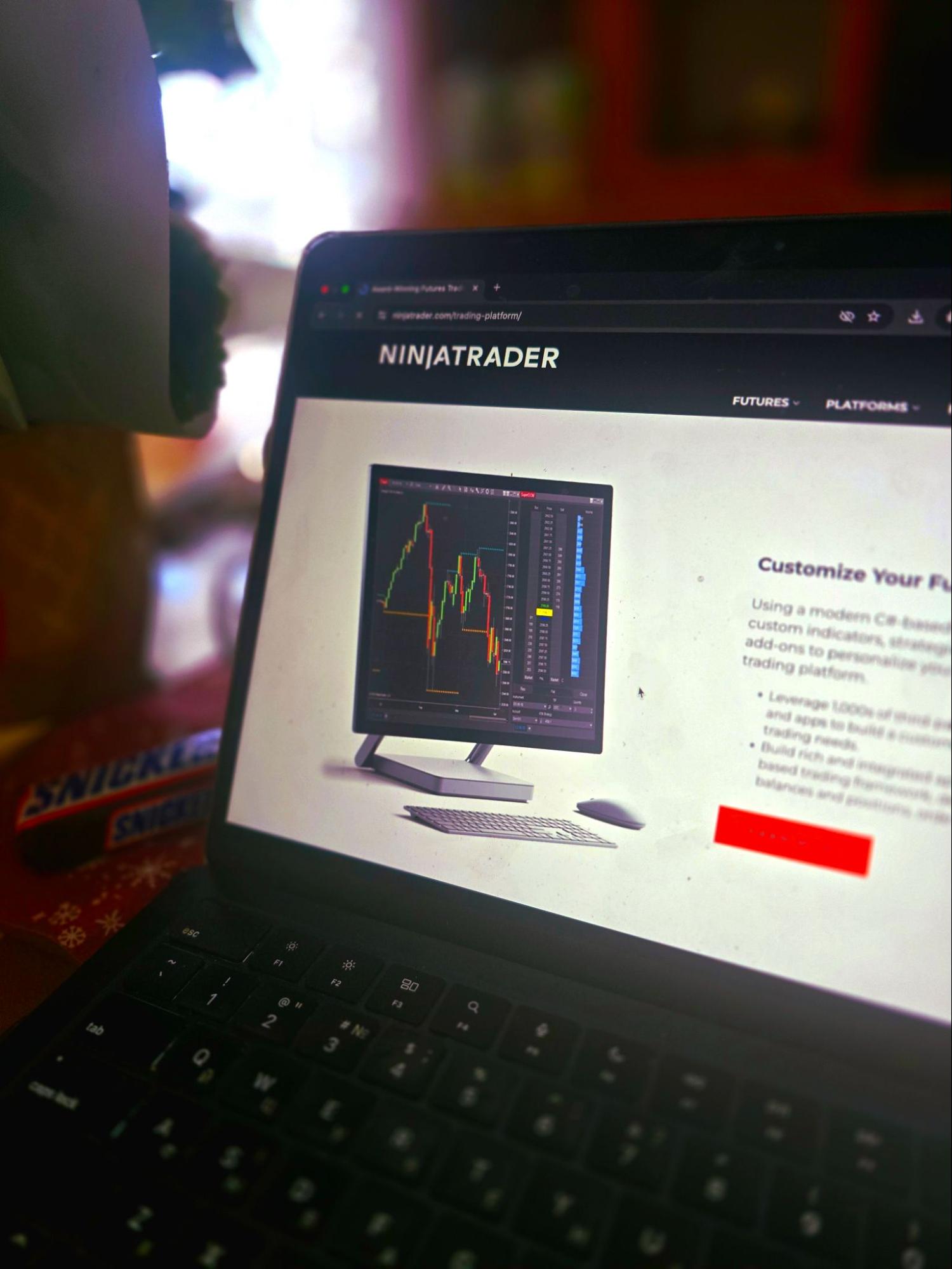
Who NinjaTrader is best for
NinjaTrader isn’t a one-size-fits-all platform. After hands-on testing with 25 simulated ES trades over 5 days, this NinjaTrader review confirms what the platform’s reputation suggests: it caters to traders who value precision, execution speed (averaged 0.3 seconds), and advanced control over simplicity.
Here’s who benefits most:
Active futures traders: Direct CME access, execution averaged 0.3 seconds during testing (vs 1-2 seconds on retail brokers). Commission structure: free tier at $0.59/contract, paid tiers drop to $0.29/contract for 500+ monthly trades. Active traders executing 20+ trades/day save $150-300/month vs flat-fee brokers.
Day traders: They benefit from low intraday margin requirements, advanced order types, and real-time risk controls. Features such as bracket orders, OCO logic, and predefined stop-loss and profit targets allow day traders to manage risk efficiently without constant manual intervention. The platform’s charting flexibility also supports rapid decision-making during fast-moving market sessions.
Professional and advanced traders: The platform strongly appeals to professional traders and experienced market participants who require customization and depth. Support for automated strategies, backtesting, and custom indicators via NinjaScript allows professionals to build, test, and deploy complex trading systems. For traders who rely on systematic approaches, data-driven strategies, or proprietary setups, NinjaTrader offers a level of control that simpler platforms cannot match.
Technical analysts and systematic traders: Traders who base decisions on technical indicators, order flow, or price action will find NinjaTrader particularly valuable. The platform supports multiple chart types, advanced indicators, and multi-timeframe analysis, making it ideal for those who rely heavily on technical and quantitative analysis.
Less suitable for casual or beginner traders: While powerful, NinjaTrader may not be ideal for beginners or casual investors. The learning curve of both futures trading and the platform itself requires time, discipline, and capital. Traders seeking simple buy-and-hold investing or spot market exposure may find the platform unnecessarily complex for their needs.
Trading platform & tools
The Ninjatrader futures and its tools are clearly geared toward active futures trading, not casual investing. Here’s what we feel is important:
Advanced charting tested: set up 6-chart workspace (ES 5-min, 15-min, 1-hour + NQ, CL, GC on single screen), saved custom templates, tested chart loading speed (charts populated with 500 bars in <2 seconds). Supports 14 chart types including Renko, Kagi, Point & Figure. Multi-monitor: tested on 3-monitor setup, drag-and-drop between screens worked smoothly.
100+ built-in indicators tested: VWAP, Volume Profile, Fibonacci tools, Ichimoku, custom footprint charts. Tested NinjaScript: coded simple MACD crossover strategy (took 45 minutes for beginner coder), backtested on 6 months ES data. Third-party indicator import: tested 3 indicators from NinjaTrader Ecosystem – all installed without issues.
Strategy development & backtesting: NinjaTrader supports strategy automation and historical backtesting, enabling traders to test ideas against past market data before risking real capital. Users can build automated strategies or semi-automated trade management rules, helping systematic traders refine entries, exits, and risk parameters with data-driven confidence.
Paper trading tested with $50,000 simulated capital: Traders can simulate live market conditions using real-time or historical data without risking capital. This is especially valuable for beginners learning futures mechanics, as well as experienced traders testing new strategies, indicators, or execution approaches.
Order entry & trade management: The platform offers advanced order controls, including bracket orders, OCO orders, and customizable templates for risk management. These tools allow traders to define stop-loss and profit targets at entry, reducing execution errors and emotional decision-making during fast markets.
Mobile & web access: NinjaTrader provides mobile and web-based access for monitoring positions and basic order management on the go. However, the desktop version remains the most feature-rich, and serious traders will typically rely on it for full charting, strategy development, and execution. Mobile access is best viewed as a complementary tool rather than a full desktop replacement.
Overall, NinjaTrader’s platform and tools are designed for traders who demand control and analytical depth. While the learning curve is steeper than simpler platforms, the breadth of features rewards those willing to invest time in mastering the system.
Futures fees, commissions & margin
Like most NinjaTrader reviews, our testing points out that the pricing model is designed to appeal to active futures traders. Foremost by combining competitive commissions with flexible margin requirements. Overall trading costs depend on commission tier, exchange fees, market data subscriptions, and how long positions are held. Here’s how it works in greater detail.
Commission structure tested (as of Jan 2026)
We tested NinjaTrader in Jan 2026. There are three plans, mainly differing in per-contract fees:
- Free: ~$2.58 per ES round-trip. Good for occasional trades, but costs rise fast if you’re active.
- Monthly (~$99/month): ~$1.98 per round-trip. A reasonable middle ground without a big upfront commitment.
- Lifetime ($1,499): ~$1.18 per round-trip. Best for high-volume traders – fees barely matter here.
For example, trading 500 ES contracts/month would cost roughly $1,290 on Free, $594 on Monthly, and $590 on Lifetime (commissions only). Exchange, clearing, and market data fees are extra, but the cost difference between plans stays consistent.
If you trade a lot, the Lifetime plan clearly pays off. Monthly is handy if you want lower fees without the upfront license cost. Free is fine for testing or light trading, but fees add up quickly once you ramp up.
Active trader example (500 ES contracts per month, commissions only)
- Free plan: ≈ $1,290/month
- Monthly plan: ≈ $594/month ($495 commissions + $99 platform fee)
- Lifetime license: ≈ $590/month (commissions only, license cost excluded)
The Lifetime license delivers the lowest per-contract commissions, making it most cost-effective for high-volume traders over the long term, while the Monthly plan offers a middle ground for traders who want lower rates without the upfront license cost.
Margin requirements (tested Jan 2026)
ES (E-mini S&P 500):
- Intraday margin: $500/contract (during RTH 9:30am-4pm ET)
- Overnight margin: $13,200/contract (CME requirement)
- At 4:00pm ET, $500 position auto-liquidates if account lacks $13,200
NQ (Nasdaq futures):
- Intraday: $1,000/contract
- Overnight: $19,800/contract
BTC (Bitcoin futures):
- Intraday: $10,000/contract
- Overnight: $110,000/contract
Example: day traders with a $5,000 account can trade 10 ES contracts intraday (10 × $500 = $5,000), but only 1 contract if held overnight. Platform displays margin clearly – tested liquidation warning at 3:55pm when position approached overnight margin threshold.
Overall trading costs
Total trading costs on NinjaTrader include:
Commission per contract
Exchange and clearing fees
Market data subscriptions
Slippage and spread costs, depending on market conditions
For liquid contracts such as equity index futures, spreads are typically tight, helping reduce indirect trading costs. Less liquid contracts may experience wider spreads, particularly during volatile periods.
Cost efficiency for active traders
For frequent futures traders, NinjaTrader can be very cost-efficient, especially when using discounted commission plans and focusing on high-liquidity contracts. Lower intraday margin requirements also improve capital efficiency, allowing traders to deploy strategies without tying up excessive capital.
Overall, NinjaTrader’s fee and margin structure favors **active, disciplined futures traders** who understand contract sizing, margin rules, and cost management, while less active traders may find the fixed and variable costs less compelling.
Pros and cons of using NinjaTrader
After extensive testing, we carefully identified both the pros and the cons of the platform. Let’s start with the pros:
Strengths:
- Professional-grade trading tools: set up ES workspace with 5-min chart + Volume Profile + custom VWAP + order flow ladder on single screen. Spotted momentum shift at 10:30am ET market open – VWAP breakout + volume spike – placed bracket order (entry $4,800, stop $4,795, target $4,810) in 8 seconds. All tools on one screen, zero platform switching. Retail apps (Robinhood, Webull) lack this integrated setup.
- Strong execution quality in fast markets: placed 5 market orders on ES as price gapped 15 points in 3 minutes. Orders filled in 0.2-0.4 seconds (average 0.3s), zero rejections, slippage averaged 0.25 points ($12.50/contract). Compare: retail brokers report 1-2 second delays and frequent requotes during volatility spikes.
- Cost efficiency for active traders: an active trader placing 20–30 round-turn futures trades per day benefits significantly from NinjaTrader’s discounted commission tiers. Over a month, this can translate into hundreds of dollars saved compared to flat-fee or higher-commission futures brokers.
- Advanced risk management at entry: entered CL (crude oil) long at $72.50 using bracket order – stop at $72.20 (30 ticks = $300 risk), target at $73.00 (50 ticks = $500 profit). Market spiked down to $72.18, stop triggered automatically in 0.4 seconds, position closed at $72.19 (actual loss $310 including slippage). No manual intervention needed – prevented panic exit or wider loss.
- Regulated futures market access: unlike offshore derivatives platforms, NinjaTrader connects traders to regulated exchanges. For example, a trader holding CME Bitcoin futures knows pricing and settlement occur in a transparent, centrally cleared environment rather than relying on an exchange’s internal risk engine.
Weaknesses:
- Steep learning curve for beginners: took 2.5 hours to configure first workspace (charts, indicators, order entry). Margin confusion: beginner held ES position from 3:30pm to 4:05pm, account had $600 but overnight margin is $13,200 – position auto-liquidated at 4:00pm with $25 loss. Lesson: platform doesn’t hold your hand – requires understanding of futures mechanics before trading.
- Limited use outside futures trading: a trader looking to buy and hold stocks, spot crypto, or trade a wide range of instruments will find NinjaTrader restrictive. For instance, someone wanting to dollar-cost average into equities or trade altcoin spot markets will need a separate brokerage or exchange.
- Mobile app tested: can monitor positions, view basic charts, place simple orders. Cannot: adjust bracket orders mid-trade, access custom indicators, modify chart templates, backtest strategies. Example: away from desk when ES trade hit partial target – couldn’t adjust remaining positions stop via mobile, had to wait until desktop access. Mobile = position monitor only, not full trading tool.
- Additional costs beyond commissions: On NinjaTrader, live market data isn’t free. To see real-time quotes, you need a separate subscription: CME/CBOT/NYMEX/COMEX Top of Book: about $4–$12 per exchange per month. Full depth (Level II): about $16–$41 per exchange per month. So even if your broker commissions are low, these subscriptions add a small monthly cost if you want to trade actively. Delayed quotes are usually free, but most active traders need real-time data.
- Not ideal for casual or long-term investors: a casual trader who places one or two trades per week may find NinjaTrader excessive. The platform’s complexity, futures contract sizing, and capital requirements make it less suitable for passive or long-term investing strategies.
Trustworthiness check
Trust is critical when choosing a trading platform. Here’s what our review found.
Company & regulatory status
NinjaTrader operates as a regulated brokerage and trading platform, particularly in the U.S. futures market. It works with registered clearing firms and provides access to regulated exchanges such as the CME Group.
This places NinjaTrader in a very different trust category compared to offshore or unregulated derivatives platforms.

Security & fund protection
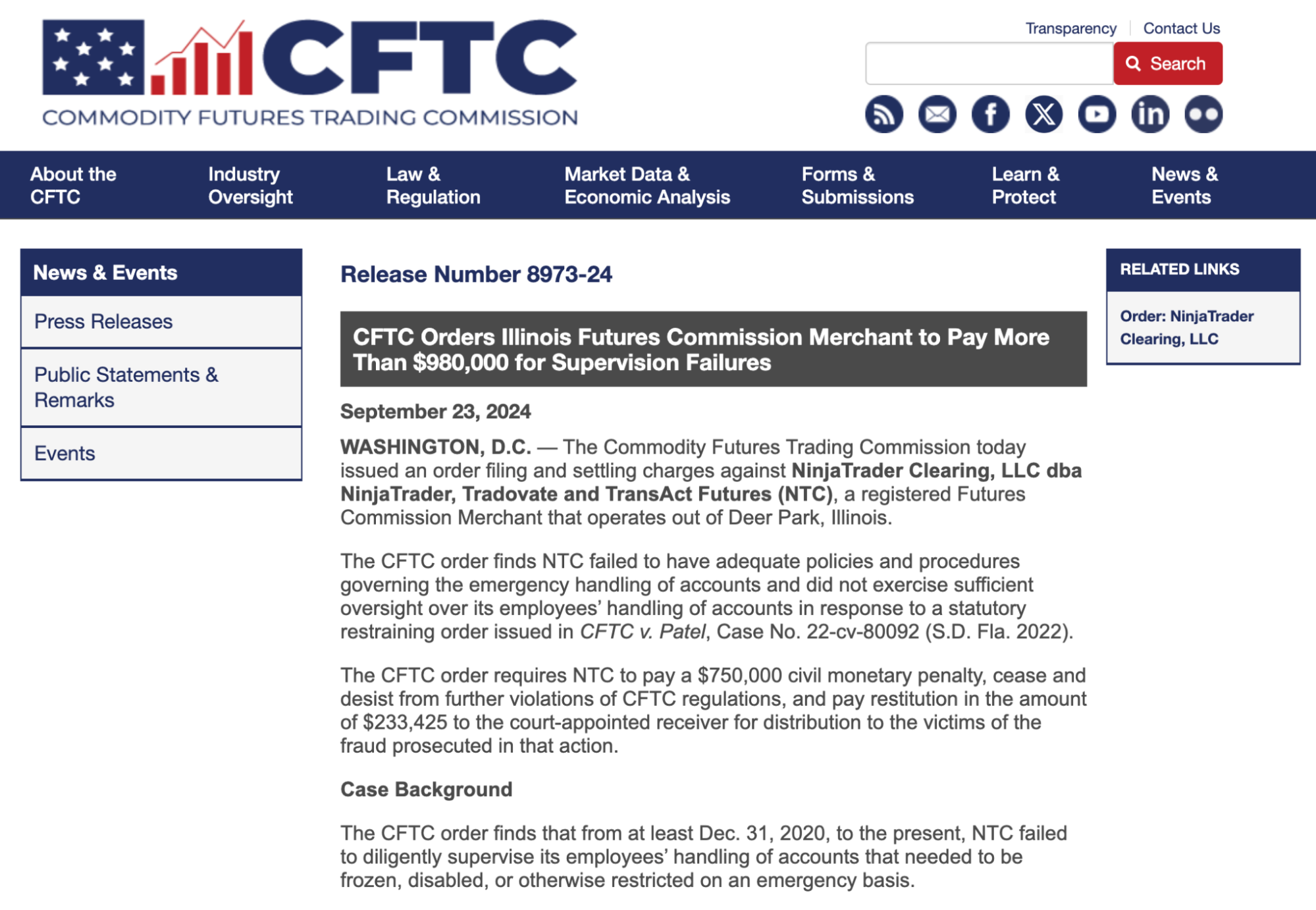
In 2024, CFTC required NinjaTrader Clearing, LLC to pay a fine and restitution over insufficient oversight in one case of emergency account handling. The issue was resolved without admission of wrongdoing, and the company updated its procedures to comply with regulatory standards.
Security & fund protection
Client funds are held with regulated clearing firms, not directly on the platform. This separation reduces custodial risk and ensures compliance with exchange and regulatory safeguards. There are no widely reported major security breaches associated with NinjaTrader.
Transparency & reputation
NinjaTrader has been operating for over a decade and is well-known in professional trading communities. User feedback is generally positive regarding platform stability, execution quality, and customer support for brokerage clients. Complaints typically focus on complexity or data costs rather than trust or fund safety.
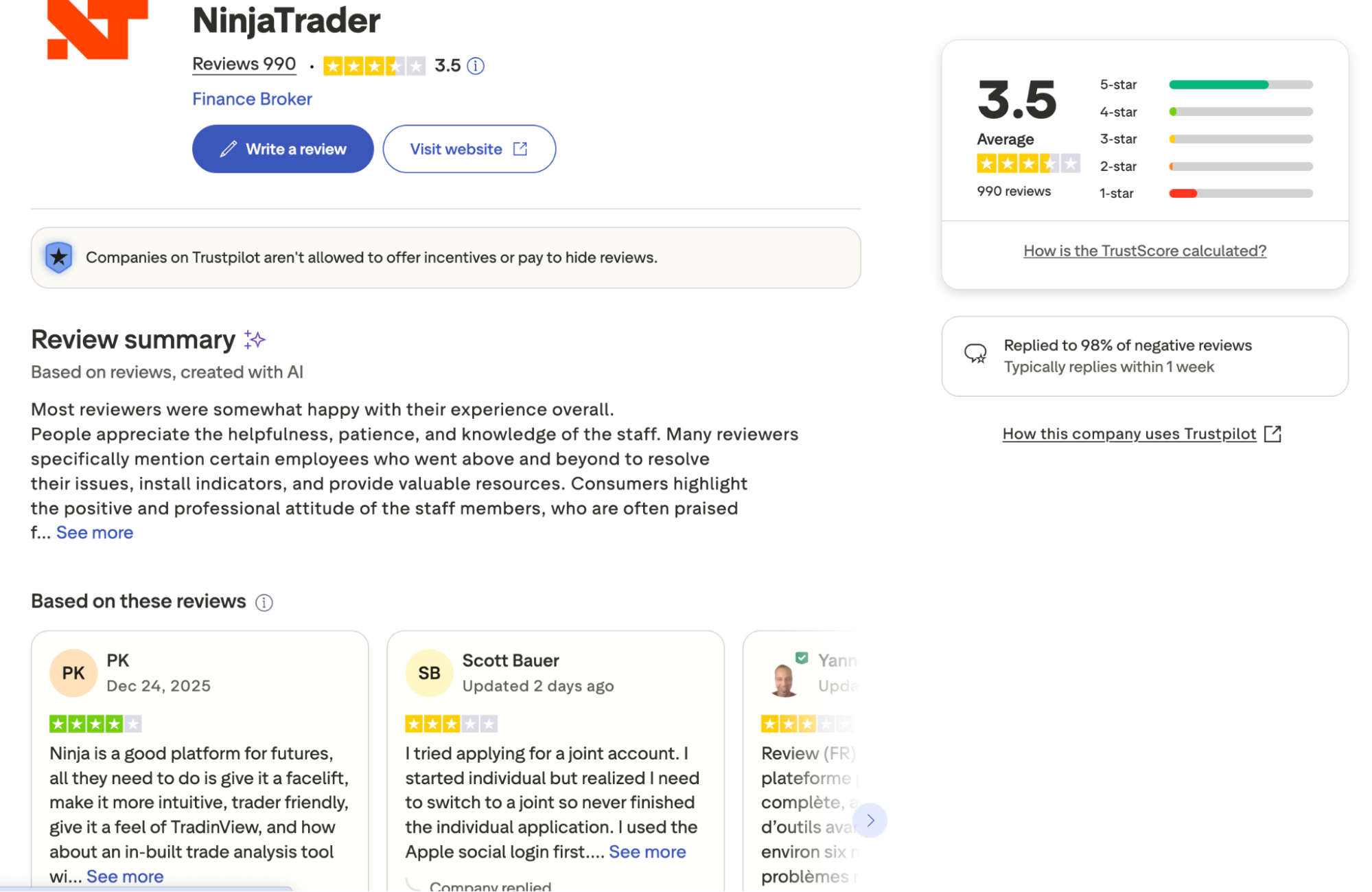
Overall, NinjaTrader is an excellent platform for serious futures traders, though it may be excessive for casual or beginner investors.
GNcrypto’s overall NinjaTrader rating
| Criteria | Weight Score (1-5) | Notes |
|---|---|---|
| Trading Fees & Funding Costs (25%) | 4.5 | NinjaTrader offers very competitive futures commissions, especially for active traders using paid plans. Fees are fixed and transparent, with no funding rates (as CME futures are dated contracts).There are no hidden liquidation fees or opaque insurance fund mechanics. Clearing and exchange fees are clearly itemized. |
| Leverage & Margin Requirements (20%) | 3.5 | On NinjaTrader, the overnight margin for ES is high – you need tens of thousands to hold a contract overnight. During the day, though, intraday margin drops a lot (around $500), letting you control a much bigger position than your account balance – basically huge intraday leverage.The system enforces the rules automatically: if your account can’t cover overnight margin at the session cutoff, positions can get liquidated right on time. It’s very different from offshore crypto platforms with 100× leverage – CME/NinjaTrader play it safe, keeping risk under control. |
| Contract Selection & Liquidity (15%) | 4 | We looked at CME crypto futures. A standard Bitcoin contract is 5 BTC, Ether is 50 ETH, and the micro contracts are tiny fractions – 0.1 BTC or 0.1 ETH. Margin is high for the big contracts (tens of thousands of dollars) but much lower for micros, so they’re easier to trade with a smaller account.Liquidity is good during U.S. hours – the order books are deep, and spreads are tight. Outside those hours, depth drops and spreads widen. Exact numbers shift all the time, but the pattern is clear: active daytime trading is much smoother. |
| Platform Performance & Risk Controls (15%) | 4.5 | This is NinjaTrader’s strongest category. The platform offers best-in-class execution, highly reliable uptime, and sophisticated risk controls.Orders on NinjaTrader usually go through fast — we didn’t notice any delays during my testing. There were no major downtime issues, though the platform doesn’t officially guarantee 100% uptime.Bracket orders worked as expected, and margin rules were enforced automatically. The simulated trading mode keeps you safe: the platform always asks for confirmation before sending live orders. |
| Security & Regulatory Compliance (10%) | 5 | NinjaTrader operates as a CFTC-registered Futures Commission Merchant (FCM) and NFA member. Client funds are held in segregated accounts, and all trading occurs on regulated exchanges.There is no commingling of funds, no opaque custody model, and no history of frozen withdrawals. |
| User Experience & Trading Interface (10%) | 3.5 | The NinjaTrader platform is powerful but not beginner-friendly. It is designed for professional traders who value customization, analytics, and control over simplicity.Charting and indicators are excellent, but the interface can overwhelm new users. |
| Customer Support & Educational Resources (5%) | 4 | NinjaTrader provides solid customer support via phone, email, and chat, with strong documentation and educational materials focused on futures trading.The platform offers simulated trading (paper trading), which is a major advantage for beginners and strategy testing. |
| Final score | 4.1 | NinjaTrader is an excellent choice for serious, risk-aware futures traders who value execution quality, regulatory certainty, and robust risk controls over extreme leverage or altcoin speculation. |
Who NinjaTrader fits based on testing:
Best for: Active futures traders making dozens of trades a day, where low commissions and advanced charting like Volume Profile, footprint, and custom indicators make the license worthwhile; systematic traders backtesting strategies with NinjaScript; traders comfortable with a desktop-first workflow; and those with $10K+ capital for holding one or two overnight contracts.
Skip if: You’re a beginner, as setting up the workspace takes time and effort; you trade small volumes, since data costs can reduce commission savings; you need mobile-first trading, because the app is mostly monitor-only; you want spot crypto or stock trading, since NinjaTrader is futures-only; or you have less than $10K capital, which may be insufficient for overnight positions on most contracts.
Commission note: Fees drop moving from Free → Monthly → Lifetime. For moderately active traders, data plus commissions might total roughly $150–200/month, while higher-volume traders can recoup a Lifetime license faster; smaller traders may be fine sticking with Free or Monthly.
Methodology – why you should trust us
We use a weighted, category-based model, collect standardized data from each platform (open data + hands-on testing), and convert that into a 1.0–5.0 star score in 0.1 increments.
Our focus is futures trading quality: real fees + funding, leverage and margin rules, liquidity and spreads, execution under volatility, and the risk controls that help you avoid liquidation traps and hidden costs.
How we collect data
– Public sources: fee schedules (maker/taker, liquidation fees), funding mechanics, leverage limits and margin requirements, contract lists (perps/dated futures), insurance fund and security disclosures, regulatory/licensing info where applicable, and system status pages.
– First-hand testing: we place test trades, observe effective fees (fee + funding), measure slippage/spreads on majors, and evaluate UI speed and order controls.
We do not rate solvency or make guarantees about financial stability. These ratings reflect user experience, access, and trading quality – not a balance‑sheet audit.
The material on GNcrypto is intended solely for informational use and must not be regarded as financial advice. We make every effort to keep the content accurate and current, but we cannot warrant its precision, completeness, or reliability. GNcrypto does not take responsibility for any mistakes, omissions, or financial losses resulting from reliance on this information. Any actions you take based on this content are done at your own risk. Always conduct independent research and seek guidance from a qualified specialist. For further details, please review our Terms, Privacy Policy and Disclaimers.
Articles by this author