NinjaTrader alternative 2026: top low cost trading platforms we tested
Our team tests five NinjaTrader alternatives on real and paper accounts. We look at execution speed, charting, automation tools and total trading costs to see which platforms work better than NinjaTrader for futures, day trading and longer term strategies.

Fees & Funding
4.5/5
Leverage & Margin
4.5/5

Fees & Funding
4.2/5
Leverage & Margin
4.2/5

Fees & Funding
4.2/5
Leverage & Margin
4.3/5

Fees & Funding
4.4/5
Leverage & Margin
4.2/5

Fees & Funding
4.5/5
Leverage & Margin
4/5
GNcrypto’s verdict: best NinjaTrader alternatives 2026
After testing five platforms on demo and live accounts, our ranking looks like this:
Best overall: Interactive Brokers (4.7/5)
Global market access, low commissions on futures and stocks, plus the TWS platform and API. A solid primary platform if you’re willing to set up the interface and margin once and then leave it alone.
Runner-up: Optimus Futures (4.5/5)
A pure futures broker with low fees and flexible intraday margin on micro contracts. A strong choice if you trade futures only and don’t need stocks and options in the same account.
Third option: Webull (4.2/5)
Stocks, options, crypto, and futures in one app, zero commissions on U.S. stocks, and clear, readable charts. It lacks the depth of professional terminals but stands out for its simple mobile interface.
Specialized pick: TradingView (4.3/5)
Not a broker, but a terminal layered on top of existing accounts. Offers solid charts, Pine scripts, backtesting, alerts, and chart-based trading through connected brokers.
Quick decision framework:
- Global multi-asset trading? → Interactive Brokers
- Futures only, intraday and micros? → Optimus Futures
- One mobile app for stocks, options, crypto and some futures? → Webull
- US-based, want a simple web platform for CME futures with fixed fees? → Plus500 Futures
- Already have brokers, need a single advanced terminal with scripts and alerts? → TradingView
Full breakdowns below.
Why consider alternatives to NinjaTrader
In our view, NinjaTrader remains one of the stronger platforms for futures trading, with low commissions, flexible margin requirements, no minimum deposit, and an advanced terminal featuring SuperDOM and backtesting. It works best for traders focused exclusively on futures.
That same specialization and complexity, however, is why many traders eventually start looking elsewhere.
NinjaTrader’s core product lineup is almost entirely futures. Access to stocks and other markets requires external brokerage accounts. The desktop platform officially runs only on Windows, while the mobile app and overall interface are often criticized for being cluttered and difficult for beginners to navigate.
There is also the issue of hidden ownership costs: paid market data subscriptions, paid add-ons, an inactivity fee of around $25 after just one month, and higher fees for bank transfers.
During our testing, we found that NinjaTrader’s strengths are best realized by experienced futures traders with consistent volume and a clearly defined strategy. For those who trade less frequently, are still learning, or want to combine futures, stocks, options, and crypto in one place, the total cost of the platform, data, and fees can become unexpectedly high. Technical limitations remain as well, with Mac users forced to rely on workarounds.
As a result, searching for NinjaTrader alternatives is a logical step for traders who need a more versatile platform with a clearer, more predictable cost structure.
Comparing the best NinjaTrader alternatives
Optimus Futures stands out as a dedicated futures broker among NinjaTrader alternatives.
In our tests of Optimus Futures, Plus500 Futures, Webull, Interactive Brokers, and TradingView, we focused on how each one handles specific scenarios: short-term futures scalping, stock trading from a mobile app, options trading, or pure analysis and alerts.
We break down each platform and show where it can realistically replace NinjaTrader and where it works better as a complementary tool.
Optimus Futures
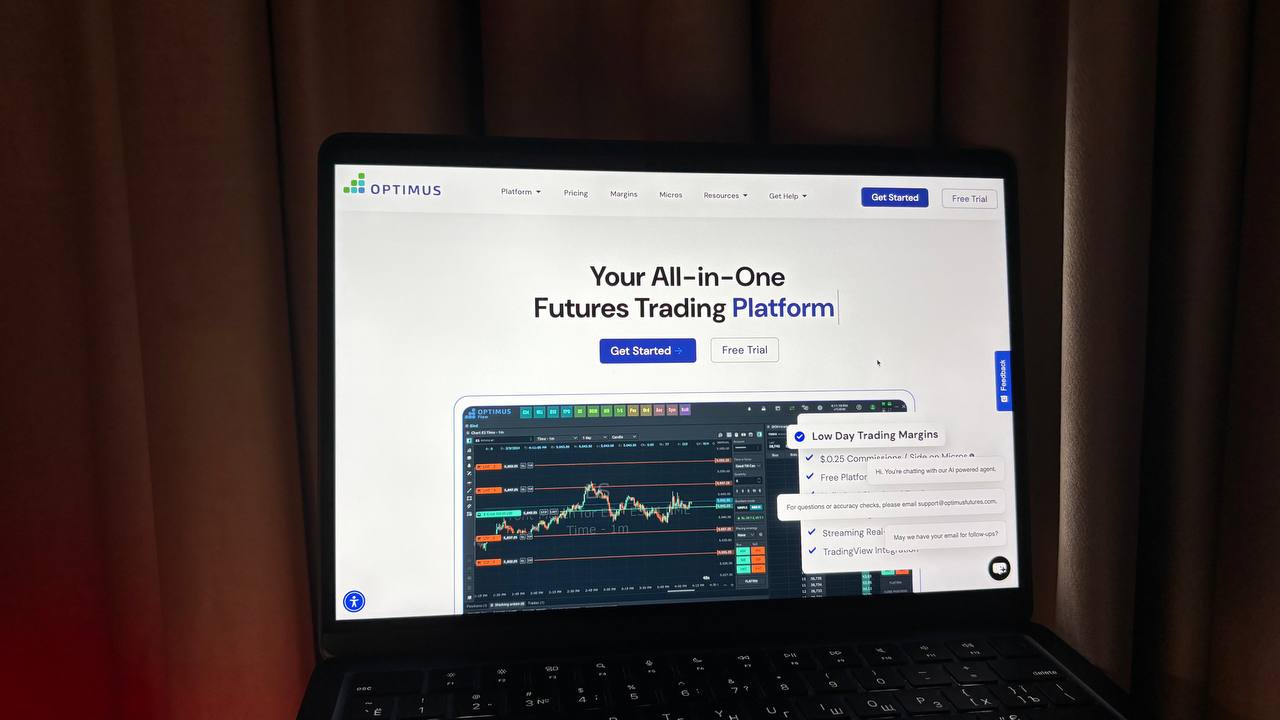
Among the most notable alternatives to NinjaTrader, we would highlight Optimus Futures as a dedicated futures broker. In our tests with Optimus Flow, we used standard candlestick charts from 1 minute, tick and volume charts, along with volume profile and DOM. For short-term trades in micro futures, this toolkit is sufficient: you can see order flow, the tape, and intraday price reactions without paying for a separate premium terminal.
Benefits
During testing, we valued the combination of low commissions on micro contracts and flexible intraday margins. Even a small account can hold multiple positions at once without running into margin constraints. Optimus is also not locked to a single platform: in addition to Optimus Flow, you can connect TradingView, Sierra Chart, and other terminals.
Limitations
A futures-only broker. Stocks, options, and spot crypto are not available in the same account, so these asset classes require separate accounts with other brokers. Deposits and withdrawals are handled mainly via bank transfers, which makes frequent fund movements more expensive for small accounts than with retail apps that support card payments.
Best for
Traders who trade futures regularly, treat commissions and margin as key factors, and are comfortable keeping futures strategies separate from stock and crypto portfolios.
Strengths:
- Low futures commissions with volume discounts and no platform fees.
- Some of the lowest day margins on micro contracts (from $50), making it easier to test strategies in live markets.
- Multiple platform options: the native Optimus Flow, plus integrations with TradingView, Sierra Chart, MetaTrader 5, and others for different trading styles and automation.
- Strong focus on service and personal support, including phone and email assistance, platform setup help, and risk management guidance for newer futures traders.
Weaknesses:
- Futures only: if you need stocks, options, or crypto in a single terminal, you’ll need separate accounts with other brokers.
- Wire withdrawals cost $20–60, which makes frequent withdrawals expensive for smaller accounts.
Plus500 Futures
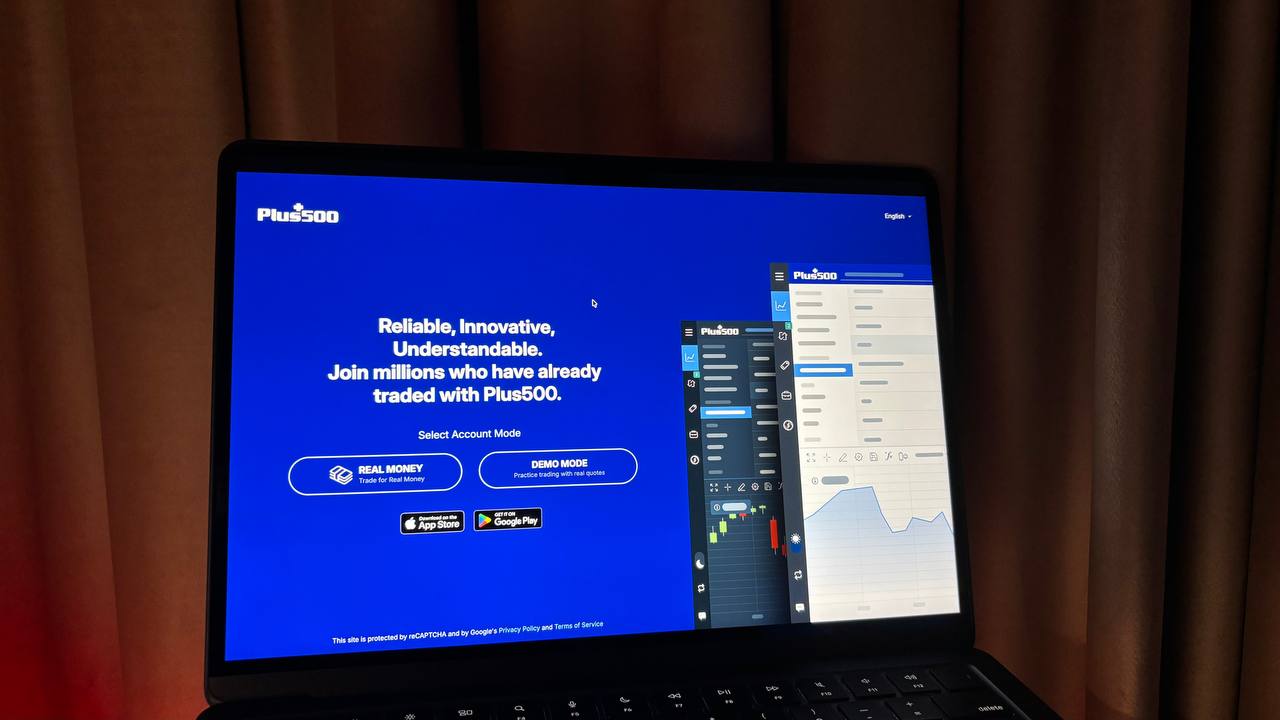
Plus500 Futures is a futures broker for retail traders in the US. Launched in 2022, the platform is positioned as a simplified entry point into regulated futures: standard, mini, and micro contracts on indices, commodities, FX, and Bitcoin via a web terminal and mobile app, with no separate fees for the platform or market data.
Benefits
Each trade includes a broker commission plus exchange and regulatory fees of a few cents per contract, but there are no separate subscriptions for quotes, no terminal fees, and no hidden platform charges. Getting started requires a minimum deposit of $100, the demo account runs directly in the browser with no desktop installation, and the interface feels closer to retail trading apps than to heavyweight professional terminals.
Limitations
In our tests, we found no advanced strategy builder, API, or environment for full automation like those offered by professional platforms. Intraday margin requirements are set via a table and change dynamically, and a forced liquidation fee of $10 per contract applies, so trading without close control of leverage and margin can be risky.
Best for
US-based traders who want a straightforward way into regulated futures, clear pricing, and no subscriptions for platforms or data, and who do not need advanced automation or deep workspace customization.
Strengths:
- Fixed commissions: $0.49 per micro contract and $0.89 per standard and E-mini contract per side, with no platform, data, or inactivity fees.
- Only additional costs are exchange, clearing, and regulatory fees of about $0.02 per contract, making total trade costs easier to calculate than multi-tier pricing at traditional brokers.
- Access to liquid US futures markets: equity indices, commodities, FX, and crypto contracts, plus recently added event-based contracts tied to macro and market events.
- Regulatory setup: trading is routed through Cunningham Commodities LLC, an FCM registered with the CFTC and a member of the NFA; the Plus500 Group is listed in the FTSE 250 and operates under multiple regulators.
Weaknesses:
- Manual trading only: there is no full-featured API or environment for building trading bots, so complex systematic strategies require other platforms.
- Strict margin and auto-liquidation rules: positions are closed with a fixed $10 per contract fee when requirements are breached, which can be costly if leverage is mismanaged frequently.
Webull
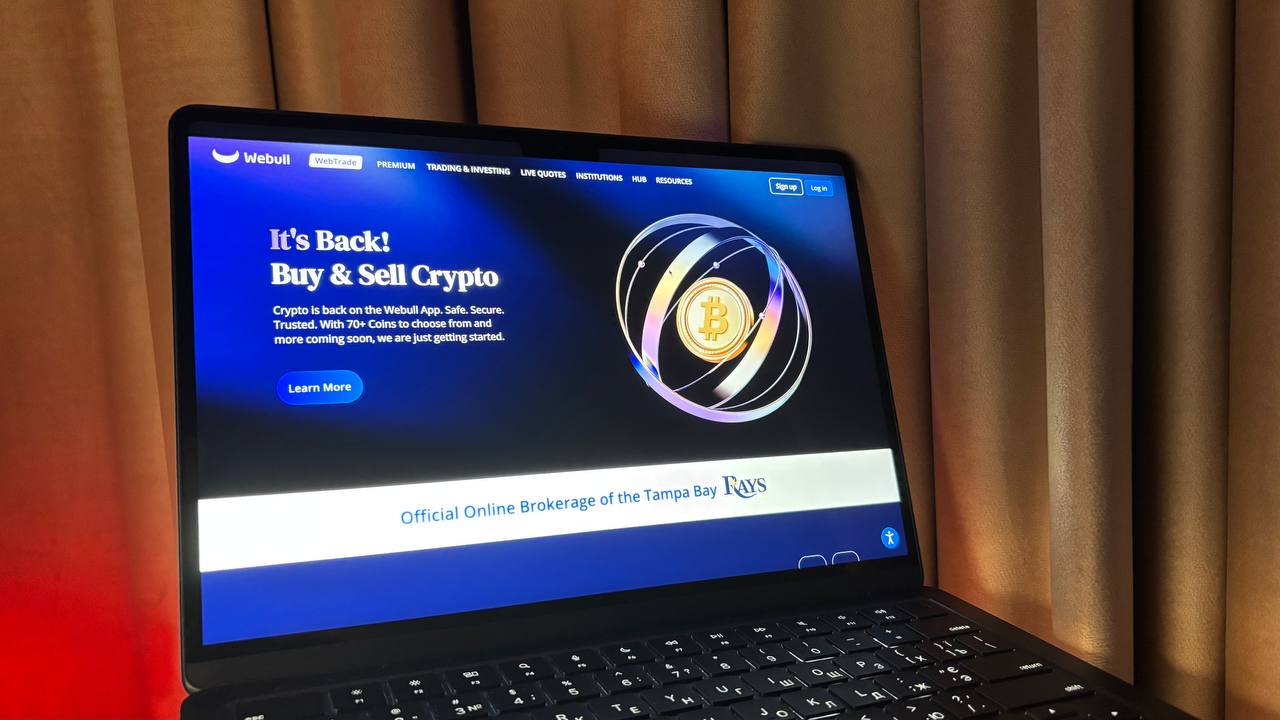
In our experience, Webull works best as a multi-asset platform that brings stocks, ETFs, options, futures, and crypto into a single app. In our tests, we used both the desktop and mobile versions: opening and closing US equity positions, trading micro futures, and running paper trading to see how easily the same strategy carries across asset classes.
Benefits
Within one account, Webull provides access to US stocks, more than 3,300 ETFs, options, OTC securities, and futures, with zero broker commissions on stocks, ETFs, and most options. For futures, our tests showed commissions starting at $0.25 per micro contract and about $1.25 per standard contract, which is competitive for a retail platform.
Limitations
Unlike specialized futures terminals, Webull offers limited workspace customization and no environment for building complex coded strategies. Algorithmic trading and custom bots must be handled elsewhere. Intraday margin is reduced during the session, but at 4:15 PM EST margin requirements automatically reset to full exchange levels. If the account balance falls short at that time, positions may be force-closed.
Best for
Traders who want a single platform for stocks, options, futures, and crypto, with zero commissions on US equities and solid charting, and who do not need a complex automated trading setup.
Strengths:
- Unified access to US stocks, ETFs, options, OTC securities, futures, and cryptocurrencies within one ecosystem.
- Zero broker commissions on US stocks, ETFs, and most options, with no platform fees.
- Advanced charting with 50+ indicators, dozens of technical signals, Chart Trading, and a customizable desktop terminal.
- Paper trading for strategy testing and review, available on both desktop and mobile.
- Futures trading with reduced intraday margin and support for micro contracts and crypto futures (via Coinbase Derivatives), lowering the capital threshold.
Weaknesses:
- No full-featured environment for developing and testing complex algorithmic strategies; the platform is geared toward manual and semi-automated trading.
- Intraday margin rules require discipline: positions must be closed before the session ends or the account must meet full exchange margin, or auto-liquidation may occur.
Interactive Brokers
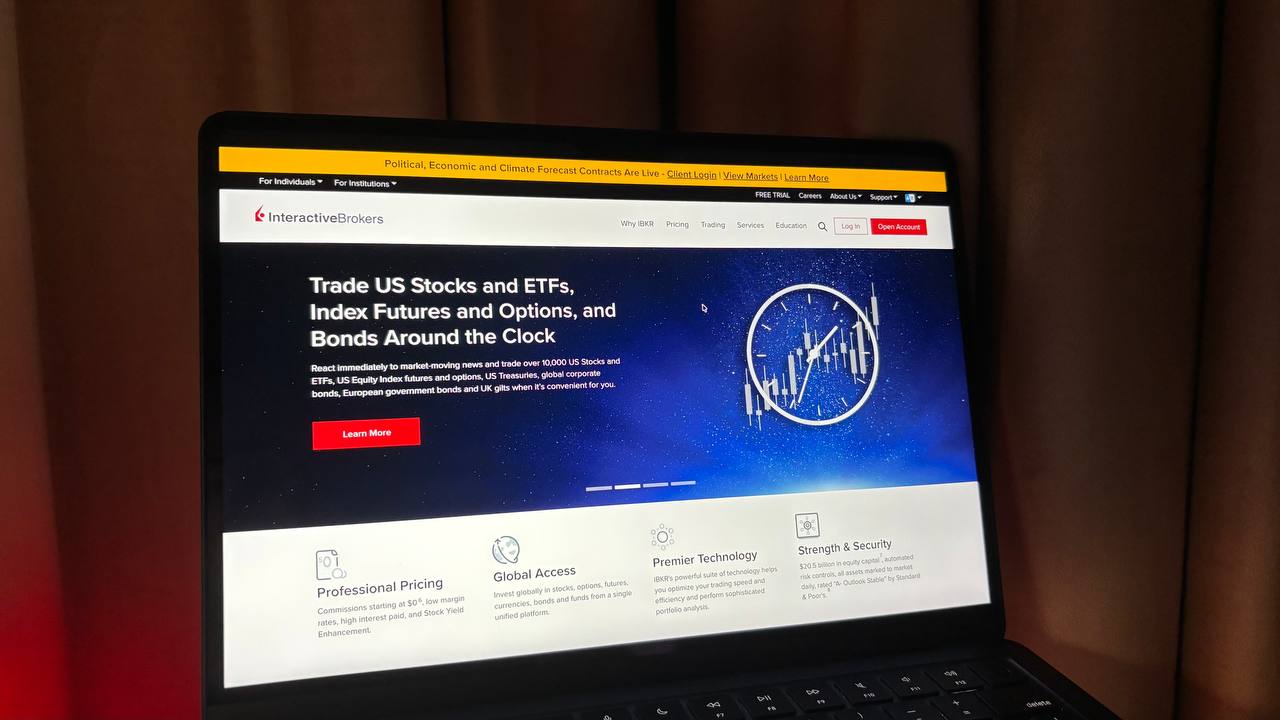
We viewed Interactive Brokers as the most heavyweight broker in the lineup: global market access, low futures commissions, and the professional Trader Workstation terminal. In our tests, we traded index micro contracts, US stocks, and options from a single account to see how smoothly we could move between asset classes without relying on separate platforms.
Benefits
A single account provides access to futures, stocks, bonds, and options across dozens of exchanges, with futures and equity commissions closer to institutional levels than typical retail apps.
Limitations
Account opening takes longer due to detailed questionnaires, document checks, and occasional compliance follow-ups. Trader Workstation is dense with settings, and without a solid grasp of order types, routing, and margin rules, it is easy to misjudge position size.
Best for
Experienced traders who want one broker for futures, stocks, and options across global markets and are willing to invest time in configuring the terminal and risk parameters.
Strengths:
- Futures commissions of about $0.25–0.85 per contract, depending on the exchange, with no separate platform fee.
- One account covers dozens of futures exchanges and hundreds of markets across stocks, ETFs, options, and bonds.
- Trader Workstation includes depth of market, time and sales, a wide range of order types, an options module, and built-in execution algorithms.
- API access with Python support, allowing custom bots and integration with external systems.
- No minimum deposit and no inactivity fees on standard accounts, making it possible to keep a small balance without paying for downtime.
Weaknesses:
- Steep onboarding and a complex terminal: compared with Webull or Plus500 Futures, the interface and settings require time to learn, or many features will go unused.
- Paid market data subscriptions for some exchanges and strict auto-liquidation rules increase the need for tight position control, as leverage mistakes can quickly lead to forced market closures.
TradingView
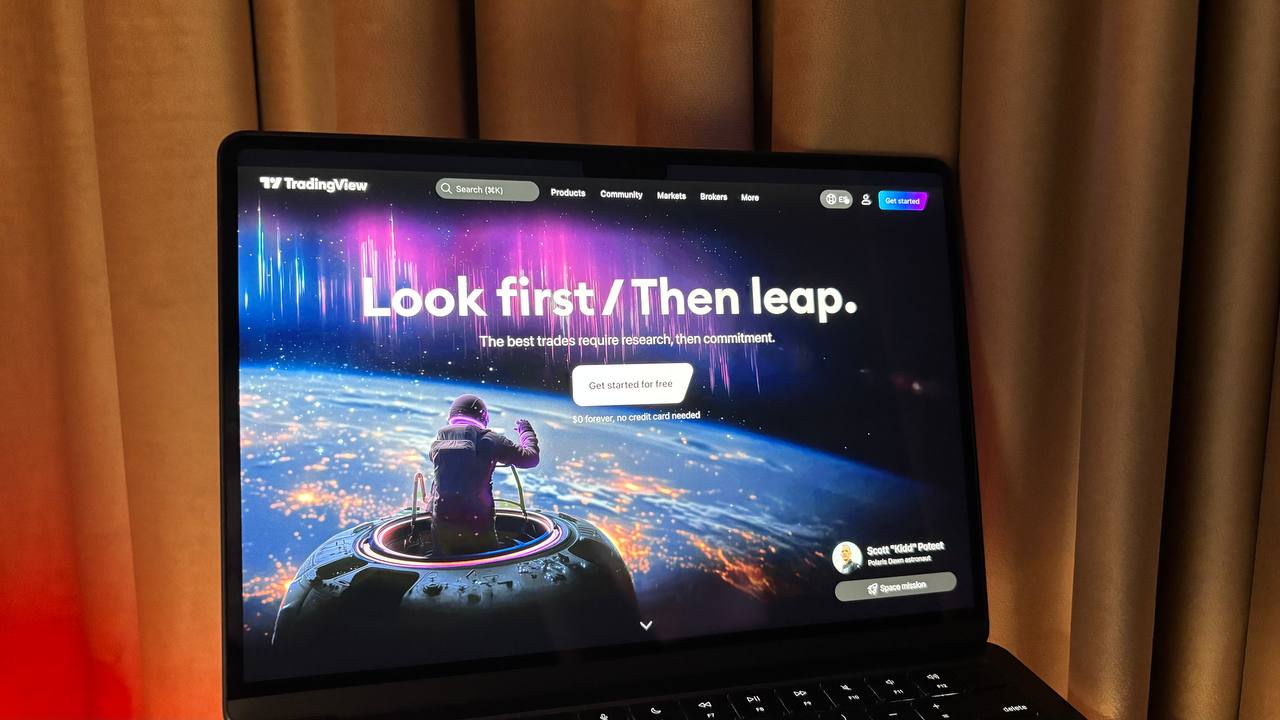
In our TradingView tests, we built workspaces with futures, stocks, and crypto, connected brokerage accounts via the Trading Panel, and placed trades directly from charts. Orders are created on the chart, while execution happens on the connected broker’s side. TradingView itself remains a web-based terminal with desktop and mobile apps, not a broker.
Benefits
TradingView works well as a central terminal. With 20+ chart types, volume profiles, dozens of drawing tools, and more than 400 built-in indicators, it supports everything from intraday setups to long-term technical analysis.
Limitations
You still need a brokerage account to trade. TradingView only links charts and the trading panel to external brokers. The partner list is broad but does not cover every region or account type, so some local brokers cannot be connected. Real-time futures data and quotes from some exchanges require paid subscriptions. By default, many markets are delayed by 10-15 minutes, and CME, NYMEX, and EUREX data require separate monthly fees.
Best for
Traders who want a single advanced terminal that works across multiple brokers and markets.
Strengths:
- Around 20+ chart types, from classic candlesticks to Renko, Heikin Ashi, TPO, and session-based volume profiles, all configurable within one workspace.
- More than 400 built-in indicators and strategies, plus over 100,000 public community scripts that can be added with one click.
- Pine Script for building custom indicators and strategies, backtesting them on historical data, and reviewing performance statistics in the tester.
- A flexible alert system with signals based on price, indicators, Pine scripts, and even automatically detected chart patterns.
- Direct integration with dozens of brokers, enabling trading in stocks, forex, crypto, and futures directly from charts, with support for switching between brokers or connecting several at once.
Weaknesses:
- Real-time data for many exchanges, especially futures, requires paid subscriptions. Without them, quotes are delayed by 10-15 minutes, which limits intraday trading.
- The platform does not replace a broker. Separate accounts are required, margin rules and commissions depend on third parties, and some regional brokers and account types cannot be connected.
Top NinjaTrader alternatives based on traders goals
When choosing a NinjaTrader alternative, it makes more sense to start with your use case rather than the brand. If your focus is strictly on futures and commissions and margin requirements matter most, Optimus Futures or Plus500 Futures are the more logical options.
If you need a single setup for stocks, options, and futures, Webull and Interactive Brokers can fill that role. TradingView is a separate case altogether. It is not a broker, but a terminal that sits on top of existing accounts and adds solid charts, Pine scripts, and alerts.
Top NinjaTrader alternatives – Quick comparison
| Exchange | Standout | Fees | Assets | Fiat | PoR | Best for |
|---|---|---|---|---|---|---|
| NinjaTrader | Pro futures desktop, deep ES tools | ES about $1.18-2.58 round trip depending on plan; separate market data | CME futures and options, no spot or stocks | ACH, debit card, wire, checks | CFTC/NFA regulated FCM, client funds segregated at clearing firms | High volume futures and day traders who want full DOM and strategy tools |
| Optimus Futures | Low intraday margins, multiple pro platforms | From $0.25 per side on micros, $0.75 on standard contracts, volume discounts possible | Futures on CME, ICE, Eurex and major US, EU, Asia exchanges | Bank wire, ACH, physical checks; no cards or wallets | CFTC and NFA regulated introducing broker, funds held segregated at FCMs | Cost focused intraday futures traders who want choice of desktop terminals |
| Plus500 Futures | Simple US focused browser platform for CME futures | $0.49 micro / $0.89 standard per side; $0 platform and data fees | Mini and micro futures on FX, indices, commodities, rates, plus a few crypto contracts | Bank transfer, debit cards, Apple Pay, Google Pay, some fintechs like Revolut/Wise; no broker deposit fees | Clearing via Cunningham Commodities FCM, CFTC and NFA supervised | US traders who want low minimums and a straightforward web interface for regulated futures |
| Webull | App first broker combining stocks, options, crypto and CME futures in one account | $0 commissions on US stocks, ETFs and options; futures about $1.25 standard, $0.25 micro per contract | US stocks, ETFs, listed options, OTC, a large crypto list and CME/crypto futures | USD ACH and bank wire funding; region specific local bank rails | SEC registered broker dealer, FINRA and SIPC member | US based multi asset traders who want one mobile app for equities, options, crypto and some futures |
| Interactive Brokers | Global market access with very low tiered commissions and DMA style tools | US futures roughly $0.25-0.85 per contract depending on volume and pricing plan | 170+ markets worldwide in stocks, options, futures, forex, bonds and ETFs | Multi currency bank transfers and ACH, no cash or card deposits | Supervised by SEC and CFTC, member of FINRA, NFA and SIPC, segregated commodities funds | Experienced traders and investors who need global exchanges, portfolio margin and advanced risk controls |
| TradingView | Advanced charting and scripting terminal that connects to 100+ partner brokers | No trading commissions; free and paid subscriptions for charts and data, broker fees charged separately | Via connected brokers: stocks, forex, crypto, futures and more | No own deposits or withdrawals; all funding happens at the linked brokerage | Not a broker, holds no client funds; safety depends on the connected regulated broker | Traders who want one analytics and execution terminal on top of existing broker accounts |
Methodology – why you should trust us
We reviewed NinjaTrader and its main alternatives using our weighted, category-based model designed for leveraged crypto trading. As a consistent benchmark, we use a small-balance scenario (around $200) and place retail-size leveraged trades (typically 10x to 50x) on major perpetual markets like BTC and ETH where access is available. We track funding across multiple 8-hour cycles, check stop-loss behavior during volatility, compare spreads across US and Asia trading hours, and verify basic withdrawal flows when possible. We rate platforms across seven weighted criteria from 1.0 to 5.0, focusing on real execution quality and risk tooling, not marketing claims.
Read our full methodology: How We Test Crypto Futures Trading Services
The material on GNcrypto is intended solely for informational use and must not be regarded as financial advice. We make every effort to keep the content accurate and current, but we cannot warrant its precision, completeness, or reliability. GNcrypto does not take responsibility for any mistakes, omissions, or financial losses resulting from reliance on this information. Any actions you take based on this content are done at your own risk. Always conduct independent research and seek guidance from a qualified specialist. For further details, please review our Terms, Privacy Policy and Disclaimers.
Articles by this author