One week left until iGaming Germany 2026 in Munich
iGaming Germany 2026 will bring together operators, regulators, legal experts and technology providers in Munich on May 21–22 to discuss regulation, AI adoption, player protection and the future of the German gaming market.
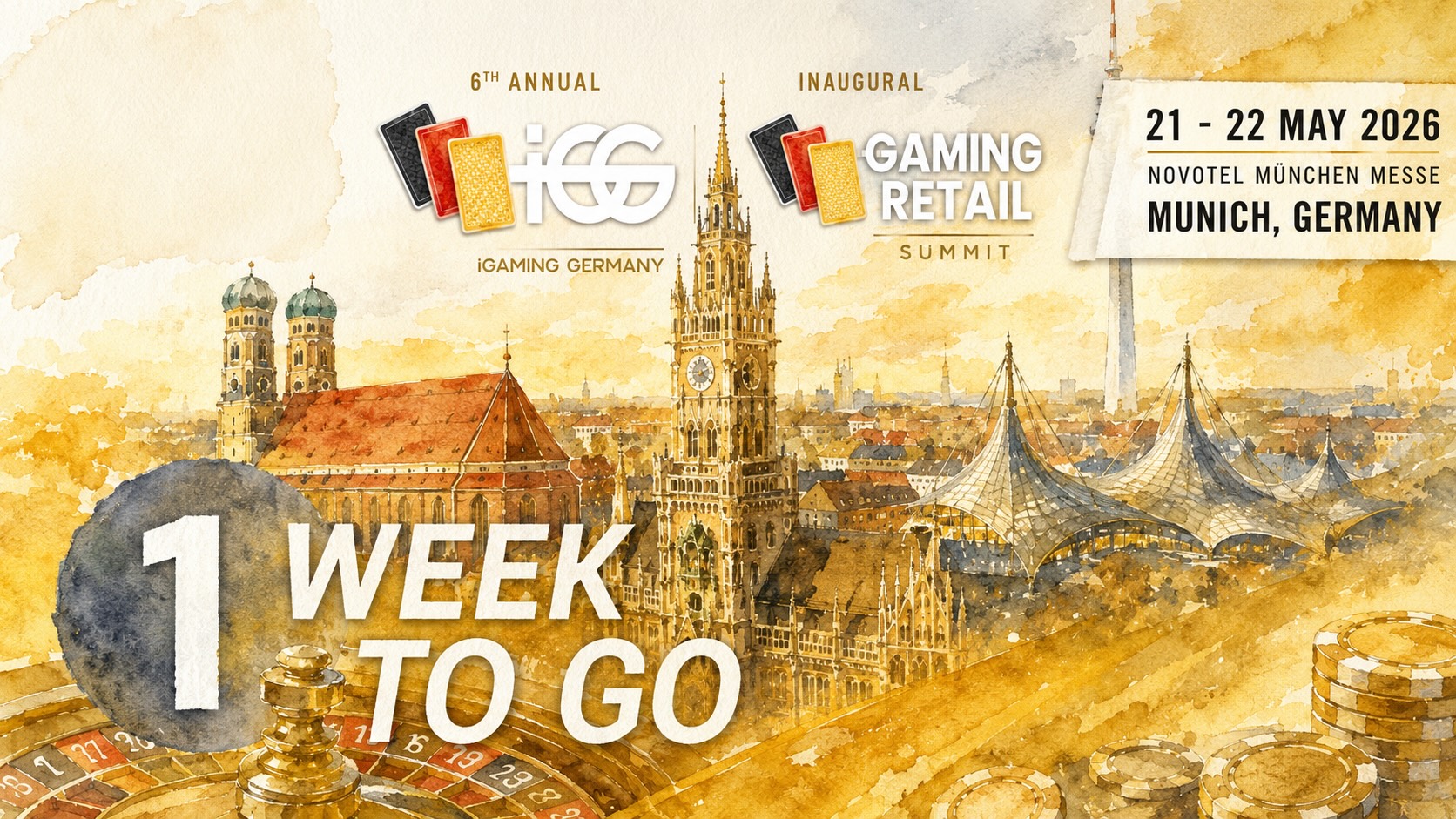
The 6th Annual iGaming Germany 2026 will take place on May 21–22 at the NOVOTEL München Messe in Munich, bringing together operators, legal experts, compliance professionals, and technology providers to discuss the future of Germany’s gaming market.
The event comes as the industry prepares for the next review of the Interstate Treaty, with growing attention on channelisation, regulatory changes, player protection, and long-term market sustainability.
Operators across online and retail gaming are also exploring new approaches to compliance, AI adoption, technology integration, and customer engagement, making iGaming Germany 2026 and the inaugural Gaming Retail Summit key platforms for industry discussion and networking.
Ahead of the conference, several industry experts shared their views on the current state of the market and the direction of European gambling regulation.
Regulators and Operators Need Ongoing Dialogue
Claus Hambach, Founding and Managing Partner at Hambach & Hambach Rechtsanwälte, said German regulators have become more open to engaging with operators and participating in international industry discussions.
According to Hambach, this shift is essential for effective player protection and the success of the regulated market.
That development is highly positive. Effective player protection can only be achieved if players choose regulated products rather than the black market,
Hambach said.
He also noted that Europe still lacks a unified framework for gambling regulation, with licensing models, taxation, and product rules varying significantly across jurisdictions.
Hambach outlined three phases of European gambling regulation over the past 25 years:
- 2000 – 2011: Online gambling’s rapid expansion and the drive toward market integration.
- 2011 – 2014: EU harmonisation at its most active, producing the Commission’s Green Paper, Action Plan, and Recommendation.
- 2015 – 2026: Re-nationalisation, with targeted cooperation emerging around AML, consumer protection, and enforcement.
He argued that Germany’s turnover-based tax model introduced in 2021 demonstrates how difficult full harmonisation remains without alignment on both taxation and regulation.
Instead of a single EU gambling law, Hambach said practical harmonisation is more likely to emerge through common technical standards, reporting frameworks, and coordinated enforcement.
In my view, this step-by-step functional alignment is the most realistic path forward,
he said.
Hambach also stressed the importance of industry events such as iGaming Germany 2026 for creating dialogue between regulators, operators, policymakers, researchers, and legal experts.
Overregulation Risks Strengthening the Black Market
Prof. Dr. Christian Piska from the Faculty of Law at the University of Vienna said Austria and Germany need to rethink their approach to online gambling regulation.
According to Piska, regulators should recognise online gambling as a legal consumer market rather than treating every player as a high-risk addiction case.
Austria and Germany first need to recognise a basic point: online gambling is a legal market, and not every player is automatically a high-risk addiction case,
Piska said.
He argued that excessive regulation has weakened the competitiveness of licensed operators while helping black-market platforms remain active.
Piska called for a more proportionate regulatory approach that focuses stricter intervention on genuinely risky behaviour instead of applying broad restrictions across the entire player base.
AI Becoming Increasingly Important for Operators
Piska also highlighted the growing importance of agent-based AI for gambling operators, particularly in compliance, fraud detection, customer interaction, and player protection.
According to him, operators that fail to integrate AI into their core strategy risk falling behind in an increasingly competitive and heavily regulated market.
He added that AI can help identify patterns linked to elevated addiction risk at an earlier stage, supporting a more risk-based and proportionate approach to player protection.
This is especially true in the area of player protection, where AI already offers strong technical possibilities to identify patterns that may indicate elevated addiction risk at an early stage,
Piska said.
Industry Leaders to Gather in Munich
iGaming Germany 2026 is expected to bring together legal, compliance, operational, technology, media, and retail professionals from across Europe.
Companies and organisations set to attend include Tipico, GG Poker, Gaming Laboratories International (GLI), Greentube, Worldpay Germany, Taylor Wessing, Sky Deutschland, Amusnet Gaming, and the University of Vienna, among many others.
The event will focus on topics including regulatory reform, responsible gaming, operational strategy, retail innovation, AI adoption, and market sustainability.
The conference will take place on May 21–22, 2026, at the NOVOTEL München Messe in Munich.
You can secure your pass here: https://www.eventus-international.com/igg
The material on GNcrypto is intended solely for informational use and must not be regarded as financial advice. We make every effort to keep the content accurate and current, but we cannot warrant its precision, completeness, or reliability. GNcrypto does not take responsibility for any mistakes, omissions, or financial losses resulting from reliance on this information. Any actions you take based on this content are done at your own risk. Always conduct independent research and seek guidance from a qualified specialist. For further details, please review our Terms, Privacy Policy and Disclaimers.
Articles by this author