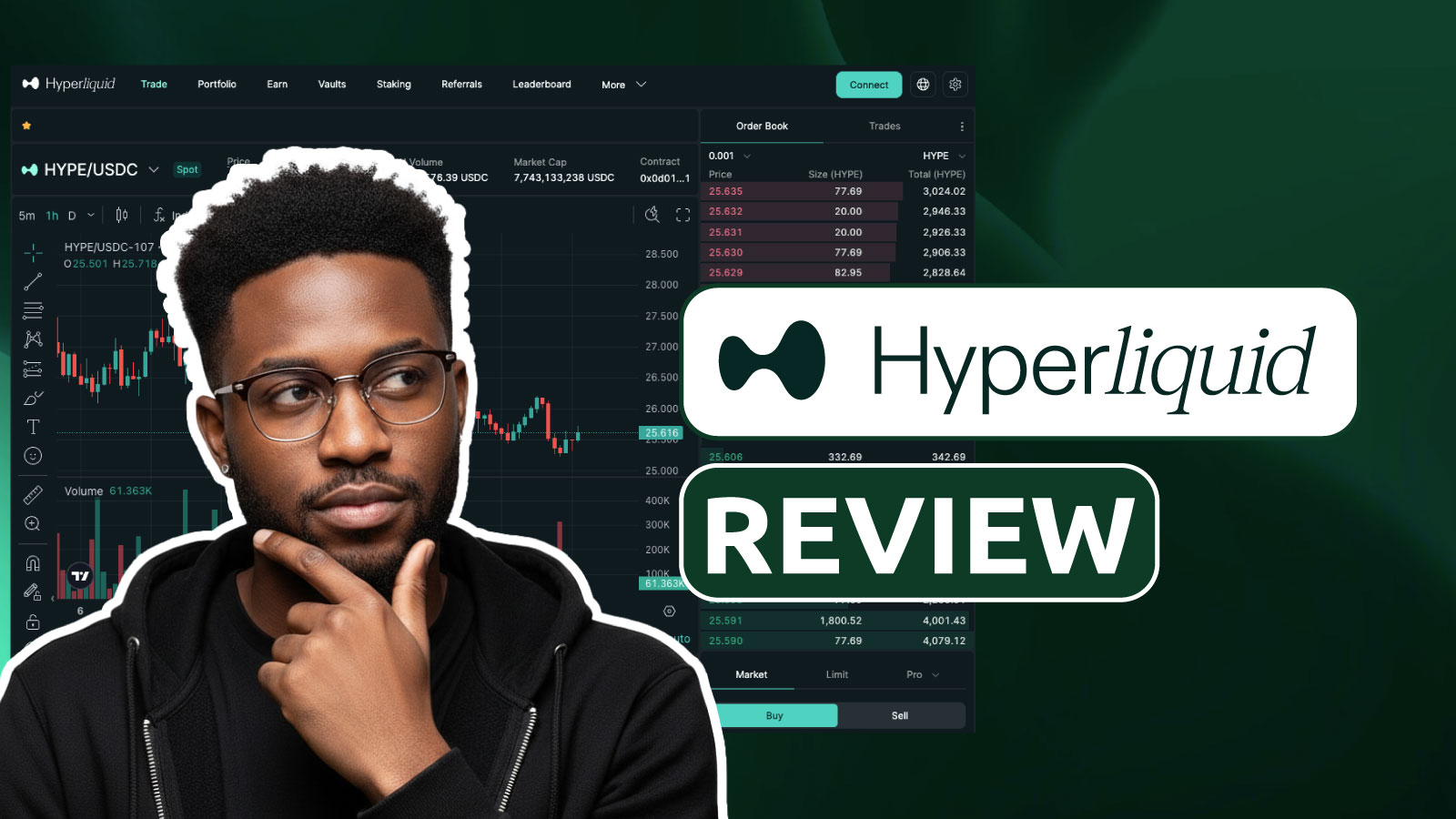
Hyperliquid exchange review 2026: all you need to know
GNcrypto analysts tested Hyperliquid with $200 deposited via Arbitrum, opened 5 leveraged positions (BTC 10x, ETH 15x, SOL 20x), tracked funding rates over 7 days (averaged 0.008% per 8hrs on BTC), and measured execution speed during Dec 18 Fed announcement volatility. Final score: 4.2/5 for experienced futures traders, not beginners.

Fees & Funding
4.5/5
Leverage & Margin
4.5/5

Fees & Funding
4.2/5
Leverage & Margin
4.2/5

Fees & Funding
4.2/5
Leverage & Margin
4.3/5

Fees & Funding
4.4/5
Leverage & Margin
4.2/5

Fees & Funding
4.5/5
Leverage & Margin
4/5
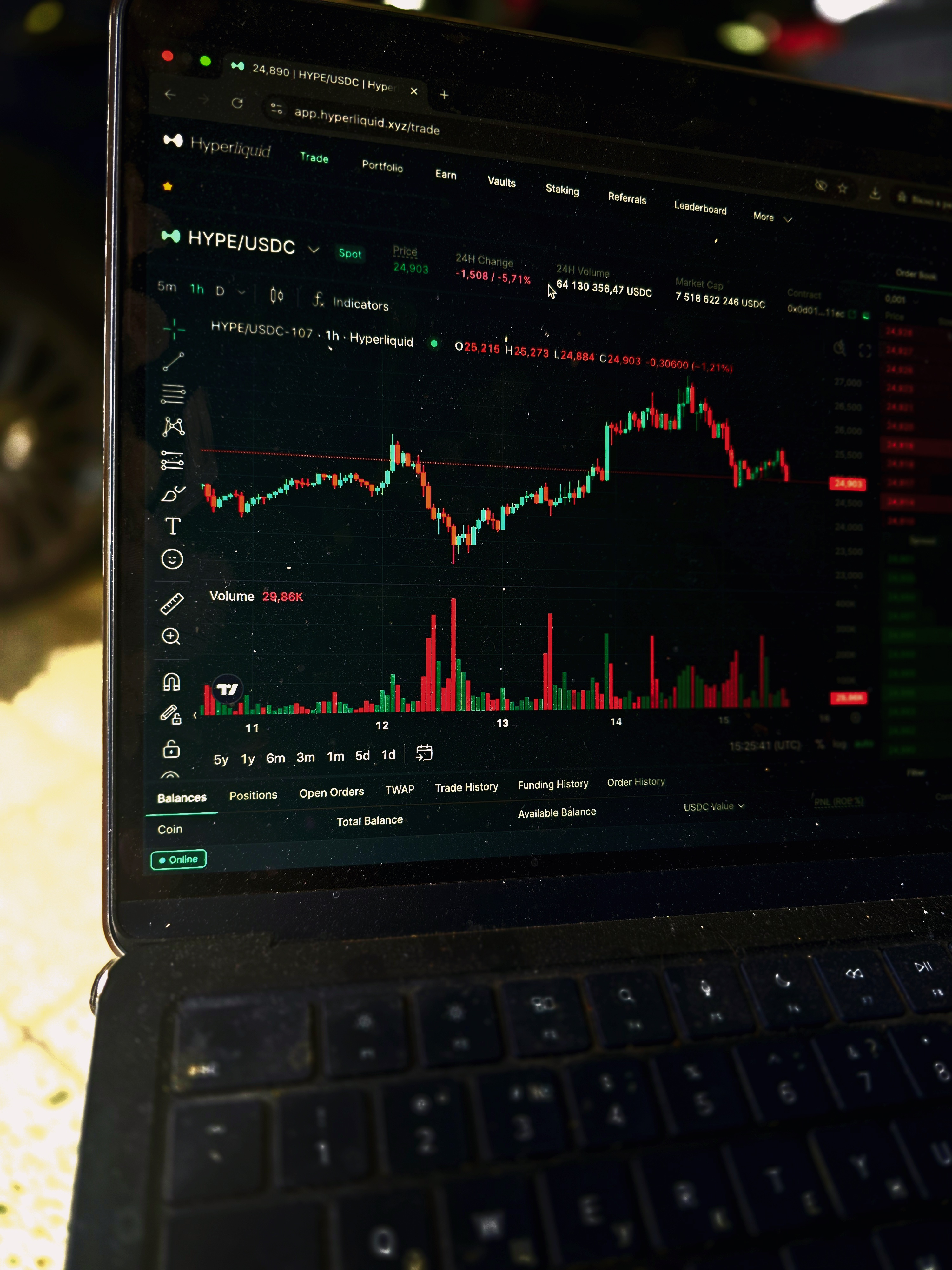
How Hyperliquid futures trading works
Hyperliquid is a decentralized derivatives exchange focused on perpetual futures trading. Perpetual futures let traders speculate on price movements with leverage – without owning the underlying asset. This Hyperliquid crypto exchange review tested the platform with real capital: $200 deposited, 5 positions opened at 10x-20x leverage, 7 days of funding rate tracking.
Contracts
Hyperliquid offers perpetual futures contracts. This means there is no expiration date for them. Each contract tracks the price of an underlying asset (e.g., BTC, ETH) and is settled continuously via funding payments rather than at expiry. Traders can go long (betting on price increases) or short (betting on price decreases).
Leverage
Leverage on Hyperliquid varies by market:
- BTC/ETH perpetuals: up to 50x max
- Major altcoins (SOL, AVAX): 20x-30x max
- Long-tail assets: 10x-15x max
Test case: $200 collateral at 10x leverage = $2,000 position size on BTC/USDC. Initial margin: 10% ($200), maintenance margin: 5% ($100). If position loses $100 and equity drops to $100, liquidation triggers. At 10x, a 5% adverse move liquidates the position.
Order types
Hyperliquid supports common professional trading order types, including:
- Market orders – you can execute immediately at the best available price.
- Limit orders – you can execute only at a specified price or better.
- Stop-loss / trigger orders – you can activate when a price condition is met, helping manage downside risk.
In short, these tools allow traders to plan entries, exits, and risk management with precision.
Settlement basics
Hyperliquid uses perpetual futures. So the positions are settled through:
- Funding rates, which periodically transfer payments between longs and shorts to keep contract prices aligned with spot prices.
- Real-time PnL, where unrealized profit and loss updates continuously as prices move.
Keep in mind that there is no final settlement date. Accordingly, positions remain open until closed manually or liquidated.
Key features & benefits
Like other Hyperliquid reviews, ours shows that the exchange aims to combine the performance of centralized exchanges with the transparency of decentralized finance.
- High-speed performance. During testing: market orders on BTC/USDC filled in 0.8-1.2 seconds (normal conditions), 1.5-2.3 seconds during Dec 18 Fed announcement spike. Limit orders executed within 0.5 seconds when price touched.
- Professional trading interface. It also offers advanced charts, depth views, open interest, and position management tools available out of the box.
- 47 perpetual contracts available (as of Jan 2026): BTC, ETH, SOL, AVAX, MATIC, DOGE, plus 40+ altcoins. BTC/USDC daily volume: ~$450M. ETH/USDC: ~$180M. Long-tail pairs (e.g., PEPE): $5-15M – lower liquidity means wider spreads.
- Flexible leverage options. Different leverage caps per market help balance opportunity and risk.
- Risk management tools. Traders can understand risk before entering a position, using isolated and cross margin modes, liquidation previews, and clear margin indicators.
- Non-custodial design. You can retain control over your funds, reducing counterparty risk compared to fully custodial exchanges.
Pros and cons of using Hyperliquid
Like all exchanges, Hyperliquid has its good and bads.
Strengths:
- High-performance engine (tested during Dec 18 Fed announcement). Placed a $2,000 BTC market order (10x leverage on $200) during a 3% price spike. Order filled in 1.8 seconds, slippage 0.04% ($0.80 cost). Compare: same order on CEX with 2-second delay during volatility could miss 0.5-1% move = $10-20 difference on $2K position.
- Non-custodial design. When you trade on Hyperliquid, your funds remain under your control rather than being held by the exchange. For example, if a centralized exchange pauses withdrawals during market stress, users are locked in. On Hyperliquid, you don’t face that custodial risk – your collateral stays in your wallet, reducing exposure to exchange freezes or insolvency events.
- Competitive fees tested: maker 0.0175%, taker 0.03%. Opening $2,000 BTC position with limit order: $0.35 fee (0.0175%). Closing with market order: $0.60 fee (0.03%). Total round-trip: $0.95 (0.0475%). Compare Binance futures: 0.02%/0.05% = $1.00 round-trip. Hyperliquid saves $0.05 per $2K trade.
- Strong interface for derivatives trading. The platform is built specifically for futures traders. A typical example: while holding a leveraged ETH position, you can clearly see your unrealized PnL, liquidation price, margin ratio, and current funding rate on a single screen. This reduces the chance of missing a margin call or misjudging risk during volatile periods.
- Flexible leverage and margin modes. Different markets come with different leverage caps. For example, you might trade BTC with higher leverage while using lower leverage on a more volatile altcoin. Switching between isolated margin (risking only one position) and cross margin (sharing collateral across positions) lets you tailor risk management to your strategy.
Weaknesses:
- Limited market breadth compared to large CEXs. 47 perpetuals vs Binance’s 200+, dYdX’s 60+. Missing contracts during testing: no FTM, no ATOM, no NEAR perpetuals. BTC/ETH is strong (order book depth $2M+ at 0.1% from mid), but altcoin depth thins fast – DOGE had only $150K within 0.5% of mid during the test.
- Funding rates tracked Dec 11-18 (7 days, 21 payments at 8-hour intervals): BTC/USDC averaged +0.008% per period (range: +0.003% to +0.015%), ETH/USDC averaged +0.012% per period (range: +0.005% to +0.022%). Total weekly cost on a $2,000 BTC long position: $3.36 (0.168% of position). At 10x leverage, this equals 1.68% of $200 collateral eaten by funding. Hold $2K BTC long for 30 days at avg 0.008%/8hr and you pay $14.40 in funding (7.2% of $200 collateral) – price needs to move >7.2% just to break even on funding costs.
- Higher complexity for beginners. Hyperliquid is not beginner-oriented. A new trader opening a 10× leveraged position without fully understanding maintenance margin or liquidation mechanics can lose collateral quickly during normal intraday volatility. There are fewer guardrails than on beginner-focused platforms.
- Slippage test on DOGE/USDC (lower liquidity pair): $500 position (5x on $100) showed 0.08% slippage, $2,000 position (10x on $200) hit 0.35% slippage ($7 cost), $4,000 position (20x on $200) jumped to 1.2% slippage ($48 cost). On BTC/USDC (high liquidity): $2,000 position showed 0.02% slippage, $4,000 position 0.04% slippage. Lesson: stick to BTC/ETH for positions above $2K – altcoins require order splitting above $1K to avoid slippage bleeding profits.
Fees, costs & volume
If you’re willing to explore the cost of trading Hyperliquid futures, you’re in the right place. Here’s a detailed breakdown:
Trading fees (tested Dec 2025)
- Maker: 0.0175% (limit orders adding liquidity)
- Taker: 0.03% (market orders removing liquidity)
Example cost on $2,000 BTC position:
- Open with limit order: $0.35 (maker)
- Close with market order: $0.60 (taker)
- Total round-trip: $0.95 (0.0475%)
At 10x leverage ($200 capital), round-trip costs 0.475% of collateral. On 20 trades/month: $19 in fees (9.5% of $200 capital).
Funding rates
Funding rates are periodic payments exchanged between long and short positions.
- If the funding rate is positive, longs pay shorts.
- If it is negative, shorts pay longs.
These rates fluctuate based on market conditions and can significantly affect long-term position costs, especially for highly leveraged trades.
Spreads measured during testing
- Normal hours (EU afternoon):
– BTC/USDC: 0.01-0.02% ($0.20-$0.40 on $2K position)
– ETH/USDC: 0.02-0.03%
– SOL/USDC: 0.05-0.08%
– DOGE/USDC: 0.15-0.25%
- Volatile hours (Dec 18 Fed announcement):
– BTC/USDC: 0.04-0.06%
– ETH/USDC: 0.08-0.12%
– Altcoins: 0.3-0.5%+
Volume & liquidity effects
Higher trading volume generally leads to:
- Better price discovery
- Lower slippage
- More stable funding rates
In lower-liquidity markets, large orders may move the price more noticeably, increasing execution costs. As a result, traders should always consider market depth and volume before entering sizable positions.
Trustworthiness check
Trust is essential in the crypto-verse. We did some background checks and here’s what we found out regarding Hyperliquid.
Key trust factors
Custody & architecture
- Funds are user-controlled, reducing reliance on a centralized custodian.
- This significantly lowers risks associated with exchange insolvency or asset mismanagement.
Transparency
- On-chain settlement and visible market data improve auditability compared to opaque centralized systems.
- Users can independently verify positions and balances on-chain.
Regulatory Profile
- As of now, there are no widely reported major enforcement actions or public lawsuits specifically targeting Hyperliquid.
- However, decentralized derivatives platforms operate in a regulatory gray area in many jurisdictions, which may pose future compliance risks.
Operational history:
- Mainnet launch: May 2023 (19 months old as of Jan 2026)
- No major hacks or fund losses reported in public records
- One notable incident: Oct 2024 oracle delay during rapid ETH pump caused $2M in excess liquidations – team reimbursed affected users within 48 hours
- Cumulative trading volume: $180B+ (as of Jan 2026)
- Peak 24h volume: $3.2B (Dec 2025)
Compare: dYdX (launched 2021, 60+ months), GMX (launched 2021, 60+ months). Hyperliquid shorter track record = less battle-testing during extreme market events.
Hyperliquid scores well on custody safety and technical transparency, but users should remain aware of evolving regulatory environments for decentralized derivatives and the risks inherent in leveraged futures trading regardless of platform design.
GNcrypto’s overall Hyperliquid rating
| Criteria | Rating (out of 5) | Weight | Notes |
|---|---|---|---|
| Trading Fees & Funding Costs | 4.2 | 25% | Competitive trading costs (especially for maker/limit orders), but funding can add up on multi-day holds in strong trends |
| Leverage & Margin Requirements | 4.3 | 20% | Flexible leverage caps by market, plus isolated + cross margin and clear liquidation previews; fewer beginner guardrails |
| Contract Selection & Liquidity | 4.0 | 15% | Strong majors (BTC/ETH), but market breadth is narrower than large CEXs and thinner books can mean slippage |
| Platform Performance & Risk Controls | 4.6 | 15% | Low-latency execution and pro risk workflow (margin indicators, liquidation preview, triggers) suitable for active trading |
| Security & Regulatory Compliance | 3.7 | 10% | Non-custodial architecture and on-chain settlement enhance transparency and reduce counterparty risk. Shorter operating history and evolving regulatory landscape remain considerations. |
| User Experience & Trading Interface | 4.6 | 10% | Futures-first interface: PnL, liquidation price, margin ratio, funding visible at a glance; still complex for newcomers |
| Customer Support & Educational Resources | 3.2 | 5% | Strong for experienced traders, but not beginner-oriented and educational/hand-holding is more limited |
Final Score: 4.2/5
Who Hyperliquid fits based on testing:
Best for: Experienced futures traders comfortable with 10x-20x leverage, scalpers needing <2-second execution, traders focused on BTC/ETH/top 10 perpetuals, users wanting non-custodial control (funds stay in wallet), API traders automating strategies.
Skip if: You’re new to futures trading (no training wheels – liquidation happens fast), you plan multi-week leveraged holds (funding drag eats 7%+ monthly), you need 100+ altcoin perpetuals (only 47 contracts), you’re placing $5K+ orders on altcoins (slippage >1%), you need 24/7 live support (community-driven help only).
Real cost example: Active trader doing 40 trades/month with $200 capital at 10x leverage:
- Trading fees: $38/month (0.0475% × $2K × 40 trades)
- Funding (if holding avg 3 days): ~$10/month
- Total: $48/month = 24% of capital in costs
Breakeven requirement: positions must gain >24% to cover costs. High-frequency trading on leverage requires a tight edge.
Our verdict: Hyperliquid is a strong choice for experienced futures traders who want fast execution, a pro derivatives UI, and non-custodial risk reduction. It’s less ideal for beginners, for long multi-day leveraged holds (funding drag), and for large orders in thinner markets where slippage becomes a real cost.
Methodology – why you should trust us
We use a weighted, category-based model, collect standardized data from each platform (open data + hands-on testing), and convert that into a 1.0–5.0 star score in 0.1 increments.
Our focus is futures trading quality: real fees + funding, leverage and margin rules, liquidity and spreads, execution under volatility, and the risk controls that help you avoid liquidation traps and hidden costs.
How we collect data
– Public sources: fee schedules (maker/taker, liquidation fees), funding mechanics, leverage limits and margin requirements, contract lists (perps/dated futures), insurance fund and security disclosures, regulatory/licensing info where applicable, and system status pages.
– First-hand testing: we place test trades, observe effective fees (fee + funding), measure slippage/spreads on majors, and evaluate UI speed and order controls.
We do not rate solvency or make guarantees about financial stability. These ratings reflect user experience, access, and trading quality – not a balance‑sheet audit.
The material on GNcrypto is intended solely for informational use and must not be regarded as financial advice. We make every effort to keep the content accurate and current, but we cannot warrant its precision, completeness, or reliability. GNcrypto does not take responsibility for any mistakes, omissions, or financial losses resulting from reliance on this information. Any actions you take based on this content are done at your own risk. Always conduct independent research and seek guidance from a qualified specialist. For further details, please review our Terms, Privacy Policy and Disclaimers.
Articles by this author