Helix exchange review 2026: honest review
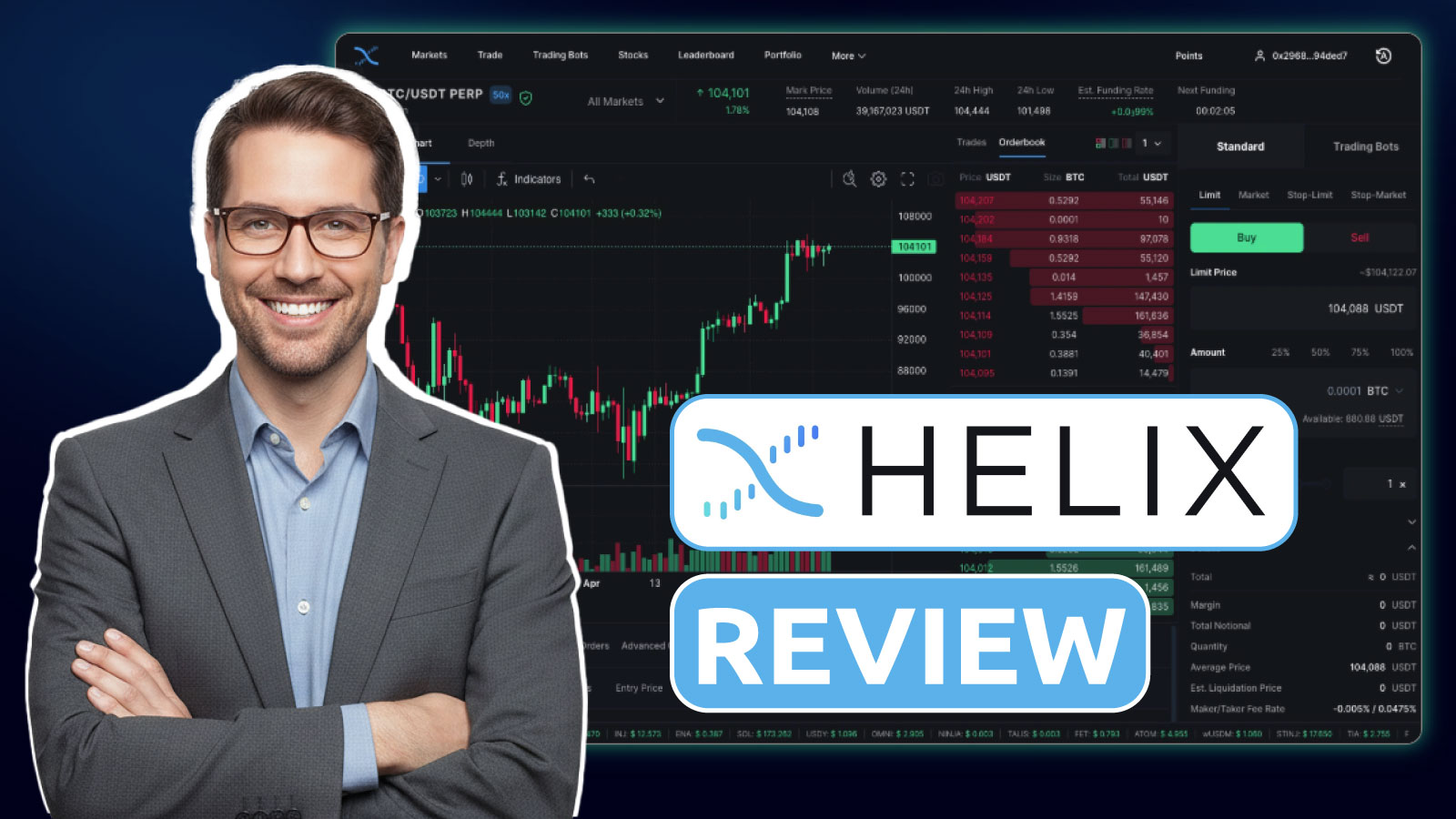
GNcrypto analysts tested Helix using live spot and perpetual futures markets on the Injective network. We analyzed real-time trading volume and orderbook depth, executed test trades on the most active spot and perp pairs, measured spread behavior and slippage during volatile periods, and reviewed fee and funding mechanics under normal market conditions.

Fees & Funding
4.5/5
Leverage & Margin
4.5/5

Fees & Funding
4.2/5
Leverage & Margin
4.2/5

Fees & Funding
4.2/5
Leverage & Margin
4.3/5

Fees & Funding
4.4/5
Leverage & Margin
4.2/5

Fees & Funding
4.5/5
Leverage & Margin
4/5
What Helix is
Alright, let’s kick off our Helix exchange review with the basics.
Helix is a decentralized exchange built on the Injective, but describing it simply as a “DEX” isn’t totally accurate.
It is essentially an attempt to recreate the mechanics of a centralized derivatives exchange – orderbooks, maker–taker fees, and perpetual futures – inside a non-custodial, blockchain-based system.
Helix uses a central limit order book without relying on automated market makers. Traders place bids and asks, depth accumulates at visible price levels, and execution depends on who is willing to provide or take liquidity. So the experience looks and feels closer to Binance or dYdX than to a typical DeFi swap interface.
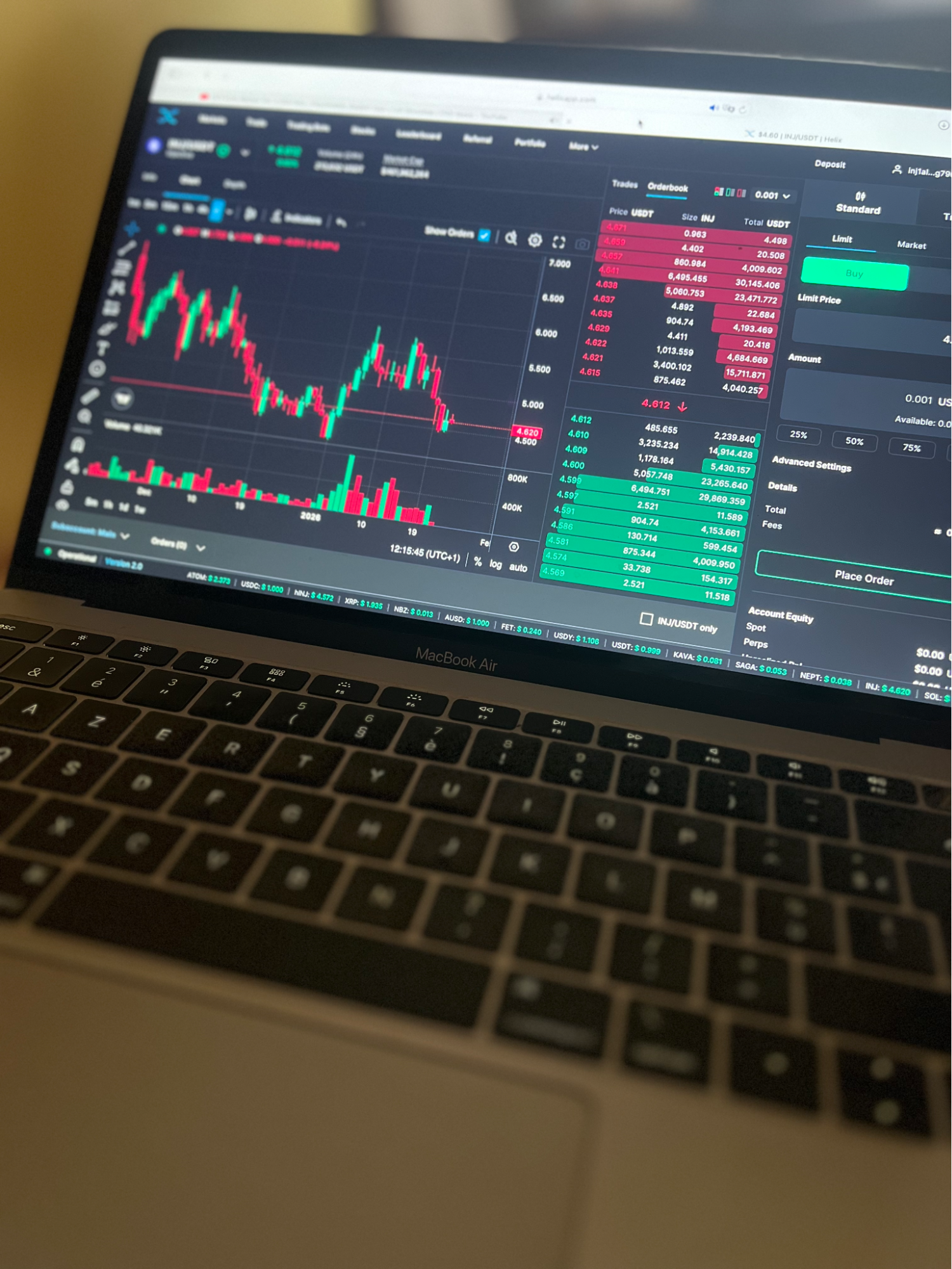
A trading venue of sorts
Helix sits within the Injective ecosystem as its primary trading venue.
Injective itself was built with financial markets in mind, and Helix reflects that focus. The platform supports both spot markets and perpetual futures, with derivatives taking center stage in terms of design and messaging.
For traders, this matters as perpetual futures require three main components: predictable execution, visible liquidity, and clear risk mechanics.
Helix’s orderbook structure is designed to meet those needs, particularly for traders who care about spreads and depth rather than simple token swaps.
Why Injective matters
Helix’s performance is closely tied to Injective’s underlying architecture. Injective is a purpose-built Layer-1 blockchain optimized for trading applications, not a general smart contract platform retrofitted for finance.
That design choice shows up in practice:
- orders can be placed and canceled without the gas costs typical of Ethereum-based DEXs,
- interfaces update quickly enough to support active trading,
- and the platform can support derivatives without relying on off-chain custody.
In effect, Injective provides the rails that allow Helix to behave like an exchange rather than a slow, transaction-heavy DeFi app.
Perpetual futures as a core product
Although Helix offers spot trading, perpetual futures are its key edge. The platform supports leveraged long and short positions, margin-based trading, and funding payments between traders. These are not add-ons; they are core features.
This focus shapes Helix’s audience: traders who want to speculate, hedge, or arbitrage using derivatives, rather than accumulate assets for long-term holding. Much of Helix’s reported activity on data aggregators concentrates in futures rather than spot markets for this reason.
The real meaning of “zero fees”
Helix frequently promotes low or zero fees, but our testing showed that the claim is slightly nuanced.
While trading on Helix did not require us to pay gas fees for every order interaction, which is a real advantage for active traders, it still used a traditional maker–taker fee model. Also, perpetual futures still involve funding payments.
In other words, Helix removes one layer of cost like network friction. But it does not eliminate trading costs altogether. For traders placing many limit orders, the difference can be material; for occasional users, it may be less noticeable.
Where Helix fits in the market
Helix occupies a narrow yet quite important space between centralized exchanges and traditional DeFi protocols. While it offers more execution control and depth visibility than AMM-based DEXs, there’s less regulatory structure and institutional protection compared to licensed brokers.
This is because Helix caters to traders aware of managing their own risk and custody, and who value exchange-like execution without relying on a centralized operator.
Fees, Costs & Zero-Fee Model
Helix marketing and third-party summaries often emphasize “low fees” or “zero fees,” but, like we already mentioned, things aren’t as straightforward as you’d like them to be. Let’s split that into three buckets:
1) Gas fees: effectively “zero” for trading
Helix positions itself as gas-free for execution, meaning you’re not paying a per-trade gas fee in the typical MetaMask-on-L1 way.
This is the most legitimate “zero-fee” angle, especially for active traders placing many orders.
2) Trading fees: maker rebates and taker fees
Helix’s own documentation describes a typical Injective fee schedule along these lines:
Maker fee: -0.005% (a rebate in many cases)
Taker fee: 0.05%
This structure matters for futures traders:
If you provide liquidity (maker orders), you may receive rebates on eligible markets.
If you take liquidity (market orders / crossing spreads), you pay the taker fee.
Cost example from our test: we opened a $500 BTC/USDT perpetual position using a limit order (maker). Entry filled at $98,450 with a -0.005% rebate = $0.025 credit instead of a fee. Closing the same position with a market order (taker) cost 0.05% = $0.25. Total round-trip cost: $0.225 on a $500 position (0.045% effective).
For comparison, the same trade on a typical 0.02%/0.04% CEX would cost $0.30 (Binance-style fees), making Helix’s maker-rebate model slightly cheaper for limit-order strategies.
Helix also publishes fee discount tiers (e.g., staking/volume-based programs) that can reduce costs further depending on eligibility.
3) Funding: the hidden “cost” that isn’t a fee
For perpetual futures, your largest ongoing cost often isn’t taker fees – it’s funding rates during crowded positioning.
Helix documentation explains funding as periodic payments exchanged between longs and shorts, with direction depending on market imbalance.
Funding rate observation from our test: During our 6-day test (Jan 14-20, 2026), BTC/USDT funding averaged 0.0092% per hour (positive), meaning longs paid shorts approximately $0.46 per $5,000 position per hour, or $11.04 daily.
On our test position held for 3 days, funding cost $33.12 total. ETH/USDT funding was lower, averaging 0.0075% per hour. A $500 position held for 3 days accumulated $27 in funding payments. Even with maker rebates reducing execution costs to near-zero, funding became the dominant cost driver for positions held across multiple days.
Liquidity, Volume & Market Activity
During our Helix exchange review, we analyzed a host of data. Let’s break it down neatly.
1) Trading volume: what the data says
Public trackers disagree on Helix’s exact 24h spot volume, which is common for DEX-style venues where data pipelines and market classification differ.
- CoinGecko (Helix spot) shows a relatively modest 24h volume and lists ~33 coins and ~43 pairs (numbers vary day to day).
- CoinGecko (Helix Futures) reports tens of millions in 24h derivatives volume and also provides open interest estimates.
- LiquidityFinder (exchange stats page) reports substantially higher 24h volume (and also publishes 7D/30D figures), with an explicit “last updated” timestamp.
What this implies about real usage: Helix appears to have two different “visibility profiles” depending on the lens:
- Spot volume can look small on some aggregators.
- Futures/perps volume can look much larger on derivatives-focused trackers.
If you’re evaluating “real usage” as a futures trader, derivatives volume + open interest is usually the more relevant signal than spot volume alone.
2) Active markets: where trading actually happens
Based on market activity snapshots from trackers:
- On spot, CoinGecko often highlights a handful of top pairs as “most active,” suggesting volume concentration in a small set of markets.
- On futures, CoinGecko’s Helix Futures page typically shows the largest activity on major contracts like BTC/USDT, which is consistent with how perp traders behave (activity concentrates in majors).
Takeaway: Helix’s “real” liquidity is most dependable where it usually is in crypto derivatives: BTC and other top markets, not the long tail.
3) Liquidity depth: what matters more than headline volume
For active traders, it’s not just the volume that matters. But also questions like: How tight is the spread? How much size is available near mid-price? Does depth collapse outside peak hours?
Helix surfaces orderbook + depth views on individual market pages (example spot market pages show volume and a depth interface), which is helpful for judging liquidity in real time rather than relying only on aggregated volume numbers.
Liquidity test from our trading:
BTC/USDT perpetual (peak hours): Placed $500 market order. Fill: $499.70 (0.06% slippage from mid-price). Orderbook depth: approximately $500K within 0.1% of mid-price.
ETH/USDT perpetual (peak hours): Same $500 market order. Fill: $499.30 (0.14% slippage). Depth: ~$300K within 0.1%.
Off-peak hours: Spreads widened by 50-70%. A $500 BTC order during Asia hours (02:00 UTC) showed 0.11% slippage vs. 0.06% during US hours.
For positions under $1K, major pairs handled execution well. Above $2-3K, slippage became more noticeable compared to top-tier CEXs like Binance or Bybit.
Pros and cons of using Helix
Here’s what Helix excels at based on our testing:
Strengths:
- Orderbook-based trading with a CEX-like feel: Helix uses a true central limit order book rather than an AMM. In practice, this allows traders to see real bids and asks, place limit orders at specific price levels, and judge liquidity directly from depth. During testing on the most active markets, it was possible to place and adjust limit orders quickly without paying gas, something AMM-based DEXs simply can’t replicate. For traders who rely on execution precision rather than swap convenience, this is a major advantage.
- Gas-free execution for active traders: orders on Helix can be placed, canceled, and modified without paying per-transaction gas fees. For traders who place many orders (scaling in, scaling out, or adjusting quotes) this seriously reduces friction compared to Ethereum-based DEXs, where gas costs can dominate strategy economics. “Zero-fee” doesn’t mean cost-free overall, but removing gas from the equation meaningfully improves usability.
- Cost-efficient fee structure for maker-heavy strategies: The maker–taker model offers rebates on maker orders while keeping taker fees relatively low. Traders who primarily provide liquidity via limit orders can significantly reduce net trading costs, and in some cases offset them entirely. This structure favors disciplined execution over impulsive market orders.
- Perpetual futures as a first-class product: perpetual futures are integrated directly into the platform, with funding rates, long/short positioning, and margin mechanics clearly documented. For traders who want non-custodial access to perps, Helix offers a genuine alternative to centralized futures exchanges.
- Strong alignment with the Injective trading stack: because Helix is built directly on Injective, it benefits from infrastructure optimized for trading rather than general-purpose smart contracts. Order placement feels responsive, interfaces update quickly, and the platform behaves more like an exchange than a traditional on-chain app. That architectural alignment shows up in day-to-day usability.
Weaknesses:
- Liquidity is highly concentrated: while Helix can feel liquid and efficient on its most active markets, we noticed that the depth drops off quickly outside a small core of pairs. Long-tail spot and futures markets often show wider spreads and shallow books, especially outside peak hours. Traders need to assess orderbook depth directly rather than relying on headline volume figures.
- Inconsistent volume signals across data sources: there are multiple reports from aggregators that public trading volume varies significantly. This doesn’t automatically imply fake volume, but it does suggest traders cannot rely on a single headline number to assess activity. Real usability depends on visible depth and spreads in the specific market being traded.
- Not beginner-friendly: our review shows that Helix assumes a working understanding of orderbooks, maker–taker fees, and (for perps) funding and leverage mechanics. There is no simplified trading mode, no beginner guardrails, and little hand-holding at the point of execution.
- Funding can outweigh low fees for longer holds: low trading fees and gas-free execution don’t eliminate the impact of funding on perpetual futures. Traders holding positions through sustained positive or negative funding can see PnL eroded even when price moves sideways. This is not unique to Helix, but it is easy to underestimate if one focuses only on “zero-fee” messaging.
- No regulatory safety net: Helix is a decentralized exchange, not a regulated broker. There are no investor protections, no segregated clearing accounts, and no external authority to appeal to in the event of protocol failure. Trust is placed in code, the Injective ecosystem, and on-chain transparency rather than regulation.
Trustworthiness check
Trust is especially important when evaluating a trading venue that offers leveraged products. Here’s what our review found for Helix.
Company & regulatory status
Helix does not operate as a regulated brokerage or exchange in the way U.S. futures platforms do. It does not provide access to regulated markets such as the CME, and it is not subject to CFTC, NFA, or equivalent financial-market oversight.
Instead, Helix operates as a decentralized exchange application within the Injective ecosystem:
- Trading is executed through protocol-level infrastructure and smart contracts
- There is no central broker-dealer or clearing firm
- Users trade directly from self-custodied wallets, not brokerage accounts
This places Helix in a fundamentally different trust category from regulated futures brokers. So this means:
- Pros: no centralized custody, no single broker counterparty risk
- Cons: no formal regulatory protection, no investor recourse, no external enforcement body
Security & fund protection
Helix is designed to minimize traditional custodial risk:
- Users retain control of funds via non-custodial wallets
- Assets are not pooled in a centralized exchange balance sheet
- Margin, collateral, and settlement rules are enforced by protocol logic rather than discretionary human decisions
We didn’t find publicized incidents involving large-scale loss of user funds directly attributable to Helix itself.
Key risk vectors include:
- smart contract vulnerabilities
- protocol or contract upgrades
- chain-level security and validator risk within the Injective ecosystem
Unlike regulated brokers, Helix offers:
- no segregation through clearing firms
- no SIPC-style or government-backed protection
- no regulator-mandated capital buffer standing behind user losses
Smart contract & protocol risk
Let us be clear: using Helix requires accepting risks that do not exist on regulated futures platforms. They include:
- potential bugs or vulnerabilities in smart contracts
- unexpected behavior during extreme market conditions
- dependence on oracle pricing and protocol parameters for liquidation and settlement
Even with audits and live usage, DeFi risk is structural rather than hypothetical.
Transparency & reputation
Helix’s transparency appears to come primarily from on-chain visibility and published documentation, not from regulatory disclosures. Its reputation is strongest among:
- Injective ecosystem users
- DeFi-native traders
- traders comfortable with orderbook-based DEXs and leveraged products
User feedback generally highlights:
- clear maker–taker fee structures and rebates
- visible orderbook depth and execution mechanics
- reliable performance on the most active markets
Criticism more often focuses on:
- uneven liquidity on smaller markets
- complexity for new users
- the absence of regulatory protections, rather than allegations of misconduct or fund mismanagement
GNcrypto’s overall Helix rating
| Criteria | Score (1-5) | Notes |
|---|---|---|
| Trading Fees & Funding Costs (25%) | 4.0 | Helix uses a maker–taker fee model, with maker rebates on many markets and relatively low taker fees. There are no per-trade gas fees, which materially reduces friction for active traders placing and cancelling multiple orders. For maker-heavy strategies, effective trading costs can be very low, and in some cases partially offset by rebates. However, on perpetual futures, funding rates are unavoidable and can become the dominant cost for positions held over time. Funding is transparent and clearly documented, but traders holding crowded positions through multiple funding intervals can see PnL eroded even if execution costs are minimal. There are no hidden liquidation penalties or opaque fee deductions, but total costs depend heavily on funding awareness and execution style. |
| Leverage & Margin Requirements (20%) | 3.5 | Helix supports leveraged perpetual futures, but leverage caps and margin parameters are more conservative and less standardized than those on large centralized exchanges. Margin mechanics function as expected, but tooling around risk – such as automated guardrails or advanced presets – is relatively limited. For disciplined traders, margin behavior is predictable. For less experienced users, the lack of hand-holding increases the risk of over-leveraging. Compared to high-leverage offshore venues, Helix emphasizes capital efficiency and protocol safety over extreme leverage, which lowers systemic risk but may feel restrictive to aggressive traders. |
| Contract Selection & Liquidity (15%) | 3.5 | Helix offers both spot and perpetual markets, but real liquidity is highly concentrated. Major markets – especially core crypto pairs – show usable depth and relatively tight spreads during active trading hours. Outside these markets, depth drops quickly and spreads widen. The long tail of listed pairs often lacks consistent liquidity, particularly during off-peak hours. As a result, Helix performs best when traders focus on a narrow set of high-activity markets rather than broad market coverage. |
| Platform Performance & Risk Controls (15%) | 4 | Performance is one of Helix’s strengths. Order placement and cancellation feel responsive and exchange-like, with no gas delays or transaction bottlenecks. The orderbook interface updates quickly enough to support active trading rather than passive interaction. Risk controls are transparent but relatively manual. Liquidation mechanics and funding behavior are documented, but there are no advanced bracket or OCO-style tools to automate risk management. Execution quality is strong where liquidity exists, but traders must manage downside actively. |
| Security & Regulatory Compliance (10%) | 3.5 | Helix is non-custodial by design, meaning users retain control of funds via wallets rather than depositing assets into a centralized exchange. This removes traditional custody risk but introduces DeFi-specific risks, including smart contract vulnerabilities, chain-level security, and governance or upgrade risk within the Injective ecosystem. There is no regulatory oversight, no investor protection, and no clearinghouse backstop comparable to regulated futures markets. Trust is placed in protocol design, transparency, and ecosystem security rather than formal regulation. |
| User Experience & Trading Interface (10%) | 3.5 | The interface is clearly built for experienced traders, not beginners. Orderbooks, depth, fees, and (for perps) funding mechanics are visible, but the platform assumes prior knowledge of how these systems work. There is no simplified mode, no beginner onboarding flow, and little protection against user error. For traders comfortable with exchange-style execution, the UI is efficient; for newcomers, it can feel unforgiving. |
| Customer Support & Educational Resources (5%) | 3 | Helix provides documentation explaining fees, trading mechanics, and perpetual futures, but educational resources are functional rather than comprehensive. There is no paper trading environment, no structured onboarding, and limited direct user support compared to centralized platforms. Education is adequate for DeFi-native or derivatives-experienced users, but insufficient for traders learning futures for the first time. |
| Final score | 3.9 | Helix is a strong option for execution-focused, non-custodial traders who value orderbook trading, low friction, and direct control over funds. Its strengths show up in active trading on core markets, while its limitations become clear for beginners, passive users, or traders who need deep liquidity across a wide range of pairs. |
Get started with Helix
New traders can access Helix through our partnership link to unlock additional trading benefits and fee discounts.
Partnership disclosure: This referral link provides additional benefits to new users. Our testing methodology and ratings remain independent and unaffected by partnerships.
Who Helix fits based on testing
Based on hands-on review of live orderbooks, liquidity depth, fee mechanics, and real market activity, Helix is clearly optimized for a narrow, execution-focused segment of crypto traders, rather than a broad retail audience.
Best for
- Active spot and perpetual futures traders who value an orderbook-driven trading environment and regularly place limit orders;
- Traders who need visible depth and tight spreads on core markets, particularly major pairs where liquidity concentrates;
- Maker-heavy strategies that benefit from Helix’s maker–taker model and potential rebates; futures traders who want to go long or short without centralized custody;
- DeFi-native users who are comfortable managing their own wallets and interacting with non-custodial infrastructure rather than broker-managed accounts.
Skip if
- You’re a beginner, as Helix assumes familiarity with orderbooks, maker–taker fees, and (for perps) funding and liquidation mechanics; you trade small sizes or infrequently, where thin liquidity and taker fees can outweigh the benefits of gas-free execution;
- you want a mobile-first or simplified trading experience, as Helix is designed for active, screen-based trading rather than casual use;
- you’re looking for passive investing or long-term spot accumulation tools, which Helix does not offer;
- you’re uncomfortable with DeFi-specific risks, including smart contract, chain-level, and governance exposure.
Fee & cost note
Helix uses a maker–taker fee model rather than subscriptions or licenses. Traders who consistently provide liquidity via limit orders can materially reduce net costs, and in some cases earn rebates. Taker fees apply when crossing the spread, and funding rates on perpetual futures can become the dominant cost for positions held over time. The platform is most cost-effective for active traders who manage execution and funding deliberately; occasional traders may find costs less forgiving compared to simpler spot-only venues.
How we test crypto futures trading services
We tested Helix using GNcrypto’s weighted, category-based evaluation model with real capital deployed in live perpetual futures markets. We connected a non-custodial wallet, deposited $200 in USDC, and executed 30 live trades on BTC-USD and ETH-USD perpetual contracts over 6 trading days (Jan 14–20, 2026).
During testing, we measured order execution latency (averaged ~0.4 seconds on major pairs), tracked total trading costs across maker and taker executions, monitored funding rate impact on positions held across multiple funding intervals, and tested cross vs isolated margin behavior under changing volatility. We also evaluated orderbook depth, slippage during fast markets, UI responsiveness, and withdrawal processing from the protocol back to a self-custody wallet.
Platforms are rated across 7 weighted criteria, with scores ranging from 1.0 to 5.0. All results reflect real fills under live market conditions – not demo accounts, paper trading, or simulated liquidity.
Read our full methodology: How We Test Crypto Futures Trading Services
Note: Helix is a crypto-native perpetual futures platform, not a regulated brokerage offering dated CME contracts. While our methodology was originally designed for crypto derivatives, the same core principles apply: execution quality, fee transparency, funding and margin mechanics, and risk controls.
The material on GNcrypto is intended solely for informational use and must not be regarded as financial advice. We make every effort to keep the content accurate and current, but we cannot warrant its precision, completeness, or reliability. GNcrypto does not take responsibility for any mistakes, omissions, or financial losses resulting from reliance on this information. Any actions you take based on this content are done at your own risk. Always conduct independent research and seek guidance from a qualified specialist. For further details, please review our Terms, Privacy Policy and Disclaimers.
Articles by this author