Helix alternative options for 2026: top spot and perps venues
GNcrypto breaks down the best Helix alternatives for 2026 for traders who want deeper liquidity, stronger risk controls, or a simpler “one-login” experience. In our hands-on Helix test, the platform scored 3.9/5 and stood out for responsive execution plus a maker rebate (-0.005%), but funding costs and thinner liquidity outside major markets can still make traders look for other venues.

Fees & Funding
4.5/5
Leverage & Margin
4.5/5

Fees & Funding
4.2/5
Leverage & Margin
4.2/5

Fees & Funding
4.2/5
Leverage & Margin
4.3/5

Fees & Funding
4.4/5
Leverage & Margin
4.2/5

Fees & Funding
4.5/5
Leverage & Margin
4/5
Why traders seek alternatives to Helix
When people look up Helix alternatives, it’s usually for down-to-earth trading reasons, not because Helix is “bad.” The most common driver is total cost: on perps, the maker rebate (-0.005%), taker fee (0.05%), and, especially, funding can matter more than most traders expect over multi-day positions.
The second factor is market depth. Helix can feel great on the biggest contracts, but liquidity and spreads can drop off on smaller markets and outside peak hours. Third is workflow: some traders simply want a more traditional platform with easier onboarding, broader tooling (risk controls, automation, analytics), and a smoother day-to-day experience.
In our view, the best approach is to decide what you care about most: cost, liquidity, tools, or simplicity, and then choose the venue that matches that priority list.
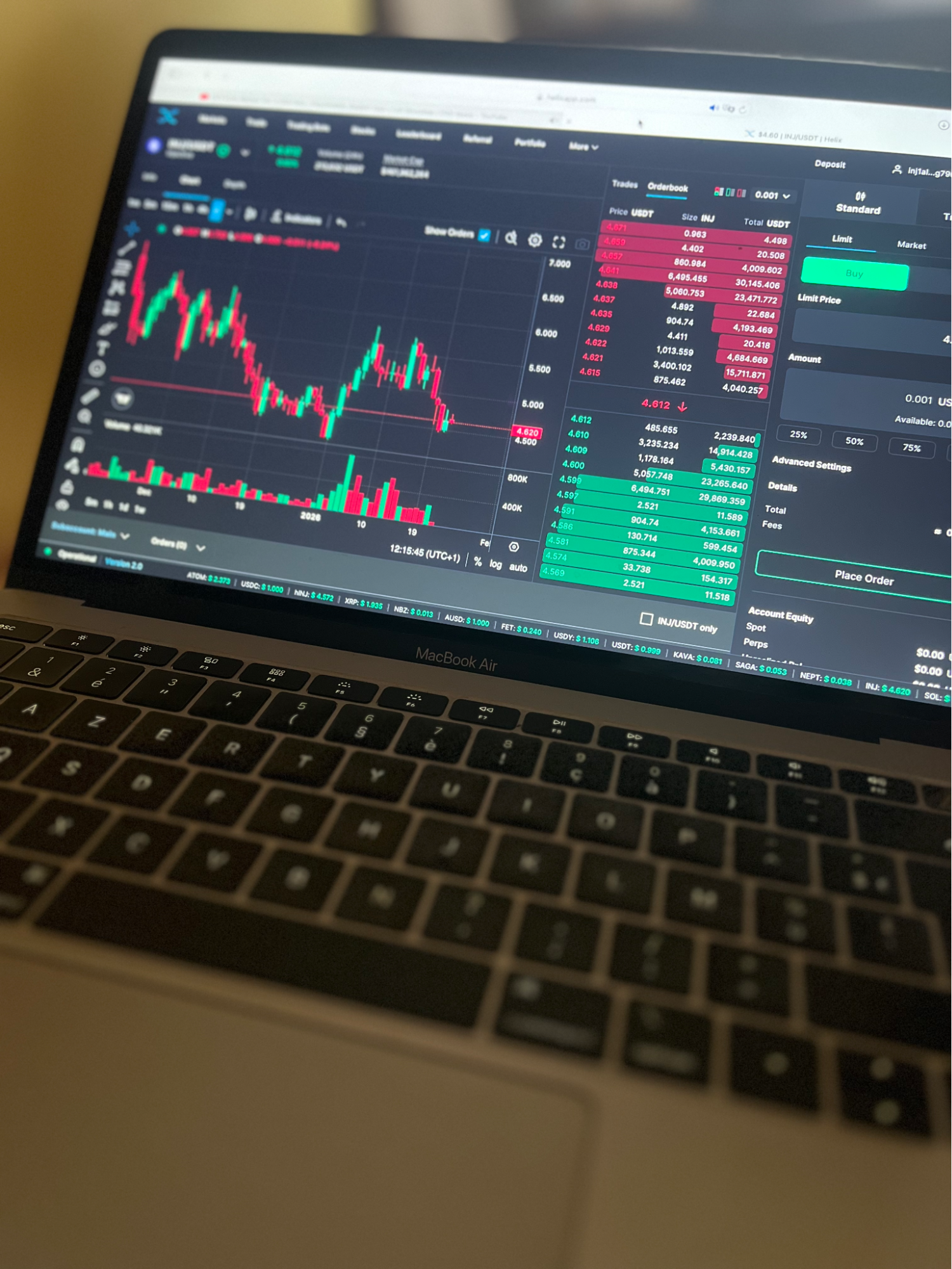
Reasons traders move away from Helix
Even if you like the idea of a decentralized, non-custodial order book, Helix won’t fit every trading style. In GNcrypto’s 2026 hands-on testing, Helix finished with a final score of 3.9/5, which is solid, but it’s also a signal that the product is optimized for a specific type of trader.
In practice, most people start searching for Helix alternatives for one (or more) of these reasons:
- Liquidity is uneven across markets. BTC/USDT perps had about ~$500K within 0.1% at peak, while smaller markets thinned out and spreads widened ~50–70% off-peak.
- Trading is not “free,” it is just gasless. Fees still follow maker–taker pricing (maker: -0.005%, taker: 0.05%), and funding can dominate total cost on longer holds.
- Funding adds up fast. In Jan 14–20, 2026, BTC/USDT funding averaged 0.0092% per hour (positive), so multi-day longs needed to price it in.
- Risk controls are limited. Execution was quick (~0.4s latency on majors), but there are fewer advanced order and safety tools than on large CEXs.
- The learning curve is steep. Helix assumes you already understand order books, maker–taker fees, funding, and liquidation mechanics, with lighter in-app guidance than big platforms.
Top Helix alternatives compared
The most practical Helix exchange alternatives for real-world traders, ranked by three priorities:
- consistent liquidity on core markets,
- transparent fees and predictable trading costs,
- a trading experience that matches specific goals (from high-frequency perps to casual spot).
Binance
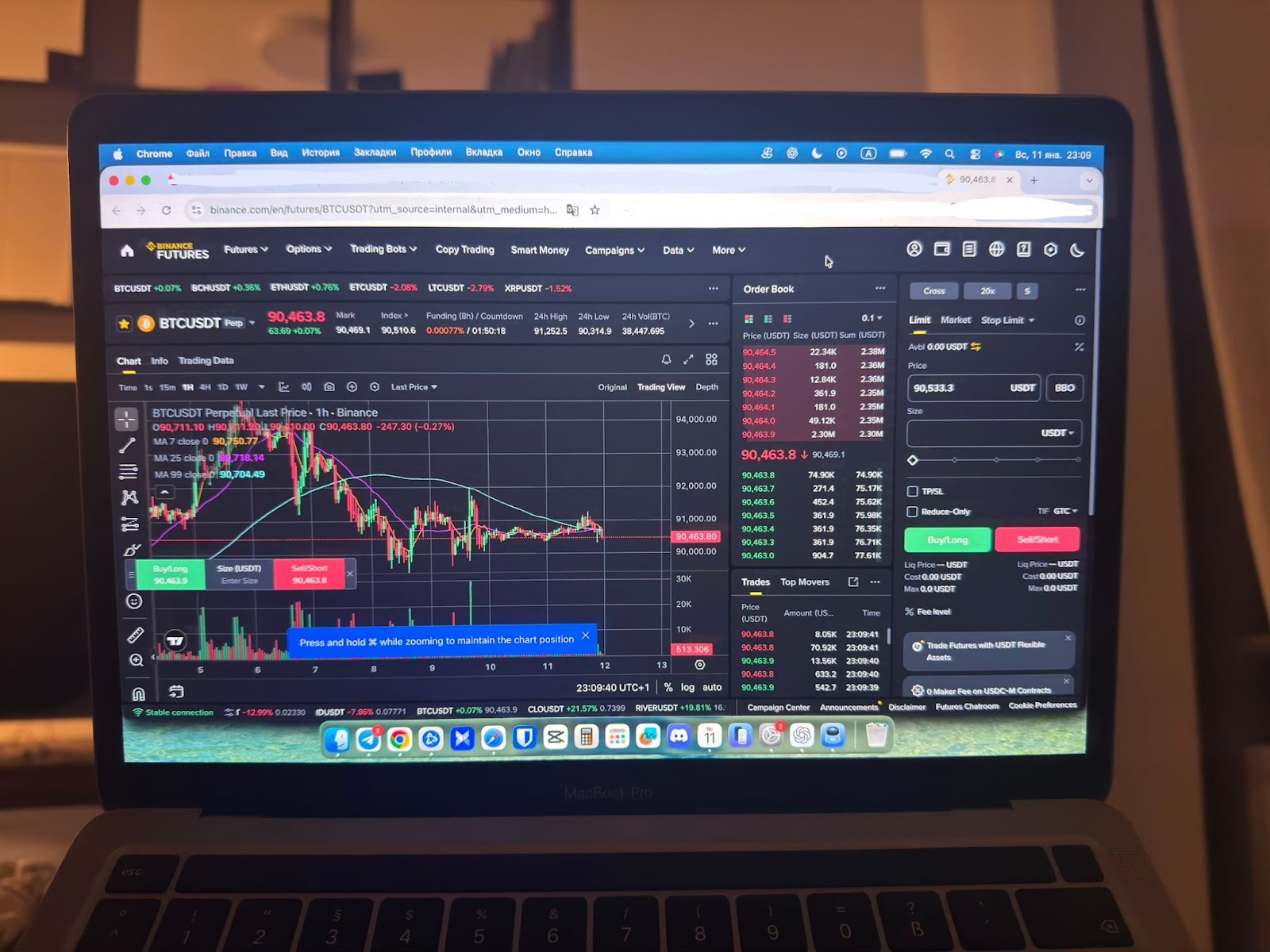
Based on GNcrypto’s Binance Futures 2026 review, Binance scored 4.4/5 in hands-on testing, compared with Helix at 3.9/5. The difference is mostly about what each venue is built for. Binance Futures is a centralized derivatives platform with very high liquidity, a huge contract list, and a full suite of margin and risk tools. Helix is a non-custodial, orderbook-based venue on Injective, which can feel fast and “exchange-like” on major markets, but liquidity and spreads become less consistent once you move beyond the most active pairs.
On pure trading costs, the pricing models are different. Helix uses a maker rebate (maker: -0.005%) and a 0.05% taker fee, while Binance Futures lists VIP 0 fees at maker 0.02% and taker 0.04% (sometimes 0.05% depending on contract). Funding is the bigger wildcard on both platforms. Binance applies funding every 8 hours, while Helix funding in testing averaged 0.0092% per hour on BTC/USDT during Jan 14 to 20, 2026, which made holding positions for days meaningfully more expensive.
Benefits
Very deep liquidity on major perps, fast execution, broad contract coverage, and mature risk tooling.
Limitations
Binance Futures is unavailable in several countries, including the United States, Canada, the United Kingdom, Germany, Italy, Singapore, Japan, and others. It is also a complex product that assumes you already understand leverage, margin, and liquidation mechanics.
Best for
Experienced derivatives traders who want maximum liquidity, high leverage options, and advanced order controls.
Strengths:
- Higher overall score than Helix in GNcrypto testing: 4.4/5 vs 3.9/5.
- Very strong liquidity profile, with average daily futures volume around $96B and market orders executing in about 180 to 320 ms on major pairs.
- Broad derivatives coverage, with 200+ futures and options pairs, plus new listings announced in advance.
- Up to 125x leverage on major pairs, with isolated and cross margin modes.
- Strong risk tooling and order types (stop market, trailing stop, post only, TWAP, scaled orders), with stop execution behaving as intended in volatility tests.
Weaknesses:
- Access is restricted by region, and Binance Futures is not available in the United States and many other jurisdictions.
- Customer support was slow in testing (first response after 23 hours), and user reports cite occasional losses tied to sudden token delistings or trading halts.
Margex
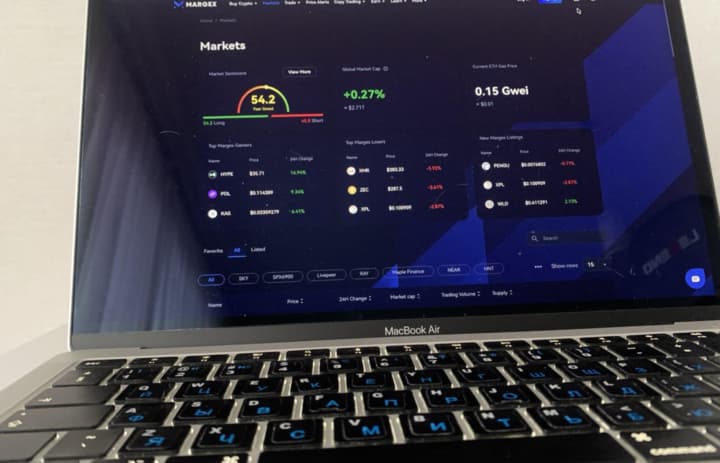
Based on GNcrypto’s Margex 2026 review, Margex scored 3.1/5 in hands-on testing, compared with Helix at 3.9/5. Margex is a centralized, retail-focused perpetual futures venue built around simplicity. Helix is a non-custodial, orderbook-based venue on Injective that can feel fast on major markets, but it tends to be more “DeFi-native” in workflow.
Costs also differ by design. Helix uses a maker rebate (maker: -0.005%) and a 0.05% taker fee. Margex tested at maker 0.019% and taker 0.060%. Funding is a key variable on both. In Margex testing, BTC funding averaged 0.011% per 8 hours over a 7-day tracking window. In Helix testing, BTC/USDT funding averaged 0.0092% per hour in the Jan 14 to 20, 2026 window, so longer holds needed extra attention to funding impact.
On liquidity, Margex is fine for retail sizing on majors, but it is not a “deep book” venue. The review cites daily volume around $85M on BTC/USDT and $35M on ETH/USDT, with slippage staying low on BTC for $2K to $4K orders, while altcoin slippage rose quickly once position size increased.
Benefits
A clean, beginner-friendly interface for perps, clear liquidation and margin visibility, and basic risk tools (stop-loss and take-profit) that worked as expected in testing.
Limitations
Margex offers a small contract list (18 perpetuals as of Jan 2026), has no direct fiat deposits or withdrawals, and has weaker regulatory standing than top-tier exchanges. The platform is also typically blocked for U.S. users, and slippage can become costly on lower-liquidity altcoin contracts.
Best for
Retail traders who want a simple perpetual futures interface and mostly trade BTC or ETH with small to mid-sized orders.
Strengths:
- Simple, readable UI that makes liquidation price, margin usage, and PnL easy to track.
- Competitive fees for a retail venue (maker 0.019%, taker 0.060%), with clearly measurable costs in the review’s test trades.
- Solid major-pair execution for modest sizing, with low BTC slippage reported for $2K to $4K orders.
- Adjustable leverage up to 100x on BTC and ETH, with lower caps on altcoins.
- Core risk controls (stop-loss, take-profit) behaved as intended during volatility tests.
Weaknesses:
- Lower overall score than Helix in GNcrypto testing: 3.1/5 vs 3.9/5.
- Limited market coverage (18 contracts) and no fiat on-ramps or off-ramps.
- Regional access limits, including typical blocking of U.S. users, plus a weaker regulatory profile.
- Funding costs can be meaningful over time, and altcoin slippage can spike at larger sizes.
PrimeXBT
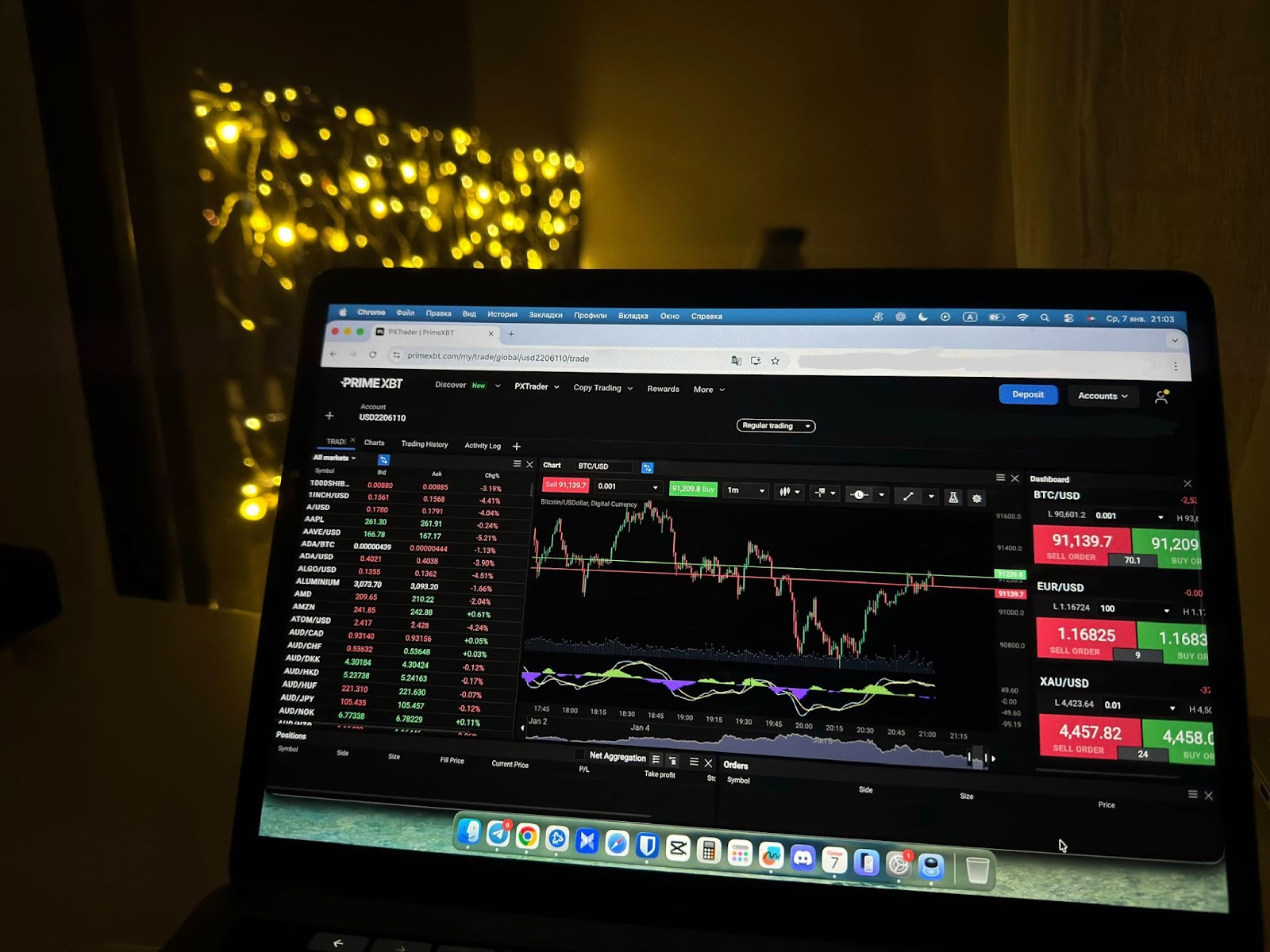
Based on GNcrypto’s PrimeXBT Futures 2026 review, PrimeXBT scored 4.0/5 in hands-on testing, compared with Helix at 3.9/5. PrimeXBT is a derivatives-first platform focused on perpetual crypto futures and CFDs. It has no spot markets and no asset custody, which makes it a tool for active traders, not long-term investors. Helix is a non-custodial, orderbook-based venue on Injective, which can feel fast and exchange-like on majors, but it is more DeFi-native in workflow.
On trading costs, the fee model is the clearest difference. Helix uses maker/taker pricing (maker: -0.005% rebate, taker: 0.05%). PrimeXBT applies a fixed 0.05% fee on crypto futures per trade, with no classic maker/taker split, and the fee is charged when a position is opened. Funding is also a key variable. PrimeXBT applies funding every 8 hours. Helix funding in testing averaged 0.0092% per hour on BTC/USDT during Jan 14 to 20, 2026, so multi-day holds needed careful funding math.
PrimeXBT’s execution on majors tested as stable, with tight spreads on BTC and ETH thanks to an aggregated liquidity model, while spreads widened faster on less liquid altcoins. Tooling is built for active trading: TradingView charts, market and limit orders, stop-loss, take-profit, and OCO. The platform also offers Covesting copy trading, but the profit-share model can take a meaningful cut (up to 40% split between the trader and the platform).
Benefits
Strong major-pair execution, TradingView charting, OCO orders, and high leverage options for experienced traders.
Limitations
PrimeXBT is derivatives-only (no spot trading), does not publish a Proof of Reserves, and does not support fiat withdrawals. Availability is restricted in several countries, and the interface can feel unfamiliar if you are coming from Tier-1 exchanges.
Best for
Experienced derivatives traders who want high leverage, multi-asset exposure (including CFDs), and a trading terminal optimized for short-term strategies.
Strengths:
- Higher overall score than Helix in GNcrypto testing: 4.0/5 vs 3.9/5.
- Simple crypto futures pricing, with a fixed 0.05% fee per trade and no maker/taker split.
- High leverage ceiling (up to 500x on crypto futures), with flexible leverage selection per position.
- Solid majors execution and tight BTC and ETH spreads in testing, supported by aggregated liquidity.
- Practical trading tools such as TradingView charts and OCO orders, plus a full-featured mobile app.
- Live chat support reached a human agent in about 3 minutes in the review.
Weaknesses:
- No spot markets or real coin ownership, so it is not designed for long-term holding.
- No Proof of Reserves, which is a transparency gap for a leveraged, custodial platform.
- Crypto-only withdrawals, with no fiat cash-out option.
- Very high leverage can liquidate positions faster than stops in fast moves, especially at extreme settings.
- Country restrictions, with access blocked in the United States and other major jurisdictions.
- No built-in VPS, and the interface can be unintuitive for users used to Binance or Bybit layouts.
ApeX Pro
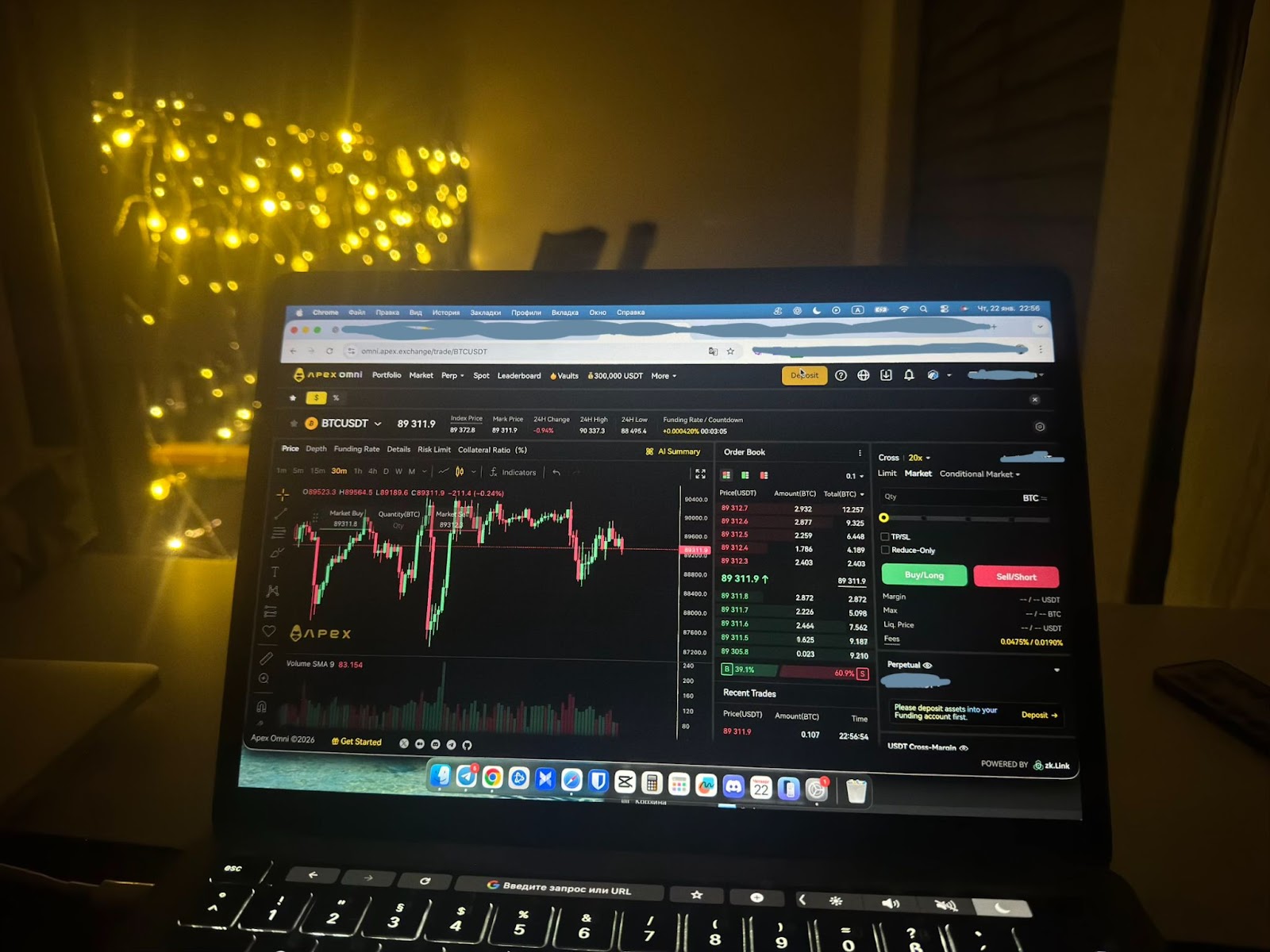
Based on GNcrypto’s ApeX Pro 2026 review, ApeX Pro scored 3.8/5 in hands-on testing, compared with Helix at 3.9/5. We think both are non-custodial in different ways, but with distinct approaches. Helix is an on-chain order book on Injective, while ApeX Pro runs a USDC-margined perpetuals order book across networks like Ethereum, Arbitrum, BNB Chain, and Polygon, using Layer 2 execution (StarkEx) to keep trading fast and gasless.
On costs, ApeX Pro uses standard maker/taker pricing at about 0.02% maker and 0.05% taker, with no gas fees. Helix, in GNcrypto testing, used a -0.005% maker rebate and a 0.05% taker fee, so maker-heavy traders can see meaningfully lower costs on Helix. Ongoing costs behave differently across platforms. In the ApeX Pro review, GNcrypto did not observe classic periodic funding payments, since pricing is set directly by the order book, while Helix perps include funding that can materially affect multi-day holds.
Execution on ApeX Pro was responsive. Market orders filled in under 1 second from click to confirmation, and limit orders appeared in the book within about 0.5 seconds. During a 4% BTC move in 15 minutes, the interface stayed stable with no order rejections. Liquidity was described as reliable for small to mid-sized trades on majors, but large positions can face partial fills.
Benefits
Low fees with no gas costs, fast execution that feels CEX-like, and a non-custodial setup with audited smart contracts.
Limitations
ApeX Pro has a limited instrument list beyond BTC and ETH, fewer order types than top venues, and support that is mostly Discord and email with delays. Access is also restricted in some countries, including the United States.
Best for
Futures traders who want a non-custodial perpetual order book, low fees, and fast execution, and who mainly trade majors.
Strengths:
- Comparable overall score to Helix in GNcrypto testing: 3.8/5 vs 3.9/5.
- Low trading fees (about 0.02% maker and 0.05% taker) with no gas fees, thanks to Layer 2 execution.
- Clear cross margin mechanics with leverage tested up to 20x, plus transparent liquidation and margin metrics.
- Strong performance in volatility, with market fills under 1 second and limit orders posting in about 0.5 seconds.
- Non-custodial model with audited contracts, plus flexible network support (Ethereum, Arbitrum, BNB Chain, Polygon).
- Fast withdrawals in testing, with a $50 USDC withdrawal on Arbitrum arriving in 12 seconds.
Weaknesses:
- Lower depth outside majors, and large orders can see partial fills or worse execution.
- Limited order types (Limit, Market, Conditional Market, Conditional Limit).
- Support quality is weak, with bot-first chat and delayed human help via Discord or email.
- Geographic access limits, including blocking for U.S. users.
- No traditional regulatory oversight, and no Proof of Reserves.
Best Helix alternatives by trading objectives
The right Helix alternative depends on your trading style. Use these quick picks to match a venue to your workflow:
If you want the simplest onboarding and the most familiar CEX-style interface:
Margex
It stood out for a clean, beginner-friendly layout with clear margin and liquidation visibility, plus basic SL/TP controls that worked as expected.
If you care most about deep liquidity on major spot pairs:
Binance
The review data points to an extremely strong liquidity profile on major markets, with average daily futures volume around $96B and market orders executing in roughly 180 to 320 ms on top pairs.
If you mainly trade perpetuals and need robust risk controls:
Binance first, PrimeXBT as a simpler “trading terminal” alternative
Binance offers the most mature set of order types and margin modes, while PrimeXBT adds practical tools like TradingView charting and OCO orders for active strategies.
If you want a DeFi-first experience with self-custody and on-chain settlement:
ApeX Pro
It is built around a non-custodial perpetual order book with Layer 2 execution for fast, gasless trading, and it performed reliably during volatility testing.
If you’re a U.S. trader and need a platform that actually works for your region. None of the futures products covered here are presented as U.S.-available in the source reviews. If you are U.S.-based, double-check access before you deposit, and prioritize venues that explicitly support your state and compliance requirements.
Helix alternatives 2026: side-by-side comparison
| Exchange | Score | Standout | Fees | Assets | Best for |
|---|---|---|---|---|---|
| Helix | 3.9/5 | Non-custodial order book on Injective | Maker: -0.005%, Taker: 0.05%, Funding: 0.0092%/hr | BTC, ETH, majors | DeFi-native traders, on-chain perps |
| Binance Futures | 4.4/5 | Deepest liquidity on majors | Maker: 0.02%, Taker: 0.04-0.05%, 8hr funding | 200+ futures/options | Experienced derivatives traders |
| Margex | 3.1/5 | Simple retail perps interface | Maker: 0.019%, Taker: 0.060% | 18 perpetuals | Retail traders, BTC/ETH focus |
| PrimeXBT | 4.0/5 | High leverage, TradingView charts | Fixed: 0.05%, 8hr funding | 130+ crypto futures | Active traders, multi-asset exposure |
| ApeX Pro | 3.8/5 | Non-custodial L2 perps | Maker: 0.02%, Taker: 0.05%, no gas | BTC, ETH, majors | DeFi-first traders, self-custody |
The material on GNcrypto is intended solely for informational use and must not be regarded as financial advice. We make every effort to keep the content accurate and current, but we cannot warrant its precision, completeness, or reliability. GNcrypto does not take responsibility for any mistakes, omissions, or financial losses resulting from reliance on this information. Any actions you take based on this content are done at your own risk. Always conduct independent research and seek guidance from a qualified specialist. For further details, please review our Terms, Privacy Policy and Disclaimers.
Articles by this author