GMX reviews 2026: futures, fees, and trader experience

GNcrypto analysts tested GMX under live trading conditions with $200 to evaluate trading fees, leverage usage, order execution, and overall platform usability. We also assessed liquidity, supported assets, and key trust factors, assigning the platform a final score of 3.6/5.

Fees & Funding
4.5/5
Leverage & Margin
4.5/5

Fees & Funding
4.2/5
Leverage & Margin
4.2/5

Fees & Funding
4.2/5
Leverage & Margin
4.3/5

Fees & Funding
4.4/5
Leverage & Margin
4.2/5

Fees & Funding
4.5/5
Leverage & Margin
4/5
What GMX is
GMX is a decentralized perpetual futures exchange operating fully on-chain across Arbitrum One, Avalanche, and Botanix, where all positions and liquidity are managed directly on the network’s smart contracts. Through the Multichain/LayerZero system, trading is also available from other EVM chains like Base or Ethereum; however, actual execution and liquidity remain on GMX’s main markets, with trades from external networks routed via cross-chain bridges to synchronize with the native perp contracts. The maximum leverage for each trading pair is determined dynamically through smart contracts, taking into account pool liquidity, open interest, and risk parameters such as the minCollateralFactor. Deeply liquid markets – like BTC/USDC on Arbitrum – can offer up to 100× leverage, while more volatile or less liquid pairs have lower caps (e.g., 50×).
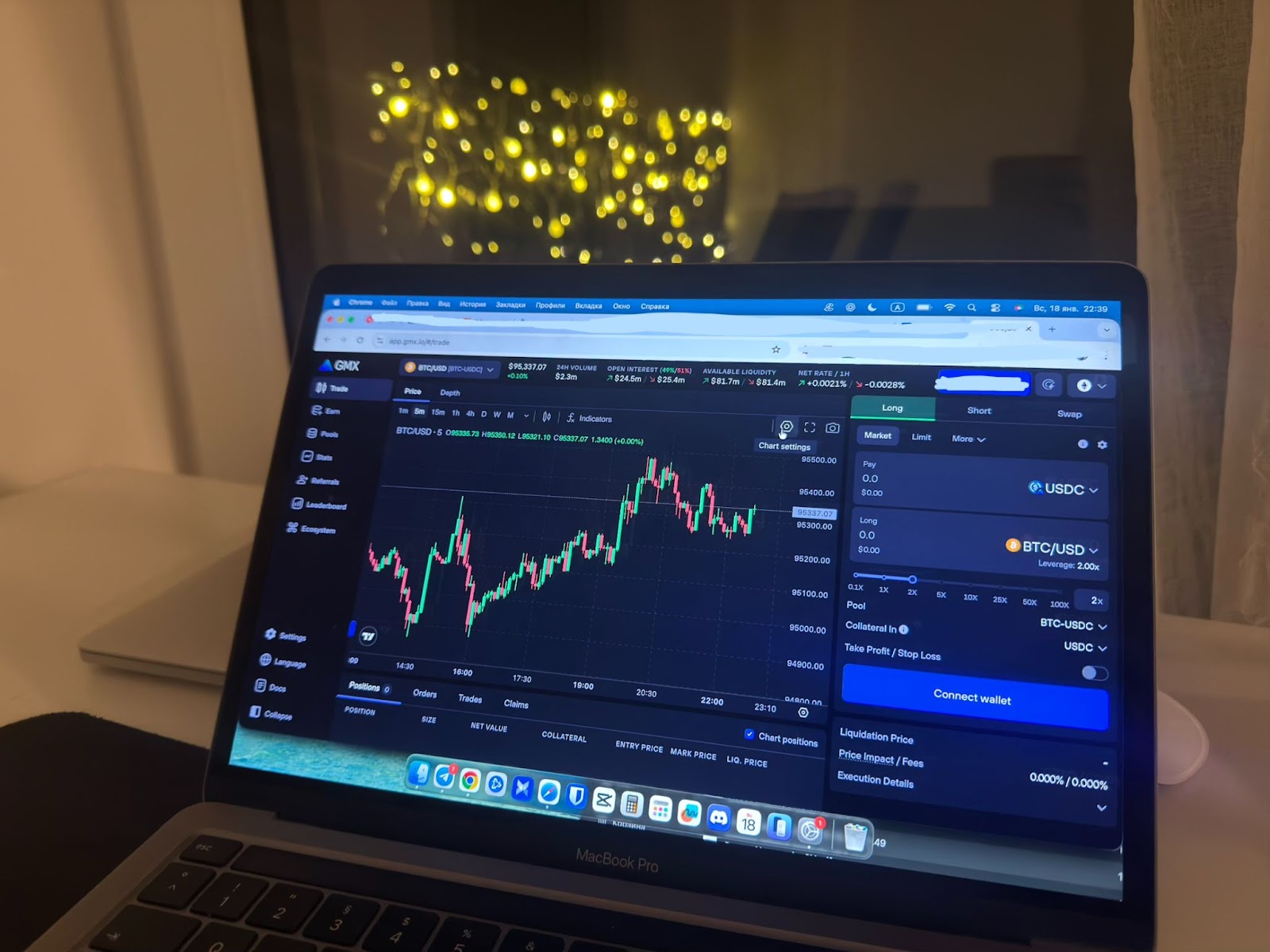
The standout feature of GMX is its oracle-based pricing system. Prices are sourced from multiple major exchanges via Chainlink, helping to prevent sudden market swings and accidental liquidations – a common issue on centralized platforms.
We tested the platform for our GMX review as everyday users and here’s what it offers:
- Easy onboarding: we only had to connect our wallet – no registration, accounts or KYC
- Long and short positions, market, limit, take-profit, stop-loss, and TWAP orders
- Leverage up to 100× on liquid pairs
- Two trading models: V1 and V2
- Trading through liquidity pools rather than an order book
On-chain data shows that GMX has surpassed $230+ billion in total trading volume, with over 600,000 users – a remarkable achievement for a derivatives DEX.
Fees, funding & incentives
We tested all of GMX’s fees and economic mechanics to understand the real cost of trading and what users actually get for their money. Like most GMX reviews, we also compared V1 and V2 to highlight differences in fees and incentives.
Fees: V1 vs V2
GMX V1
- Opening/closing a position: 0.1%
- Swaps: 0.2% – 0.8%, depending on pool balances
Funding rate: none - Execution fee: paid to the network
GMX V2
- Opening/closing a position: 0.04% – 0.06%
- Swaps: 0.05% – 0.07%
- Stablecoin swaps: 0.005% – 0.02%
- Borrowing fees apply when the market is imbalanced
We noticed that all fees are displayed before opening a trade – no hidden costs. In practice, V2 tends to be cheaper for balanced positions and active trading.
Incentive model
GMX doesn’t use a traditional funding rate. All revenue flows through:
- GMX token – holders earn a share of fees and participate in governance.
- GLP / GM – liquidity providers earn from spot trading and trader losses.
We opened a short position with leverage, and the fees went directly to the pool, with GLP holders receiving immediate profits. This shows that the economic model is transparent and easy to understand. If you’re a trader, V2 is more cost-effective, whereas V1 and GLP offer a steady stream of fees for passive liquidity providers.
Who GMX is best for
Based on our testing, GMX is a niche tool rather than a one-size-fits-all exchange.
GMX is suited for:
- Traders focused on GMX futures rather than spot trading
- Users who value trading without KYC
- Those who appreciate transparent fees and on-chain logic
- Experienced traders working with leverage and risk management
GMX is not suited for:
- Beginners without derivatives experience
- Users looking for a wide selection of altcoins
- Those unwilling to accept smart contract risks
After testing the platform, we can say it outright: GMX is one of the strongest perpetual DEXs on the market, but it’s designed for prepared, knowledgeable users. It’s not a direct replacement for all CEXs. It’s a functional on-chain tool for futures trading, featuring clear economics, fair fees, and zero marketing illusions.
GMX pros & cons
Here are its real strengths and weaknesses.
Strengths:
- High leverage with protection against price spikes – when trading ETH with 20× leverage, liquidations only triggered on actual price drops, not due to sudden anomalous oracle candles.
- Low and transparent fees – opening a position on V2 cost 0.05%, USDC swaps were 0.01%, and all calculations are visible upfront.
- On-chain revenue participation – GLP holders immediately see their share of income from trader losses and swap fees, with no delays.
Multichain support and cheap networks – Arbitrum and Avalanche provide fast transactions with minimal gas fees; we tested $1K swaps that executed in seconds with $2–3 fees.
Weaknesses:
- Limited asset selection – GMX currently supports only a handful of digital assets: V1 on Avalanche offers 4 pairs, while Arbitrum has 10–12. During testing, we wanted to short DOGE and had to switch to V2. Overall, the platform’s range of coins is noticeably narrower than on many other exchanges.
- Smart contract risk – the platform is fully decentralized, and although a $5M bug bounty exists, any vulnerabilities in the code could result in loss of funds. Withdrawals from pools and swaps were fast during our testing, but inherent smart contract risks remain.
- High-risk trading – leverage trading is inherently risky and can amplify both gains and losses, making it unsuitable for inexperienced traders.
Trustworthiness check
When evaluating GMX’s reliability, we focused on audits and smart contracts, fund protection via liquidity pools, the bug bounty program, and overall platform transparency.
- Audits: All contracts are regularly reviewed by independent firms, with reports publicly available.
- Bug bounty: The $5M program incentivizes the identification of vulnerabilities and has proven effective in practice.
- Decentralization and fund control: Users trade directly from their own wallets – GMX does not hold funds centrally.
- Oracle protection: Chainlink oracles safeguard against sudden price manipulations.
- Limitations: Like any DEX, GMX cannot fully eliminate the risks of smart contract bugs or liquidity imbalances.
GNcrypto’s overall rating
| Criteria | Rating (out of 5) | Weight | Notes |
|---|---|---|---|
| Trading Fees & Funding Costs | 3.5/5 | 25% | Trading fees are low, ranging from 0.05–0.07% on V2, with swaps for stablecoins costing just 0.005–0.02%. However, borrowing fees can increase during imbalances, and network fees vary depending on blockchain congestion |
| Leverage & Margin Requirements | 4/5 | 20% | Leverage goes up to 100×, though it’s generally safer to use lower levels. This feature is suited for experienced traders, while beginners may find it too risky |
| Contract Selection & Liquidity | 3/5 | 15% | V2 on Arbitrum supports over 40 cryptocurrencies, while V1 is limited to 4–10 assets. Liquidity remains stable thanks to the GLP pool, but the range of trading instruments is narrower compared to major centralized exchanges |
| Platform Performance & Risk Controls | 3.5/5 | 15% | The platform offers high speed on Arbitrum and Avalanche, with stop-loss and take-profit orders functioning correctly. However, there’s no support for MT4/MT5, and trading tools remain fairly basic |
| Security & Regulatory Compliance | 4/5 | 10% | Regular audits, a $5M bug bounty, and direct user control over funds enhance security, but smart contract risks remain |
| User Experience & Trading Interface | 3.5/5 | 10% | The interface is clean and intuitive, though beginners might find navigating between V1 and V2 a bit challenging |
| Customer Support & Educational Resources | 3/5 | 5% | Documentation is available, including wallet guides and instructions for Arbitrum and Avalanche. There’s no 24/7 support, and educational materials are sufficient but fairly basic |
Final Score: 3.6/5
Our verdict: GMX is a fast and secure DEX offering high leverage and transparent fees. Its main strengths include speed, protection against price manipulation, and decentralized fund control. However, the platform’s limited asset selection, smart contract risks, and minimal support for beginners make it better suited for experienced derivatives traders rather than the general crypto audience.
Methodology – why you should trust us
We tested GMX using our weighted, category-based model, depositing $200 in BTC and opening leveraged positions (10x-50x) on BTC/USD and ETH/USD perpetuals. We monitored funding rates over 5 days, tested stop-loss execution during volatility, measured spreads during US and Asia trading hours, and withdrew funds to verify processing times. We rate platforms on 7 weighted criteria with scores from 1.0 to 5.0. Our testing uses real capital, not demo accounts.
Read our full methodology: How We Test Crypto Futures Trading Services
The material on GNcrypto is intended solely for informational use and must not be regarded as financial advice. We make every effort to keep the content accurate and current, but we cannot warrant its precision, completeness, or reliability. GNcrypto does not take responsibility for any mistakes, omissions, or financial losses resulting from reliance on this information. Any actions you take based on this content are done at your own risk. Always conduct independent research and seek guidance from a qualified specialist. For further details, please review our Terms, Privacy Policy and Disclaimers.
Articles by this author