Solana decentralization questioned as validator ranks thin

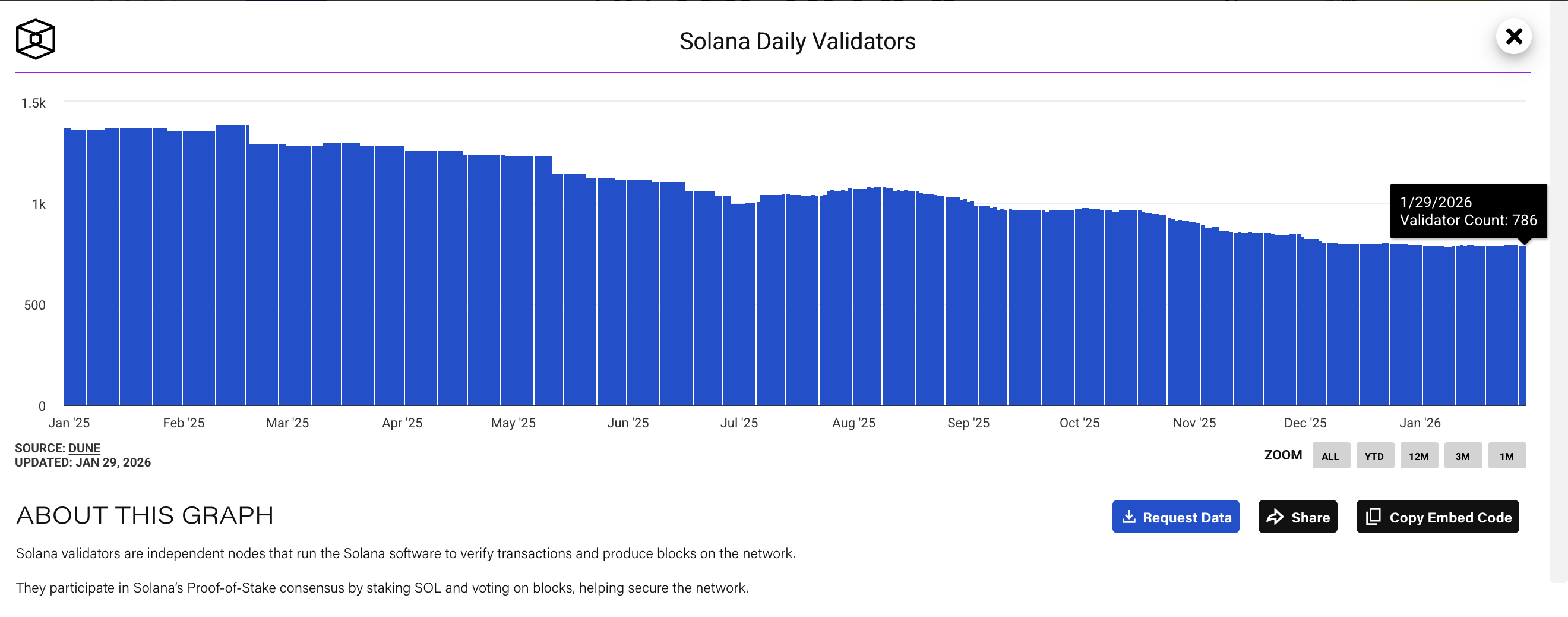
Solana active validator count has fallen to about 795 from a March 2023 peak of 2,560, while the network Nakamoto coefficient declined to 20 from 31, renewing attention on how much stake and block production are concentrated among a smaller group of operators.
The validator decline has coincided with a weaker decentralization reading. The Nakamoto coefficient is commonly used as a proxy for how many independent entities would need to coordinate to disrupt or censor the network, and the latest drop implies fewer operators now account for a critical share of stake compared with early 2023.
Operators have pointed to tightening economics as a key driver. Validators must continuously submit votes to participate in consensus, an activity that carries recurring on-chain costs that rise with network activity. At the same time, hardware requirements have trended higher over time, with validators increasingly needing high-memory servers, fast NVMe storage and reliable high-bandwidth connectivity to keep pace with Solana’s throughput.
Revenue pressure has also intensified as larger operators compete aggressively for delegated stake. Some major validators now advertise 0% commission, a practice that compresses margins across the ecosystem and leaves smaller operators with limited income to cover fixed expenses such as infrastructure, monitoring and maintenance. Validators have said this dynamic makes it difficult for independent nodes to scale sustainably without significant self-stake or external backing.
Part of the headline reduction reflects the cleanup of inactive or “zombie” validators that were no longer participating in consensus, but the remaining set is still materially smaller than in 2023, with concentration metrics moving in parallel.
The Solana Foundation continues to run delegation and support programs aimed at distributing stake to smaller validators, but network data shows that economic forces are still favoring operators with larger balance sheets and existing scale. As a result, the validator landscape is increasingly shaped by cost efficiency and access to stake, alongside technical performance, rather than simple node count alone.
The material on GNcrypto is intended solely for informational use and must not be regarded as financial advice. We make every effort to keep the content accurate and current, but we cannot warrant its precision, completeness, or reliability. GNcrypto does not take responsibility for any mistakes, omissions, or financial losses resulting from reliance on this information. Any actions you take based on this content are done at your own risk. Always conduct independent research and seek guidance from a qualified specialist. For further details, please review our Terms, Privacy Policy and Disclaimers.
Articles by this author