ETH Denver 2026 opens with a builder focus amid market downturn

ETH Denver 2026 opened at the new National Western Center campus, showing that despite the market slump, builder activity and interest in the Ethereum ecosystem remain high.
Editor’s note: This story is being updated daily with live coverage from the conference.
Day 1: Atkins, stablecoins, and AI agents
Regulatory clarity moves forward
SEC Chair Paul Atkins made his first-ever crypto conference appearance alongside Commissioner Hester Peirce, drawing sustained applause. Atkins previewed what’s coming: a framework for investment contracts, an innovation exemption for tokenized securities trading, and rulemaking on custody, capital raising, and transfer agent modernization. On the recent market downturn, he was direct:
It’s not the regulator’s job to worry about daily swings. It’s our job to make sure market participants have the disclosures they need to make informed decisions.
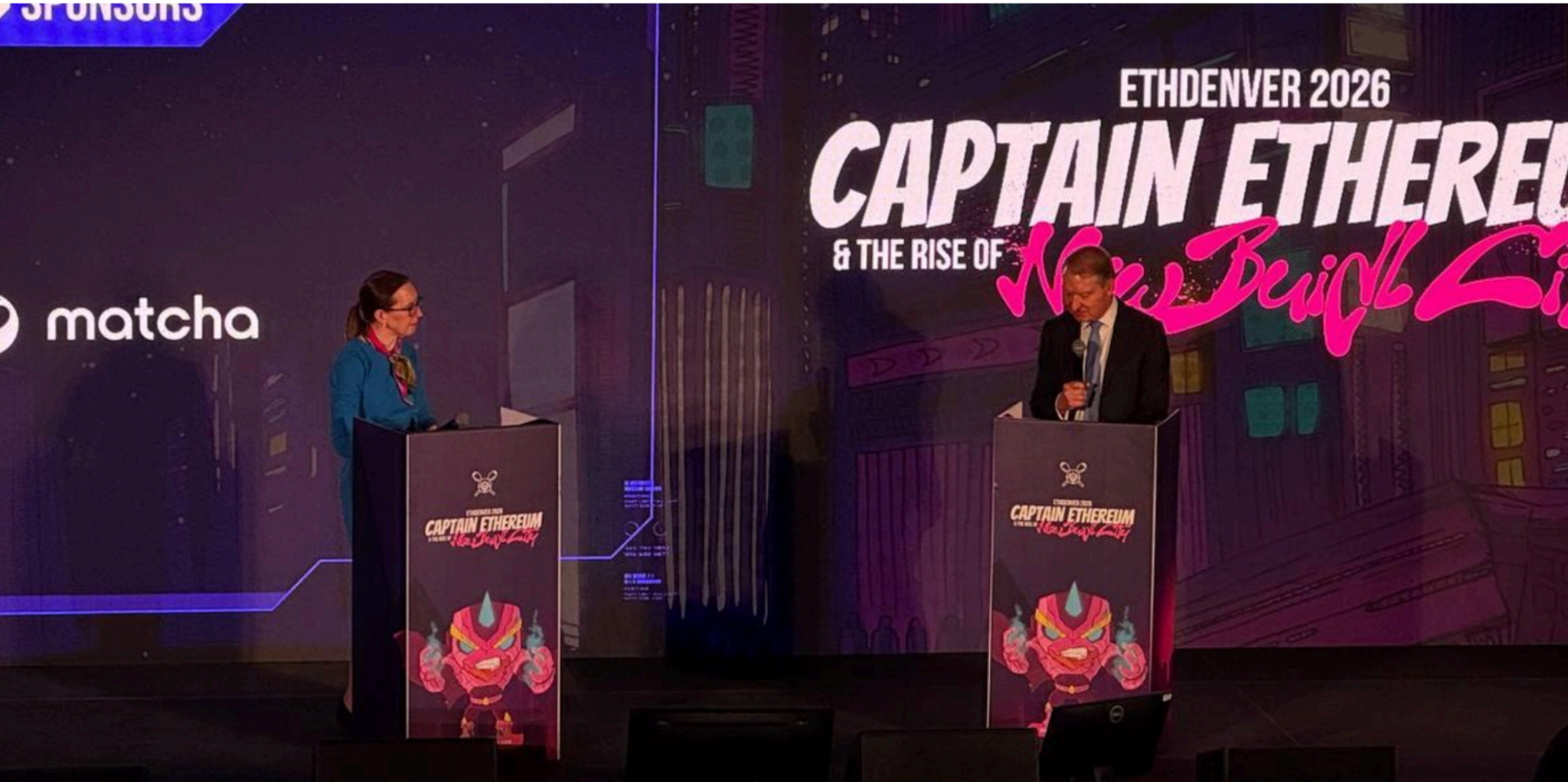
Peirce catalogued progress over the past year: roundtables on trading, custody, tokenization, and DeFi; staff guidance on staking, stablecoins, and memecoins; the end of SAB 121; and a new joint initiative with the CFTC.
Senate Subcommittee Staff Director Chris Land said the Clarity Act is at “the five-yard line” and emphasized the legislative push:
We want this industry to become part of our legal framework and give it a chance to grow.
Ethereum as stablecoin infrastructure
Maria Shen (Electric Capital) argued Ethereum is uniquely positioned to host the digital dollar economy, citing on-chain data: over $160 billion in stablecoins, $80 billion in DeFi protocols, and $14 billion in real-world assets already settled on Ethereum. She framed it as “the largest expansion of the dollar’s network effects in decades,” with stablecoins growing 60x since 2020 and 4 billion people facing significant currency risk. Her conclusion: “Holding ETH is likely the simplest and most effective way to gain exposure to this growing stablecoin economy.”
Tomasz Stańczak (Ethereum Foundation) said there are no longer “difficult hurdles” for institutions entering crypto:
What we’ve built created the rails for servicing institutional customers and fulfilling the promise of disintermediation.
AI agents cross the chasm
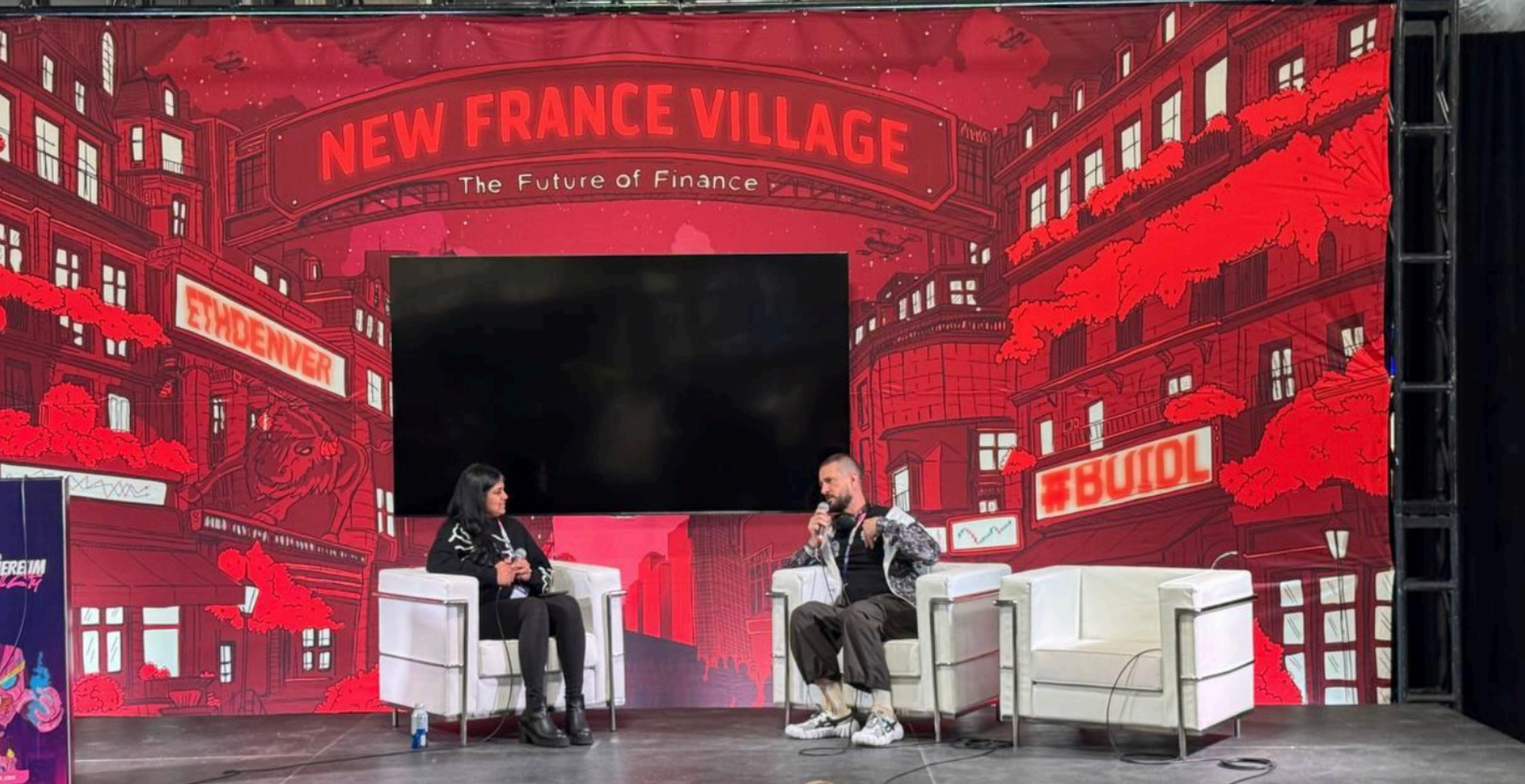
Vitalik Buterin joined virtually to discuss AI alignment with Ethereum’s security-first principles. He drew parallels to zero-knowledge proofs:
Just like ZK washed away many intricate half-solutions from the previous era, AI is going to do the same for the user. But it’s very irresponsible to treat AI as magic – we want to take a security-first mindset.

Austin Griffith (Ethereum Foundation) unveiled ETH Skills, a live library teaching AI agents to build on Ethereum. He argued the focus should shift from “don’t be evil” to “can’t be evil.”
Jesse Pollak (Base) told the room that “agent-driven development has crossed the chasm,” shifting from 80% human-led to 80% model-led. He described agents that tokenize, raise capital, and reinvest on infrastructure secured by Ethereum as forming the basis of a new onchain economy.
Gordon Liao (Circle) pushed back on hype:
Reputation is not enough – you need recourse, and that recourse has to be linked to something with stakes.
Institutional adoption and RWAs
Joseph Chalom (Sharplink) said Ethereum needs to “stop being the little brother of Bitcoin,” citing intrinsic value through staking, tokenization, and stablecoin infrastructure. He highlighted the AI agent economy as a major driver:
You’re going to end up building an agentic machine economy like we’ve never seen before.
A panel on real-world assets (Centrifuge, Pantera, Grayscale) identified three forces behind RWA’s breakout: onchain yields becoming competitive, major asset managers lending brand credibility to tokenized products, and regulatory clarity in the U.S. Rayhaneh Sharif-Askary (Grayscale) noted real demand sits with onchain capital allocators and treasury managers buying tokenized T-bills because they cannot easily buy the real thing.
Beto Aparicio (Offchain Labs) said “the bar has been raised” for fundraising but reassured builders that the next cycle will focus on fundamentals:
This will be more about something that works rather than hype – stronger fundamentals with long-term alignment.
New launches
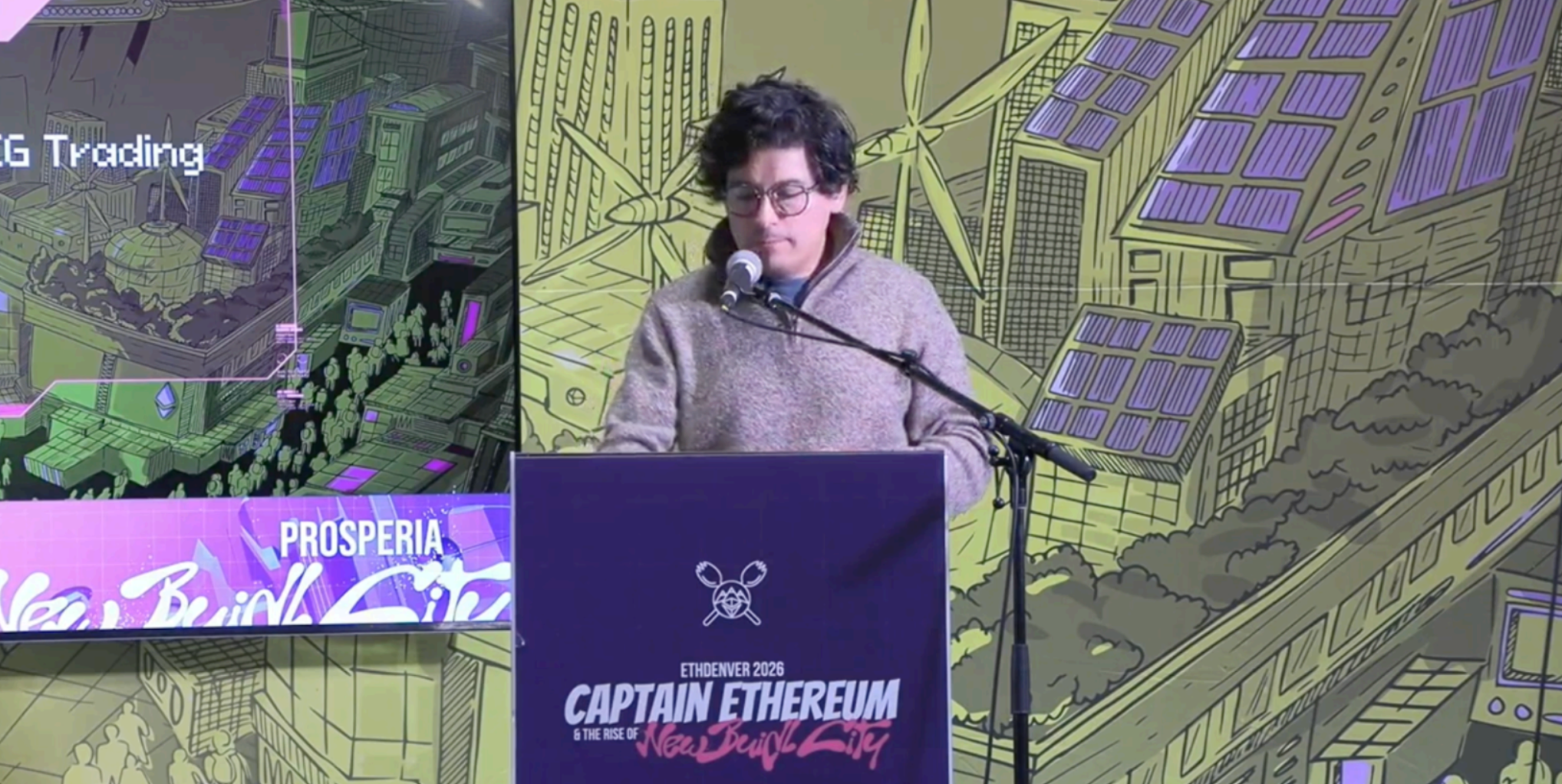
William Mougayar announced TRUSTSHIFT: Ethereum and the Reinvention of Trust, a book arguing that trust architecture is moving from centralized institutions to neutral code. The book provides a macro-level framework for executives and policymakers on why Ethereum exists, what it enables, and why it’s becoming essential infrastructure. Release: September 15, 2026.
Zircuit Finance launched an institutional-grade onchain yield platform targeting 8–11% APR.
ETHDenver 2026: The conference that works best in bear markets
ETH Denver 2026 opened at the revamped National Western Center campus with a clear message: even as the market cools, interest in building the Ethereum ecosystem remains strong.
According to conference founder John Paller, the team spent the entire year preparing, and the bear cycle only sharpened participants’ focus. He noted that ETH Denver “works best” during downturns: the audience becomes smaller but more motivated, and “the signal-to-noise ratio rises sharply.”
Organizers expect around 8,000-10,000 attendees this year – far below the peak of 25,000, but nearly four times the turnout of the 2020 conference. Long-time participants emphasize that this core community is now the main value of the event: less hype, more real ROI, networking, and practical tools.
Unicorn.eth founder Russell Castagnaro says the conference has “returned to its roots” and become more intimate.
Among the new participants are teams exploring ETH Denver as a platform to study decentralized governance models and integrate Web3 into real-world services. NEED-AID founder Tyler Gentry described using the conference to learn about DAOs and engage with active builders who remain focused on long-term ecosystem development.
The cultural layer of the event remains unchanged. Art performances, themed booths, and the Zen Zone mental-health area complement the technical agenda and create what participants describe as “a more mindful and focused” atmosphere.
NFT teams say the mix of AI, wellness themes, and Web3 culture makes the format “intense but comfortable.”
Despite the market downturn, pressure on alts, and declining liquidity, ETH Denver 2026 demonstrates that core ecosystem building continues. The conference serves as another signal: cycles may shift, but Ethereum’s builder energy remains most resilient when prices are low.
The material on GNcrypto is intended solely for informational use and must not be regarded as financial advice. We make every effort to keep the content accurate and current, but we cannot warrant its precision, completeness, or reliability. GNcrypto does not take responsibility for any mistakes, omissions, or financial losses resulting from reliance on this information. Any actions you take based on this content are done at your own risk. Always conduct independent research and seek guidance from a qualified specialist. For further details, please review our Terms, Privacy Policy and Disclaimers.
Articles by this author