Exclusive: EqoFlow’s Trevor Henry on Web3’s data revolution

EqoFlow, a new social media platform, went live with a limited beta mode on October 29, 2025. The project focuses on privacy and decentralization, offering an alternative to traditional social media.
What does EqoFlow aim to change, and how does it work? In an exclusive interview with GNcrypto, EqoFlow co-founder and CEO Tevor Henry discussed the platform’s goals, vision, and what it offers to users.
EqoFlow’s vision and positioning
GNcrypto: If you had one minute to pitch EqoFlow, how would you explain it?
Trevor Henry: EcoFlow is a social ecosystem focused on transparency and privacy. Users get not just a product but become actual shareholders of the platform. So, there’s a lot to say, but that’s where I’d start.
GNcrypto: EqoFlow positions itself as a platform where "users are partners, not products." Can you give a concrete example of how an average user would feel this difference in their first month on the platform?
Trevor Henry: Within the first month on EqoFlow, users will feel the difference by earning engagement points and some tokens for viewing personalized ads. As the community and platform grow, so does the value of your tokens. EqoFlow only collects publicly shared interests and demographics, while sensitive data is protected by Nillion's multi-party computation, and no one gets access to it. Users own their data and get engagement value for their activity on the platform.
GNcrypto: One of your taglines is "EqoFlow is what web3 was meant to be." Do you believe other Web3 social platforms have fallen short? If so, where exactly did they miss the mark, and how does EqoFlow do it differently?
Trevor Henry: Our core values include a community-first approach and data privacy. Your data can’t be exposed or sold, as Nillion’s technology prevents access to it. Even if EqoFlow processes data for analytics, your information remains cryptographically secure and private.
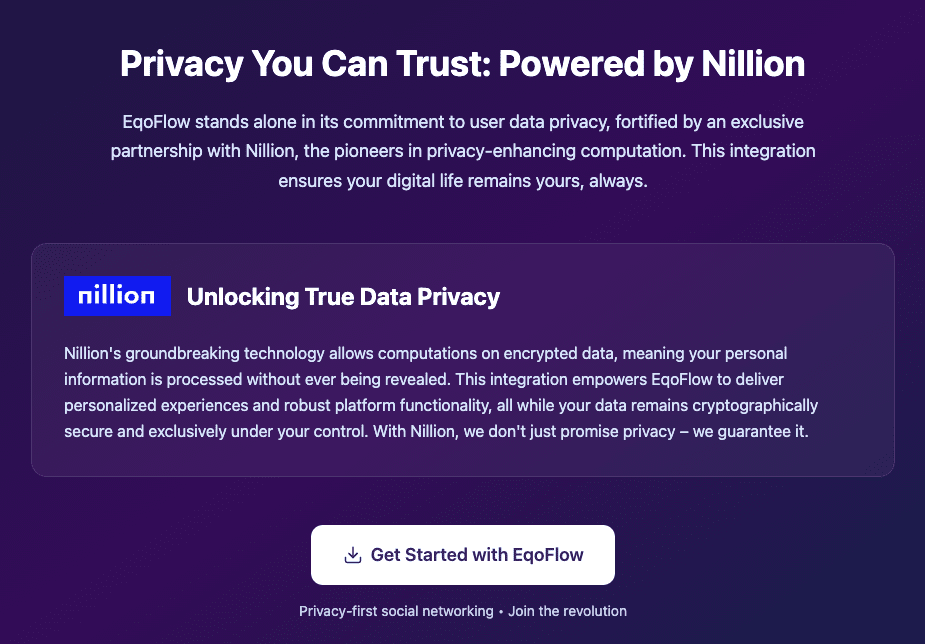
EqoFlow describes itself as a privacy-first social network. Source: eqoflowtechnologies.com
The technology side: Nillion and data security
EqoFlow uses the decentralized infrastructure Nillion, which ensures privacy and content personalization. We asked Trevor Henry how the technology works and how it secures user data.
GNcrypto: Your partnership with Nillion and Multiparty Computation sounds technically complex. How can an average user who doesn't understand cryptography verify that their data is actually protected?
Trevor Henry: Think of Nillion as a digital safety bank that stores user information. Privacy technologies like multi-party computation ensure that no outsider can access the data. That’s basically how it works. The only things we can access are your interests - what types of ads you’re watching - and your demographics, such as your location. Anything else, including who is watching an ad, can’t be revealed.
GNcrypto: EqoFlow claims it can personalize content without seeing users' personal data. That sounds a bit like magic. How does this work technically? And do you sacrifice recommendation quality for the sake of privacy?
Trevor Henry: Recommendation quality is not compromised. For example, if you’re watching cat videos, the platform will show you more of them in your feed without needing your actual data.
Individual information remains completely private, and content is personalized through AI and encrypted computation.
GNcrypto: With Self-Sovereign Identity, users can prove they're over 18 without revealing their identity. How do you prevent fraud in a system like that?
Trevor Henry: EqoFlow’s user verification system prevents fraud risks through KYC (Know Your Customer) and AML (Anti-Money Laundering) checks. A piece of information, like age, is confirmed using privacy-preserving techniques that generate proof of a user’s status without revealing identity data. So, users need to pass private verification and get confirmed, which is fine as it protects our platform from fraud and exploits.
EqoFlow’s economy and the EQOFLO token
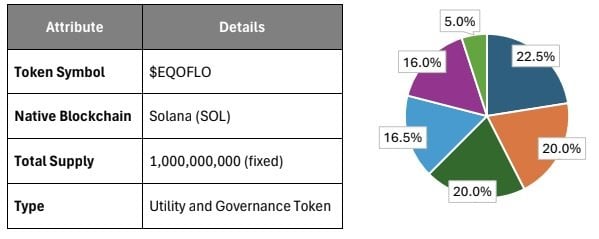
Built on Solana, EqoFlow’s native cryptocurrency, EQOFLO, aims to facilitate monetization without intermediaries and governance through a DAO (Decentralized Autonomous Organization). According to the white paper, the token has a fixed total supply of 1 billion, distributed as follows: public and private offerings (22.5%), DAO treasury (20%), team and advisors (20%), community growth and marketing (16.5%), community rewards (16%), and liquidity pool (5%). In an interview, Trevor Henry explained how the cryptocurrency fits into the ecosystem.
GNcrypto: Tell us about the $EQOFLO token. How exactly do users earn? Is it just "likes for tokens," or is there more depth to the mechanics?
Trevor Henry: The overall mechanics of EqoFlow center on value ownership. Users on the platform earn EQOFLO tokens for their engagement. Content creators take part in the leaderboard and are rewarded based on their activity. A portion of the company’s profits is allocated to the DAO treasury quarterly and distributed among EQOFLO token holders. Basically, all users are shareholders of the project.
EQOFLO tokenomics. Source: EqoFlow whitepaper
GNcrypto: What's your business model? How do you plan to remain financially sustainable if you're giving most of the value back to users?
Trevor Henry: We have quite a few revenue streams. Unlike many Web3 platforms, we have a subscription model. The core of that model is giving some value back to participants of the EqoFlow ecosystem. We carefully calculated all of these things so that the amount of inflows and outflows matches and the company, ourselves, stay sustainable. For us, it’s not about getting rich personally. Yes, it’s a goal for us as a company, but we can do this at the same time through a useful infrastructure that empowers users.
So, one of the principles of EqoFlow is that we can grow and users can grow.
GNcrypto: How does your AI-powered Brand Partnership tool work? And what stops advertisers from bypassing your platform and reaching out to creators directly?
Trevor Henry: There is quite a difference between what an AI branding tool does and the way creators traditionally spot viral content. The branding tool predicts if a post will get high exposure. It does this before publication, while the traditional way allows analyzing content only after it’s published.
GNcrypto: Engagement Points, tokens, DAO voting - isn't this too complicated for mainstream users? How do you plan to make all of this simple and intuitive?
Trevor Henry: Yes, on paper it’s complicated, but once you start, everything gets a lot easier. On the platform, we also have a learning section with videos, which is one of our benefits.
Our main goal is to educate Web2 users and help bridge them into Web3.
What’s EqoFlow’s plan to compete with social media giants?
GNcrypto: You cite data showing engagement drops on Instagram (-28%) and X.com (-15%). But these platforms are still massive. What would actually make people migrate to a completely new platform?
Trevor Henry: The main problem with traditional social networks comes down to security. A lot of users complain about privacy issues. Another issue is transparency. Users don’t know what’s going on with their information. In theory, they say you have control over your data, but reports show that not all deletion requests actually remove it. People are getting off these platforms, and the number of registered users compared to active users keeps growing.
Further, there are content moderation issues. I watched a video the other day of Charlie Kirk, who was assassinated. The video showed how this was shot, and there are kids on the platform who can view that kind of stuff. What EqoFlow is going to do is to not allow violent content on the platform, and bring a safe and secure environment compared to platforms with few restrictions.
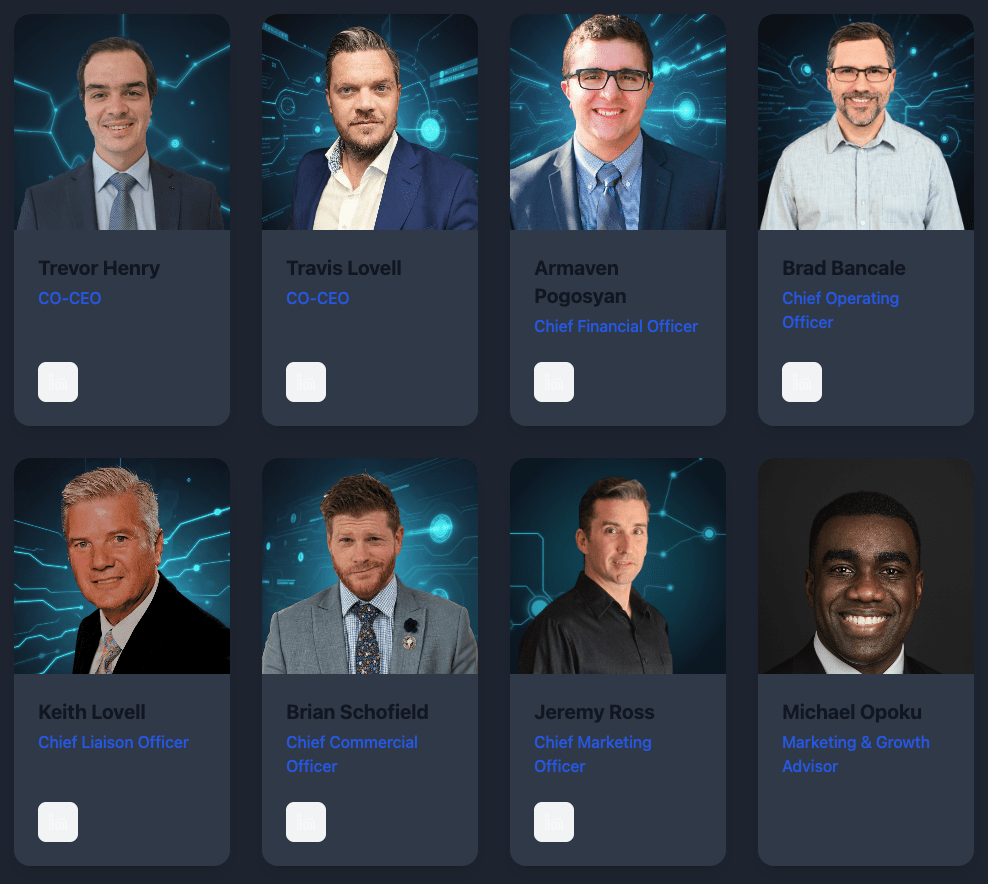
EqoFlow team. Source: eqoflowtechnologies.com
GNcrypto: Discord, Telegram, and private communities already exist and are popular. What's your competitive edge over them?
Trevor Henry: I’m not gonna say Telegram isn’t safe – the platform has a different purpose and operates differently than EqoFlow. What I can say is that the probability of seeing bots and scams on Telegram is higher. This isn’t about platform safety in particular, but scammers tend to use the network a lot. Discord is a really good communication platform for different purposes. We all aim to solve different problems. Overall, EqoFlow uses community protection measures, including a bounty program and an AI bot monitoring for fraudulent activities.
GNcrypto: Many decentralized social networks have tried to launch but failed to reach critical mass. What will be different with EqoFlow?
Trevor Henry: A lot of things. One of the biggest flaws that many platforms have is communication. EqoFlow prioritizes community engagement. We also openly share our inflows, our outflows, what we are paid, how the platform operates, and what the benefits are. We are always open to communication. Anyone can reach out to me - I’m the co-CEO and developer of EqoFlow. They can message me with any questions or proposals. We are about transparency.
One of the core values of EqoFlow is transparency. That transparency has been the downfall of many great projects, which failed because they simply weren’t transparent enough.
The difference between EqoFlow and other platforms - and how we’re going to change the game - is by being private, secure, and open. No matter how bad things are, we will share as much as we can.
What if the DAO and the founding team disagree?
GNcrypto: What happens if the community votes for a decision that contradicts your vision or could potentially harm the platform?
Trevor Henry: EqoFlow has a council made up of the original founding members, which can veto harmful decisions and protect the platform from malicious proposals. For example, if a large group of attackers comes up and tries to make harmful decisions, the team can prevent it.
EqoFlow’s limited beta rollout and future outlook
GNcrypto: The app is already available "with limited beta settings." What have early beta tests shown? What user reaction surprised you the most?
Trevor Henry: EqoFlow’s soft launch included a limited number of people, mainly friends, family, and early project supporters. Some features are already developed, and some are still in progress. There was a lot of positive feedback, showing a clear user demand for a new, problem-solving platform. As for the most surprising reaction, I wouldn’t say there was one.
We kind of knew we had built something really cool. So it would have been more surprising if people didn’t like the product.
GNcrypto: Five years from now, if everything goes according to plan – what does EqoFlow look like? What success metrics matter most to you?
Trevor Henry: Five years from now, we will hopefully become massive and compete with X and Facebook. I mean, why not? The key success metric for us will be having a high number of active users, which isn’t very different from the number of registered accounts.
GNcrypto: What advice would you give to content creators who are currently wondering whether it's worth investing time in a new platform?
Trevor Henry: Now is the best time to join the platform. You have the opportunity to build your presence on this fast-growing social platform. More importantly, you have better chances for success, higher ranks on the leaderboard, and access to benefits for early users like sponsored content and leadership opportunities. You start early and, later on, get engagement returns as the platform grows.
GNcrypto: What motivates you personally more – the technological challenge, the privacy ideology, or the business opportunity?
Trevor Henry: I’d say all of that matters, but our main motivation at EqoFlow is solving problems that exist right now on the technical side and the privacy side of social networks. Business opportunities are there, but first of all, with Nillion integration, our platform aims to give users access to a safe and secure social environment.
You can get better acquainted with the EqoFlow platform in our article.

Author
Web3 writer and crypto HODLer with a keen interest in market trends and recent technologies.