ECB study flags concentrated DeFi governance, complicating MiCA
An ECB paper released March 26 reports that in Aave, MakerDAO, Ampleforth and Uniswap, the top 100 holders own over 80% of governance tokens, raising oversight issues under the EU MiCA rules.
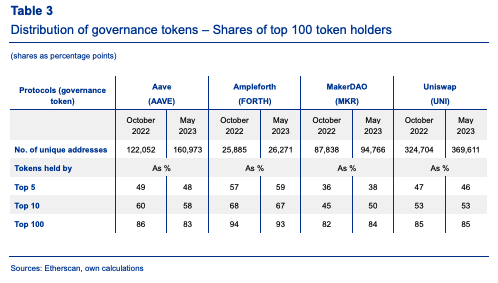
The European Central Bank released a working paper on March 26 that finds governance in four large decentralized finance protocols, Aave, MakerDAO, Ampleforth and Uniswap, is concentrated. Across all four, the top 100 addresses hold more than 80% of governance tokens, which are used to vote on key decisions.
Based on snapshots from November 2022 and May 2023, the analysis links a large share of tokens to the protocols themselves and to centralized and decentralized exchanges. Among centralized exchanges, Binance is identified as the largest holder across the four protocols. The authors rely on on-chain distributions rather than company records to assess where voting power sits.
The paper reviews who votes on proposals. In all four systems, top voters are mostly delegates who amass voting power from smaller holders. The top 20 voters in Ampleforth account for 96% of delegated votes, the top 10 in MakerDAO hold 66%, and the top 18 in Uniswap control 52%. About one-third of these top voters cannot be publicly identified. Among those that can, the largest groups are individuals and Web3 companies, followed by university blockchain societies and venture firms.
Most governance proposals relate to “risk parameters” that define each protocol’s risk profile, such as collateral rules and other settings that affect user positions. The paper notes accountability questions because public data do not show whether protocol-linked holdings belong to founders, developers or treasuries, or whether exchange wallets vote their own positions or those of customers.
The findings intersect with European regulation. MiCA excludes “fully decentralized” services from its scope. The paper states that concentrated ownership and voting power make it harder to pinpoint reliable regulatory anchor points, such as governance token holders, core developers or centralized exchanges. The appropriate anchor may vary by protocol and could require information that is not public.
The authors outline limits to the analysis. The work covers only four protocols and uses two snapshots, so it may miss changes since mid-2023. The paper reflects the authors’ views, not ECB policy, and highlights the limits of on-chain data for determining ultimate control.
The study references earlier warnings from international standard-setters that DeFi’s disintermediation can mask new forms of concentration and governance risk similar to those in traditional finance.
Kavi Jain, a senior research associate at Bitwise, noted: “Many large DeFi protocols are not as decentralized in practice as they might appear, especially in the earlier stages, where a small group still has meaningful influence over decisions.” He pointed to recent debate inside Aave’s governance as an example of concentrated voting power within a DAO structure.
The paper comes as protocols refine delegate systems intended to boost participation. The authors observe that these mechanisms can still concentrate power when a narrow set of delegates accumulates most voting rights. They also state that the identities and roles of large token holders, whether protocol treasuries, affiliated entities or exchange omnibus accounts, are difficult to verify with public data alone.
The material on GNcrypto is intended solely for informational use and must not be regarded as financial advice. We make every effort to keep the content accurate and current, but we cannot warrant its precision, completeness, or reliability. GNcrypto does not take responsibility for any mistakes, omissions, or financial losses resulting from reliance on this information. Any actions you take based on this content are done at your own risk. Always conduct independent research and seek guidance from a qualified specialist. For further details, please review our Terms, Privacy Policy and Disclaimers.
Articles by this author