Nvidia faces certified class action over alleged concealment of crypto GPU revenue

A California federal judge certified a class of Nvidia investors alleging the company hid more than $1 billion in crypto-linked GPU sales, covering buyers from Aug. 10, 2017, to Nov. 15, 2018.
A federal judge in California has certified a class of investors in a lawsuit claiming Nvidia concealed more than $1 billion in crypto-linked GPU sales in 2017 and 2018. The ruling allows investors who bought Nvidia stock from Aug. 10, 2017, through Nov. 15, 2018, to pursue claims together. Class certification does not decide liability.
U.S. District Judge Haywood S. Gilliam Jr. of the Northern District of California issued the order on on March 25, 2026. The court found Nvidia had not shown that its statements about the impact of crypto mining on demand for its GPUs had no effect on the company’s stock price. Citing internal communications, the order referenced an email from a company vice president and noted the court “cannot conclude that there was no price impact in the face of such evidence.”
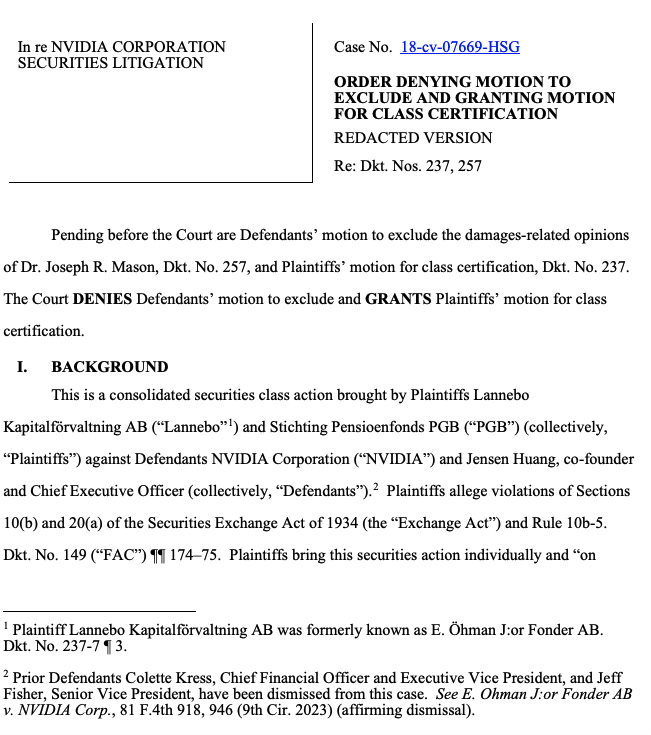
Investors first filed suit in 2018, alleging Nvidia and CEO Jensen Huang downplayed how much crypto mining drove revenue recorded in the gaming segment. According to the complaint, a large share of mining-related demand flowed through GeForce gaming GPUs and was reported in gaming, leaving the company exposed to cryptocurrency market swings.
Plaintiffs point to disclosures in 2018 as revealing that exposure. In August 2018, Nvidia cut guidance, acknowledged excess graphics card inventory, and reported a drop in demand from crypto miners. The picture became clearer on Nov. 15, 2018, when Chief Financial Officer Colette Kress stated that gaming results were short of expectations as post‑crypto channel inventory took longer to sell through, and that gaming card prices took longer to normalize after a sharp crypto falloff, according to the order. Nvidia’s stock fell about 28.5% over the next two trading sessions after those November comments, the complaint asserts.
Nvidia has maintained that Bitcoin mining represented a small portion of revenue during the period at issue and that most mining-related sales were tracked separately from its core gaming division. The company has also indicated it managed its supply chain and could address excess inventory without broader disruption.
The case has a lengthy procedural history. After a dismissal in 2021, an appeals court revived the claims. Nvidia later sought review at the U.S. Supreme Court, which did not end the matter, allowing it to proceed. A case management conference is set for April 21 to address next steps.
Regulators have scrutinized related disclosures. In 2022, the Securities and Exchange Commission imposed a $5.5 million penalty on Nvidia over earlier disclosures about the impact of crypto mining on parts of its business. That action did not resolve the private investor claims now advancing in federal court.
The material on GNcrypto is intended solely for informational use and must not be regarded as financial advice. We make every effort to keep the content accurate and current, but we cannot warrant its precision, completeness, or reliability. GNcrypto does not take responsibility for any mistakes, omissions, or financial losses resulting from reliance on this information. Any actions you take based on this content are done at your own risk. Always conduct independent research and seek guidance from a qualified specialist. For further details, please review our Terms, Privacy Policy and Disclaimers.
Articles by this author