Is KuCoin available in the US? What American users can and can’t do in 2026
KuCoin blocks US IP access and disables logins for accounts identified as US residents, shifting the experience to withdrawals-only. This guide explains what still works, what doesn’t, how the withdrawal process runs after restrictions, and the account, compliance, and legal risks US users face when trying to access a restricted platform.


KuCoin is a global exchange with a broad range of products. For many users in the United States, it long served as a de facto alternative to Coinbase: sign up, deposit funds, start trading. That is no longer the case. KuCoin now restricts access from U.S. IP addresses and disables logins for accounts it identifies as belonging to U.S. residents. If assets remain on the account, withdrawals are routed into a manual review process through customer support.
This article provides a practical overview for U.S. users – what still works on KuCoin, what doesn’t, and where the risks emerge. It does not include any guidance on bypassing restrictions. After reading, you’ll understand why access is limited, how the withdrawal process works, what causes delays, and how the “restricted” mode differs from normal exchange use.
Why KuCoin has U.S. limitations
KuCoin’s restrictions for U.S. users stem from how American law classifies crypto exchanges and the obligations that follow. In the United States, the key question is not where a company is incorporated, but whether it serves U.S. customers and transmits “value that substitutes for currency.”
If a platform receives and sends crypto assets, facilitates exchange, and processes withdrawals, it may fall under the definition of a money services business and the FinCEN rules under the Bank Secrecy Act.
This triggers requirements for registration, an AML program, customer-identification procedures, transaction monitoring, and reporting, including suspicious activity reports. These obligations apply even to companies outside the U.S. if they conduct business “in substantial part” in the American market.
The next layer is state-level licensing. In many states, activity resembling money transmission requires a separate license. New York classifies virtual-currency business activity and offers two paths: a BitLicense or a banking license/charter with authority to handle virtual assets. For a global exchange, entering the U.S. becomes a multi-jurisdiction compliance project, not a simple product decision.
The third layer concerns products. Once a platform offers margin trading, derivatives, or instruments that regulators interpret as commodity futures, swaps, or retail commodity transactions, the CFTC’s jurisdiction applies. In such cases, the platform may need to register as a derivatives exchange or execution venue and meet rules that, in traditional markets, are embedded in broker and clearing infrastructure. In its complaint against KuCoin, the CFTC highlighted registration failures and the absence of an effective customer-identification program.
Compliance goes far beyond KYC. U.S. rules require continuous processes: a customer identification program, enhanced due diligence, source-of-funds checks, sanctions screening, behavioral triggers, investigations, and reporting. When these elements are not in place at the required level, it is often cheaper and safer for a company to restrict U.S. access than to serve the market partially and risk regulatory action.
In this context, KuCoin formalized its restrictions as a full withdrawal from U.S. servicing. The exchange announced that it is blocking access from U.S. IP addresses and closing accounts identified as U.S. residents. Logins for such accounts are disabled as of January 23, 2025, at 9:00 p.m. EST.
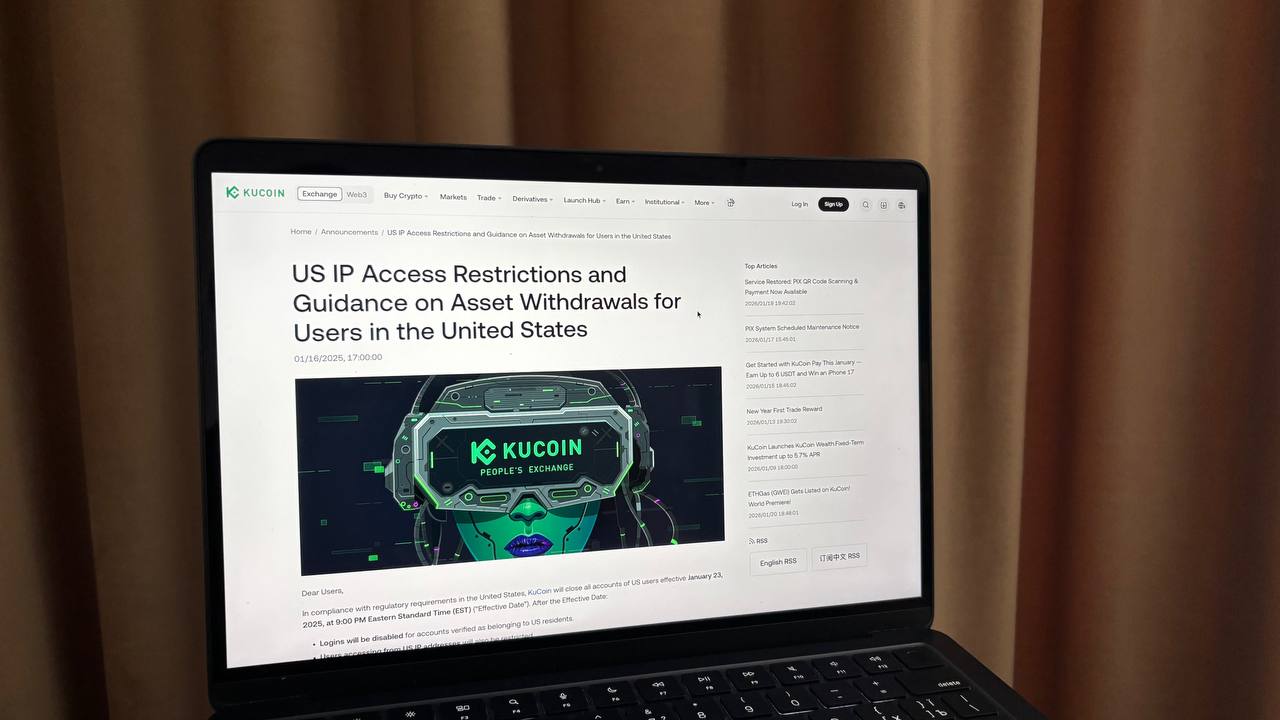
Users are advised to withdraw their assets before this date. Afterward, withdrawals move into a support-managed process and incur a one-time service fee of 30 USDT (or equivalent) for accounts that still hold assets.
It is important to note that “IP access” is only one mechanism. Compliance systems typically use a combination of indicators: account data, documents, payment traces, login geography, and device linkages. This is why questions like “is KuCoin available in USA” and attempts to bypass restrictions do not resolve the account-status issue and may complicate later operations – especially during withdrawals, when the service begins requesting verification and data checks.
The core reason for KuCoin’s U.S. restrictions is the mismatch between a global-exchange model and U.S. requirements for registration, AML/CIP, and state-level licensing, as well as product-related risks when a platform offers derivatives and margin instruments. Restricting access and shifting withdrawals to manual review is the exchange’s way of bringing user servicing in line with the regulatory framework it has chosen.
What U.S. users can and can’t do on KuCoin
After January 23, 2025, KuCoin operates in a de facto “withdraw-and-close” mode for the United States. The platform disables logins for accounts confirmed as belonging to U.S. residents, and access from U.S. IP addresses is also restricted. Even if the app loads, a U.S. user will still hit both the account block and the IP geofence.
What you can no longer do on KuCoin from the U.S.:
- log in to your account (if it is marked as a U.S.-resident account)
- use the exchange’s trading features and services
- open new positions or maintain active orders
KuCoin’s withdrawal procedure states that once access is disabled, all services on the account stop and any open orders or positions are closed automatically. From that point on, the exchange no longer treats the account as a trading account and instead shifts it into an asset-return process.
How to use KuCoin in US: withdraw the remaining assets – but not through the standard Withdraw button.
After the cutoff date, withdrawals are handled only through support. You submit a ticket, complete additional document verification, and KuCoin then creates a separate “claim” page and transfers your remaining balance there. The link to this page does not arrive immediately – the instructions specify a 30–60 day wait after successful identity verification. You then select the withdrawal network and destination address for each token and finalize the claim.
A one-time service fee of 30 USDT applies to this withdrawal method. The fee covers the manual support-and-claim process only. It does not include blockchain network fees. Network fees and KuCoin’s standard withdrawal fees still apply, and each withdrawal must meet minimum-amount thresholds and the network requirements set by KuCoin.
If you leave assets on the account and take no action, you face another risk: dormancy fees for non-KYC users, which KuCoin has issued separate notices about. For “restricted locations,” including the U.S., completing KYC/KYB is not allowed. In this scenario, the exchange recommends withdrawing assets and closing the account to avoid inactivity deductions.
Another dividing line comes from KuCoin’s KYC policy. Since August 2023, new users must complete Identity Verification to access products and services. For older non-verified accounts, available actions are limited to “residual” operations such as selling, closing futures and margin positions, and redeeming Earn and ETF products.
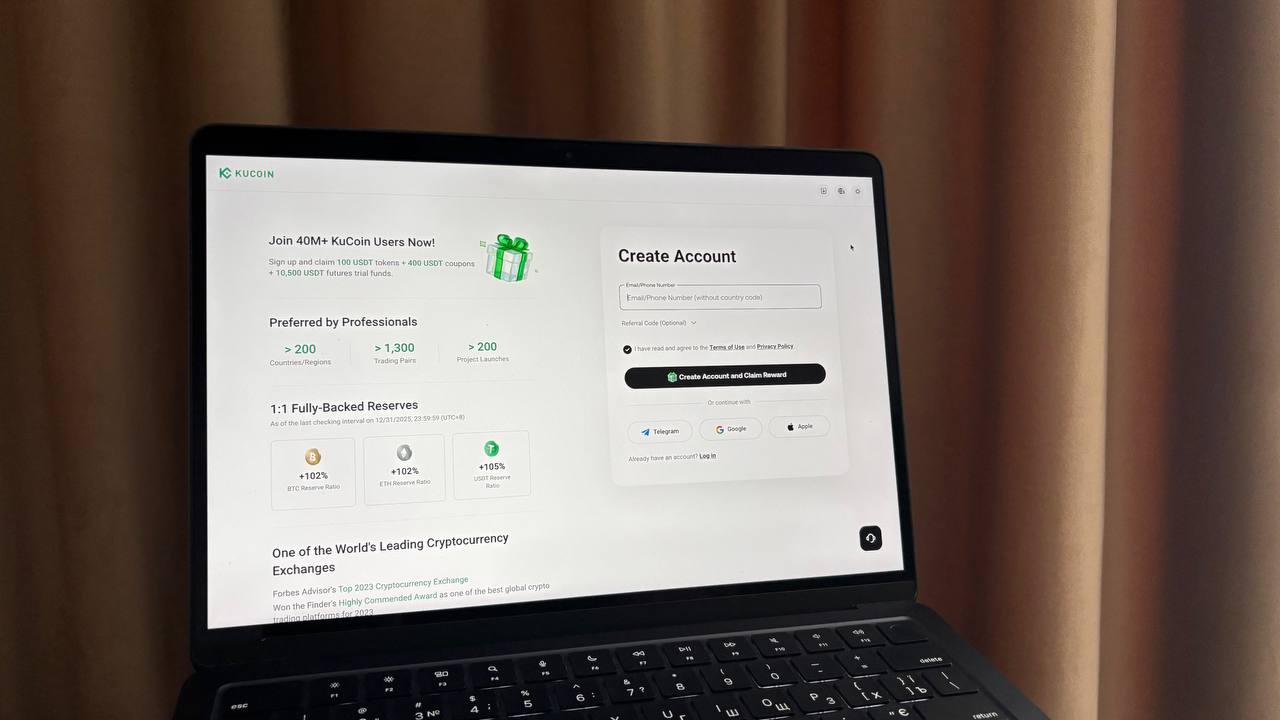
For a user in the United States, this logic offers little help, because after January 2025 the issue is not feature limits but the disabled login and the shift of withdrawals into a manual, support-handled process.
Risks of using KuCoin from the U.S.
For accounts KuCoin identifies as belonging to U.S. users, deposits are disabled and U.S. traffic is blocked by IP restrictions. As a result, the account stops functioning for trading: you may suddenly lose access to the interface even if you previously logged in without issues.
Withdrawals shift to a manual, support-handled process. Once an account enters the U.S. “restricted” mode, withdrawals are no longer standard in-app operations. They move into a support workflow: submitting a ticket, completing document verification, and then receiving a separate page for claiming assets.
KuCoin’s instructions note a 30–60 day wait for the claim-page link after verification. A one-time 30 USDT service fee applies to withdrawals for accounts with remaining assets. Blockchain network fees and minimum withdrawal thresholds are added on top, which can consume a noticeable share of a small balance.
A compliance trap tied to KYC and jurisdiction status. KuCoin has increased the dependence of account functionality on Identity Verification. For “restricted locations,” the logic is strict: the service does not assume full support and is not required to restore trading features after verification. In practice, any inconsistency in account data – documents, residency, login history, devices – increases the likelihood of added checks and delays rather than speeding up resolution.
Risk of losing control over positions and products with open exposure. If you have margin or futures positions, active orders, or products where timing is crucial (volatility, leverage, liquidity), restricted access undermines your ability to manage them. Even without forced liquidation, the inability to log in and react manually turns a technical limitation into financial risk.
Security issues and pauses triggered by attempts to bypass restrictions. Attempts to access a restricted platform through workaround methods often trigger antifraud and compliance alerts: shifting login geography, unstable IPs, mismatched data. For users, this results in extra document requests, temporary withdrawal limits, or stricter source-of-funds checks. The issue is not “VPN as a tool,” but that the account begins to appear suspicious to monitoring systems.
Waiting costs and balance erosion through fees. When access is restricted, you are not trading, but costs may continue. Some KuCoin accounts fall under dormancy-fee logic. You also incur fixed manual-withdrawal fees, network fees, and minimum-withdrawal requirements. If your balance is small and spread across several tokens, consolidation becomes necessary, adding more fees and conversions.
Legal and service risks of an unsupported jurisdiction. If you are still asking can you use KuCoin in the US, the answer is no. The United States is an unsupported jurisdiction for KuCoin. This makes it more likely that any disputes will be handled slowly and formally: the platform will follow its withdrawal and verification procedures rather than restoring functionality. For users, this means relying on a service that is not built for your market and therefore does not guarantee the features you expect.
The material on GNcrypto is intended solely for informational use and must not be regarded as financial advice. We make every effort to keep the content accurate and current, but we cannot warrant its precision, completeness, or reliability. GNcrypto does not take responsibility for any mistakes, omissions, or financial losses resulting from reliance on this information. Any actions you take based on this content are done at your own risk. Always conduct independent research and seek guidance from a qualified specialist. For further details, please review our Terms, Privacy Policy and Disclaimers.
Articles by this author