What is Bitfinex: 2026 review of fees, liquidity, and trading tools
GNcrypto’s team tested Bitfinex through spot trading to evaluate fees, market depth, liquidity, asset variety, fiat on‑ramps, and security measures. With minimal slippage, commission‑free trading since December 2025, and robust safety protocols, we rated the platform 3.9/5 – ideal for experienced traders and institutions, while beginners or casual investors might prefer simpler, more intuitive exchanges.


Bitfinex is a veteran exchange that feels built for experienced traders and institutional investors. We tested it on a real account over two days, placing spot and margin trades and moving both crypto and fiat to see how it behaves in real use. The best part was deep liquidity on big pairs, and 0% maker/taker trading fees for order execution since December 2025. But if you want a clean, guided “buy crypto” experience, the interface and fiat requirements may be a turn-off.
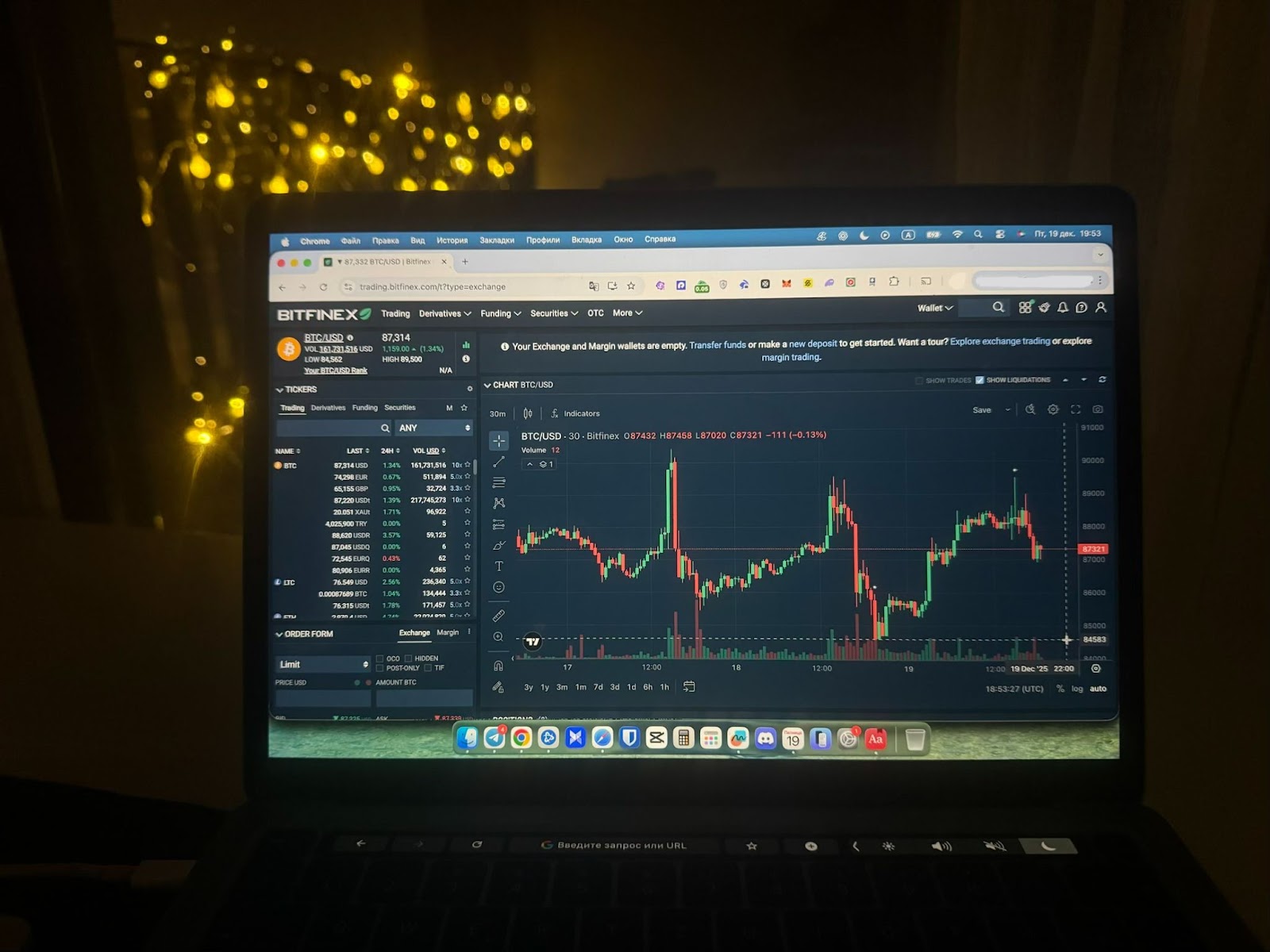
Bitfinex overview
Bitfinex is an international centralized cryptocurrency exchange, founded in 2012 and operated by iFinex Inc., registered in the British Virgin Islands. The exchange is aimed at experienced traders and institutional clients, supporting 278 cryptocurrencies and 250 trading pairs, including BTC, ETH, and SOL, and offering spot and margin trading, derivatives, and OTC deals.
During our time trading, we observed high liquidity and deep order books, with minimal slippage on large trades. For our Bitfinex exchange review, we used up to 10x margin, tried P2P lending, and tested the API for strategy automation – everything performed reliably.
Bitfinex provides two-factor authentication, cold storage for assets, and whitelisted withdrawal addresses. The exchange experienced a major hack in 2016 (~119,000 BTC), but it compensated all affected users and subsequently strengthened its security measures.
Since December 2025, trading in spot, margin, derivatives, and OTC markets has been commission-free. Fiat transfers still require KYC and are subject to limits.
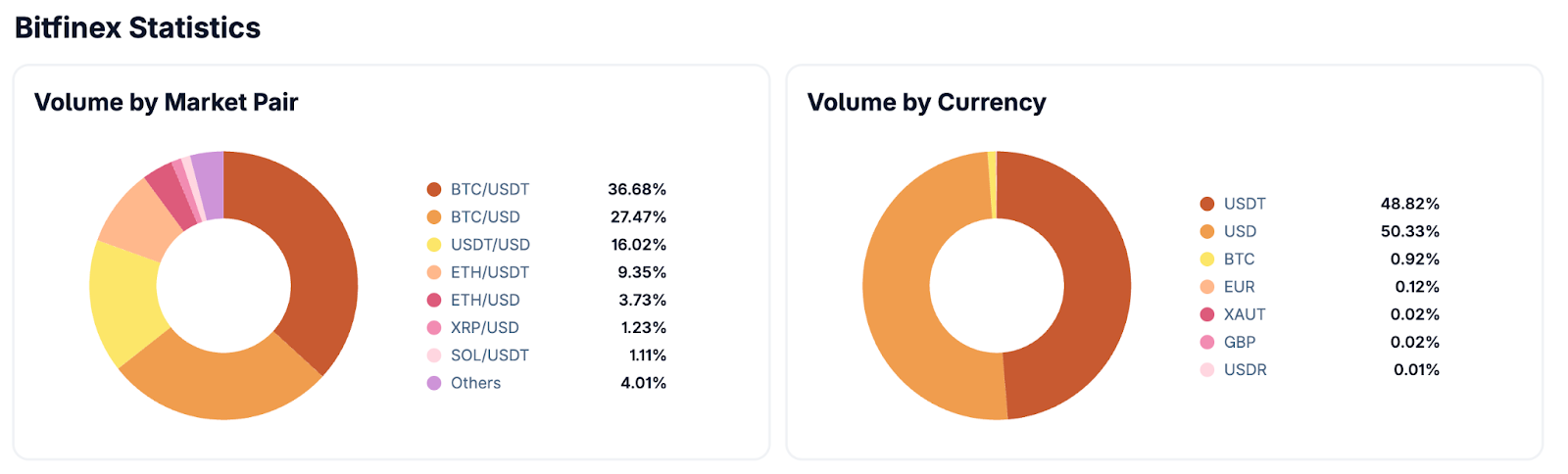
Bitfinex’s share of the global spot trading market remains small. Experts estimate it at less than 1% of total volume, whereas the largest exchanges, such as Binance, control around 40% of the market.
Fees & payment options
According to various Bitfinex reviews, the exchange historically used a maker-taker fee model: for spot trading, maker fees started at 0.1% and taker fees at 0.2%, while for derivatives, maker fees were around 0.02% and taker fees around 0.065%. High trading volumes and VIP tiers could reduce fees to as low as 0–0.055% for spot trades.
Since December 2025, the exchange has officially removed all trading fees for spot, margin, and derivatives trading, as well as OTC deals: both maker and taker fees are now 0% regardless of volume or verification level, making order execution completely free on the platform.
During our testing, we made several crypto deposits – all processed without delays or fees. Fiat deposits (USD, EUR, GBP, JPY) incurred a 0.1% fee with a minimum of around $60–€60. Crypto withdrawals depended on the network and usually required only network fees. Standard bank withdrawals cost 0.1% (minimum ~$100/€100), while express withdrawals were ~1% (minimum ~$125/€125). Internal transfers between users are free.
The exchange also offers P2P margin lending, with a 15% fee on earned interest. All our transactions required account verification. Funding options include crypto deposits, bank transfers (SWIFT/SEPA), and partners such as OpenPayd.
Pros and cons of using Bitfinex
During our testing, we actively used advanced orders, margin trading, OTC deals, and the API for strategy automation – everything worked correctly and provided full control over trades. The interface may be challenging for beginners, and access is restricted in certain jurisdictions, but for experienced traders, the platform proved reliable, with high liquidity and well-designed security measures.
Strengths:
- Wide range of assets and trading pairs: 278 cryptocurrencies and 250 pairs, including major tokens like BTC, ETH, and SOL.
- High liquidity and deep order books: even large trades executed with minimal slippage.
- Advanced tools for professionals: we used various order types, charts, and the API for algorithmic trading.
- Security: 99.5% of funds in cold storage, 2FA, whitelisting, and IP monitoring.
- Flexible funding options: crypto deposits (fee-free), fiat transfers via banks and partners.
Weaknesses:
- Complex interface: we tested both the web platform and the Bitfinex mobile app – neither interface is as user-friendly as one might hope, and beginners may struggle to navigate the numerous features and order types.
- Security history: a major hack in 2016 (~119,756 BTC).
- Jurisdiction restrictions: users from the U.S. cannot trade.
- Withdrawal issues and delays: in our tests, deposits and withdrawals experienced delays, and user reviews report that funds are sometimes frozen without explanation.
- Slow support: during testing, responses to inquiries were slow, often templated, and support proved largely ineffective.
Trustworthiness check
Bitfinex is a long-established exchange, launched in 2012, which provides it with experience and a mature infrastructure. The platform offers a high level of security: over 99.5% of funds are held in cold storage, and it supports two-factor authentication (2FA), U2F keys, and whitelisted withdrawal addresses.
For the BTC/USD pair, Bitfinex has an order book depth of approximately $47.9 million at 0.1% slippage and around $322 million at 1% slippage. For ETH/USD, the depth is even greater — over $649 million (0.1%) and about $5,974 million (1%), indicating a strong liquidity buffer on both sides of the order book.
However, the exchange experienced a major hack in 2016, with approximately 119,756 BTC stolen. All affected users were compensated, and since then Bitfinex has strengthened its security measures and implemented strict KYC/AML procedures.
In November 2022, Bitfinex CTO Paolo Ardoino published a list of approximately 135 main Bitfinex addresses on GitHub, demonstrating the presence of assets that can be verified on the blockchain. However, this does not constitute a formal, regularly updated proof of reserves with third-party auditing and liability verification.
Bitfinex is regulated in certain jurisdictions and actively complies with KYC/AML requirements, but it is not fully licensed in all countries. Additionally, users from the U.S. are unable to trade on the platform. Overall, Bitfinex remains a reliable and established exchange for professional traders and institutional clients, but users should be aware of historical risks and jurisdictional limitations.
GNcrypto’s overall Bitfinex rating
| Criteria | Rating (out of 5) |
|---|---|
| Liquidity & Volume | 4.5 |
| Fees & Total Cost to Trade | 5 |
| Asset Selection & Trading Pairs | 3.5 |
| Execution Quality / Market Quality | 4.5 |
| Tools & Order Controls | 5 |
| Fiat Access & Minimum Trade Size | 3.5 |
| Reliability & Transparency | 3.5 |
| Total Score | 3.9 |
Is Bitfinex right for you?
If you’re asking what is Bitfinex, based on our testing, we concluded that it is better suited for experienced traders and institutional clients. We observed deep liquidity, a wide range of trading pairs, and advanced tools, including margin trading, derivatives, OTC deals, and an API for algorithmic strategies.
Beginners may face challenges with the complex interface, the need for KYC when making fiat transfers, and jurisdictional restrictions — for example, users from the US cannot trade on the platform.
If you trade large volumes or actively use automation, Bitfinex offers a convenient and reliable experience. For those seeking a simple entry into cryptocurrency or long-term investing without advanced tools, the platform may be more than necessary.
Methodology – Why you should trust us
We use a weighted, category-based model, collect standardized data from each platform (open data + hands-on testing), and convert that into a 1.0–5.0 star score in 0.1 increments.
Our focus is spot trading quality: real fees, minimum trade size, crypto availability, market quality, and the user-facing experience.
How we collect data
– Public sources: fee schedules, supported asset/pair lists, proof‑of‑reserves or reserve disclosures, and system status pages.
– First-hand testing: we place test spot trades, observe effective fees (fee + spread), measure slippage/spreads on majors, and evaluate UI speed and order controls.
We do not rate solvency or make guarantees about financial stability. These ratings reflect user experience, access, and trading quality – not a balance‑sheet audit.
Categories & weights
– Liquidity & Volume – 25%
– Fees & Total Cost to Trade – 25%
– Asset Selection & Trading Pairs – 15%
– Execution Quality (Market Quality) – 10%
– Tools & Order Controls – 10%
– Fiat Access & Minimum Trade Size – 5%
– Reliability & Transparency – 10%
The material on GNcrypto is intended solely for informational use and must not be regarded as financial advice. We make every effort to keep the content accurate and current, but we cannot warrant its precision, completeness, or reliability. GNcrypto does not take responsibility for any mistakes, omissions, or financial losses resulting from reliance on this information. Any actions you take based on this content are done at your own risk. Always conduct independent research and seek guidance from a qualified specialist. For further details, please review our Terms, Privacy Policy and Disclaimers.
Articles by this author