Bitcoin posts worst Q1 since 2018 on ETF outflows, mideast strain

Bitcoin slid 23.8% in Q1 2026 to $66,619-its worst first quarter since 2018-as spot bitcoin ETFs posted $496.5 million in net outflows and Middle East tensions weighed on risk appetite.
Bitcoin fell 23.8% in the first quarter of 2026 to end March 31 at $66,619, the weakest first-quarter performance since 2018, as withdrawals from spot Bitcoin exchange-traded funds and geopolitical tension pressured demand for risk assets.
The price dropped from $87,508 on Jan. 1 to $66,619 on March 31. The last comparable first-quarter slump came in 2018, when bitcoin declined 50% from $14,112 to $6,973. The Q1 slide followed a 23% decline in the fourth quarter of 2025, from $114,057 to $87,508, leaving the token down about 41.6% over six months.
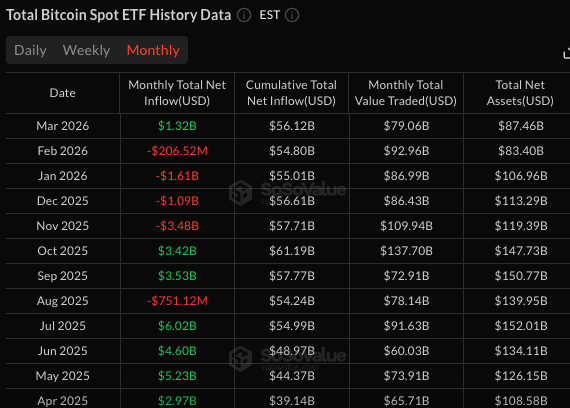
Flows into U.S. spot Bitcoin ETFs reversed early in the year. Net outflows totaled $1.8 billion across January and February, followed by $1.32 billion of inflows in March, for a quarterly net outflow of $496.5 million. Investors also contended with persistent inflation, a cautious Federal Reserve stance and heightened geopolitical risk linked to the U.S.-Iran conflict.
Andri Fauzan Adziima, research lead at Bitrue, said the drop was driven mainly by outflows from spot bitcoin ETFs, with stubborn inflation, a cautious Federal Reserve, and a broader risk-off mood across markets adding pressure. Min Jung, a research associate at Presto Research, said there’s little evidence of a deeper shift in long-term confidence in Bitcoin. Jung pointed to steady institutional participation and ongoing adoption, framing the decline as cyclical rather than caused by fundamental weakness.
Regional tensions intensified in recent weeks. On Tuesday, President Donald Trump stated the U.S.-Iran conflict could end in two to three weeks even without a formal agreement, while Iran launched attacks on nearby Gulf countries.
Looking ahead, fund flows and policy signals remain focal points. “Reversing the trend in Q2 will require renewed ETF inflows, clearer progress on crypto-friendly U.S. regulations, and a shift toward easier monetary conditions,” according to Nick Ruck, research director at LVRG Research.
On April 1, Bitcoin traded at $69,116, up 2.5% over the past 24 hours as of 2:45 a.m. Eastern Time.
The material on GNcrypto is intended solely for informational use and must not be regarded as financial advice. We make every effort to keep the content accurate and current, but we cannot warrant its precision, completeness, or reliability. GNcrypto does not take responsibility for any mistakes, omissions, or financial losses resulting from reliance on this information. Any actions you take based on this content are done at your own risk. Always conduct independent research and seek guidance from a qualified specialist. For further details, please review our Terms, Privacy Policy and Disclaimers.
Articles by this author