BTC price drops into bear market as flows and momentum turn negative

Bitcoin price has dropped more than 20% from its recent peak, with technical signals, waning ETF demand and broader liquidity indicators prompting analysts to define the current phase as a bear market.
Decline below key technical support levels and weakening demand metrics coincide with reduced institutional flows into spot Bitcoin exchange-traded products (ETPs) and broader risk-off positioning among traders. The combination of price action and market signals has led many analysts to classify the present environment as bearish.
Bitcoin’s price has slid below long-standing support benchmarks, including the 365-day moving average, a widely watched metric that smooths out year-long price data. Analysts often use this moving average as a trend separator: sustained trading below this line is interpreted as a shift toward bearish momentum. Similar crossovers coincided with major downtrends in 2022.
Other technical indicators, including on-chain metrics and derivatives positioning, have shown a broad majority of key signals turning negative. These include declines in active demand and increases in bearish derivatives bets, both of which are consistent with deteriorating market sentiment.
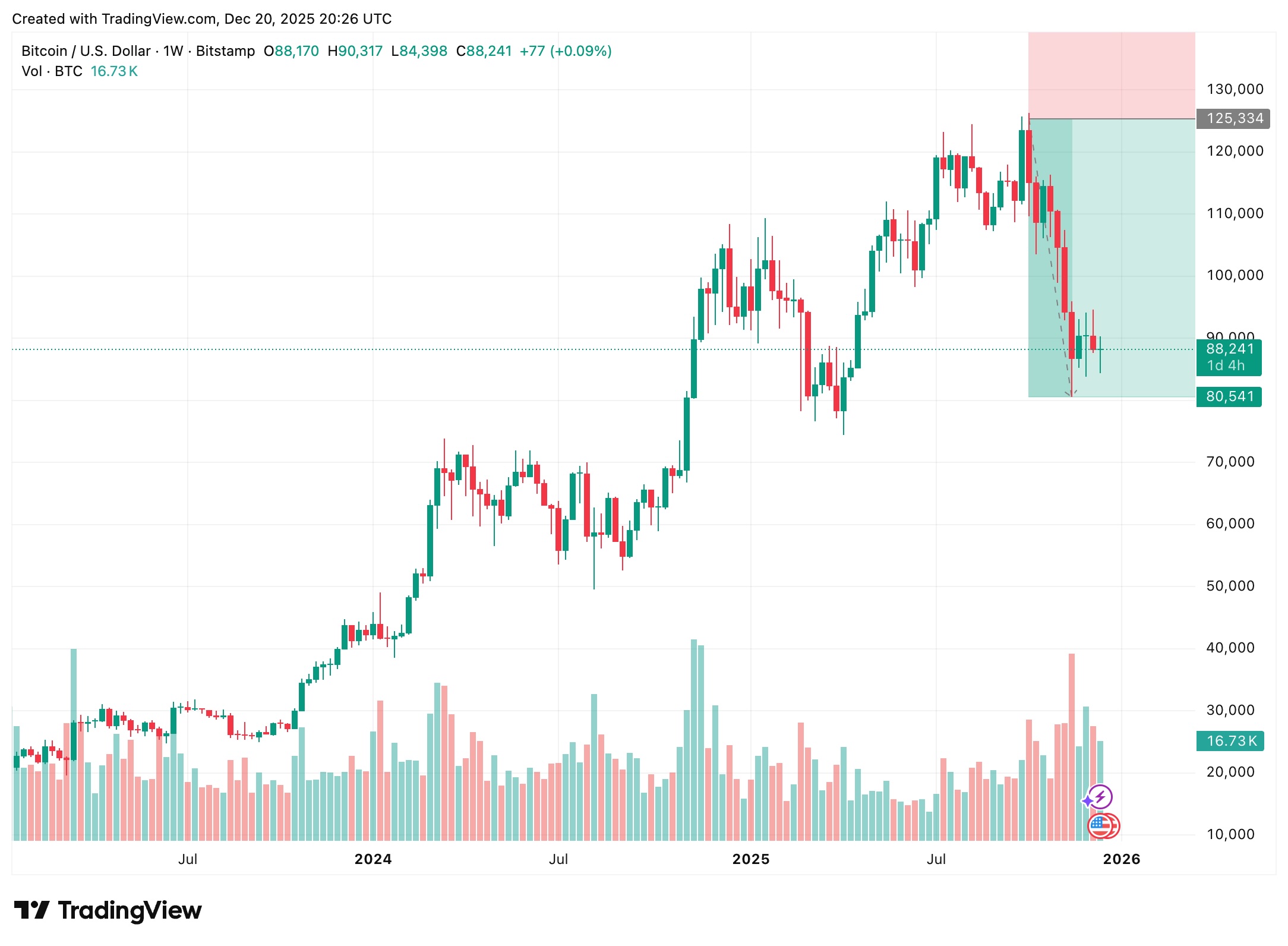
A notable characteristic of the current downtrend is the slowdown in spot ETF accumulation. According to data cited by analysts, U.S. spot Bitcoin ETFs shifted from net inflows earlier in the year to reducing holdings by about 24,000 BTC in the fourth quarter of 2025. This reversal removed a key source of marginal demand during the rally and left the market more vulnerable to selling pressure.
On-chain data also shows large holders exhibiting less aggressive buying behavior, as net inflows and on-chain activity weakened compared with prior upward phases. Combined with subdued retail participation, these patterns point to demand exhaustion even before price breaks occurred.
Market liquidity has tightened as leveraged positions have been reduced across exchanges. Some analysts point to capitulation-like conditions beginning to unfold in derivatives and funding rates, a dynamic frequently associated with market downturns rather than short corrections.
Macro conditions have also influenced behavior: broader risk-off sentiment in global markets, driven by uncertainty around interest rates and tech sector performance, has weighed on risk assets including Bitcoin. This has reinforced cautious positioning among both institutional and retail participants.
The classification of a bear market is not unanimous among all analysts. Some argue that longer processes of rotation and structural adjustment may still resemble extended consolidation rather than a full bear phase, especially if Bitcoin reclaims key technical levels. However, the 20% down move from cycle highs and the breadth of negative signals bolster the bearish interpretation.
In financial markets, a bear market is often defined by a sustained drawdown of 20% or more from a recent high. In Bitcoin’s case, breaking below multi-year moving averages and seeing diverse indicators flip green-to-red simultaneously are considered significant by many technical analysts. Indicators such as the 365-day moving average serve as trend filters smoothing out short-term swings to reveal underlying directional shifts.
The material on GNcrypto is intended solely for informational use and must not be regarded as financial advice. We make every effort to keep the content accurate and current, but we cannot warrant its precision, completeness, or reliability. GNcrypto does not take responsibility for any mistakes, omissions, or financial losses resulting from reliance on this information. Any actions you take based on this content are done at your own risk. Always conduct independent research and seek guidance from a qualified specialist. For further details, please review our Terms, Privacy Policy and Disclaimers.
Articles by this author