Best Wallet reviews 2026: how the mobile multichain wallet works
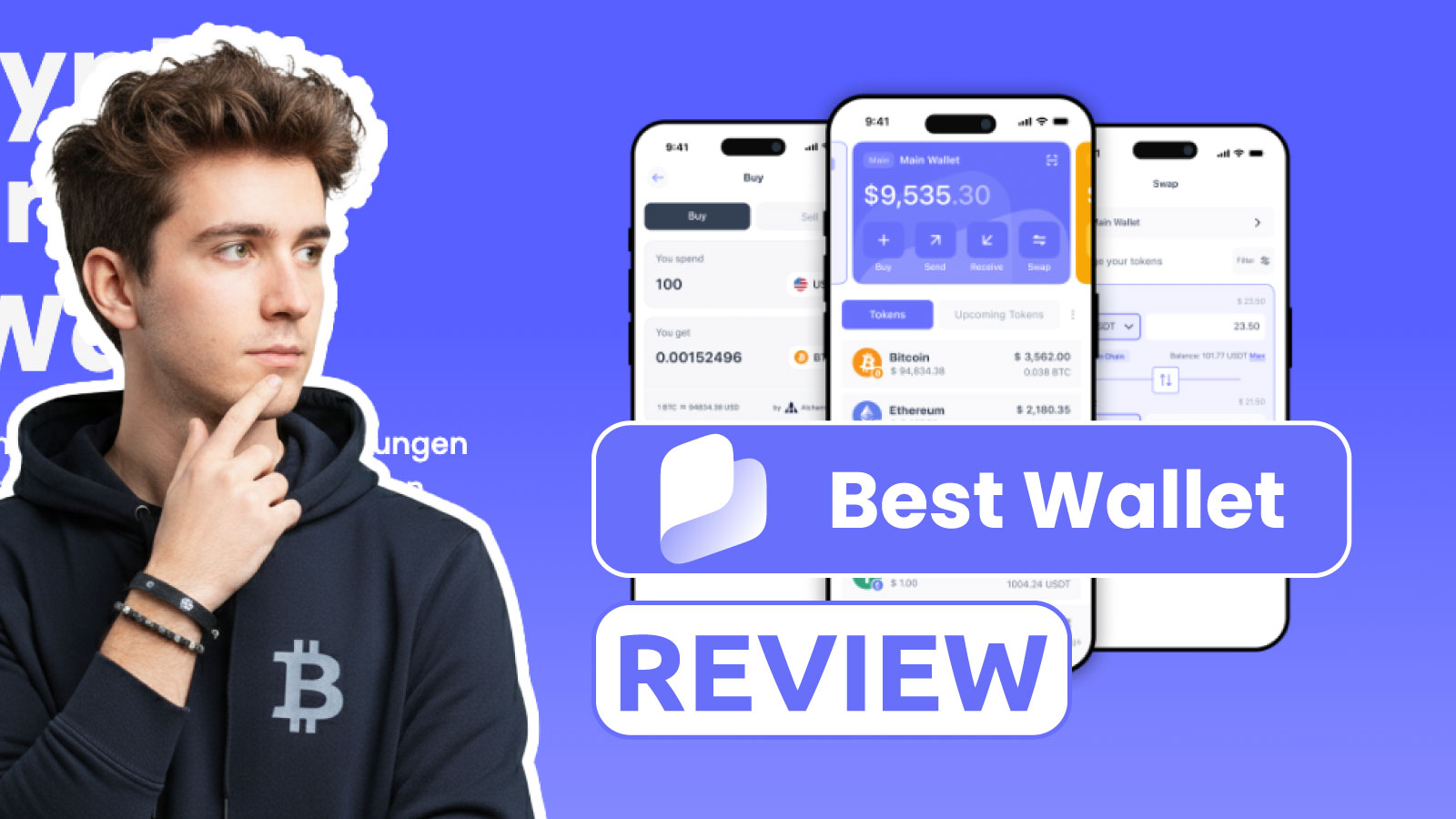
Best Wallet is a mobile self-custody wallet focused on multi-chain operations and built-in token presale access. We tested wallet setup, basic asset management, in-app swaps across networks, and presale participation. This review highlights potential costs, mobile key management, and interface elements that need extra attention during transactions.
We put Best Wallet to the test as a full-fledged mobile crypto platform: we installed the app, created a new wallet, imported an existing one, tried buying and swapping tokens, and explored multi-chain swaps and presale access directly from the interface. Special attention was paid to how the wallet handles network switching and how well its built-in market and portfolio tracking tools perform.
The main practical advantage of Best Wallet is its unified mobile interface, which combines self-custody, multi-chain operations, and presale participation – all without relying on external services. Its primary limitation lies in its focus on core use cases: analytics and DeFi tools are less advanced than on dedicated platforms, and the functionality is optimized primarily for mobile use. The table below summarizes how Best Wallet scores across our key evaluation categories.
What Best Wallet is
Best Wallet is a cryptocurrency platform founded in 2023, operating as a mobile non-custodial wallet designed for the decentralized finance (DeFi) ecosystem. The project officially launched in August 2024 as an all-in-one mobile solution for managing digital assets and accessing real-time crypto analytics.
Best Wallet reviews consistently highlight how the platform integrates Web3 features directly into the app from the start. A key launch feature was support for crypto presales, allowing users to participate in token pre-sales without relying on external websites or platforms.
As a self-custody wallet, Best Wallet ensures that users retain full control over their private keys, while the platform has no access to funds and cannot execute transactions on their behalf. This approach aligns with core DeFi principles and reduces dependence on centralized intermediaries.
Best Wallet is available exclusively as a mobile app for iOS and Android. There is no browser extension or desktop client, emphasizing its mobile-first approach – asset management, fast transactions, and seamless interaction with Web3 services on the go.
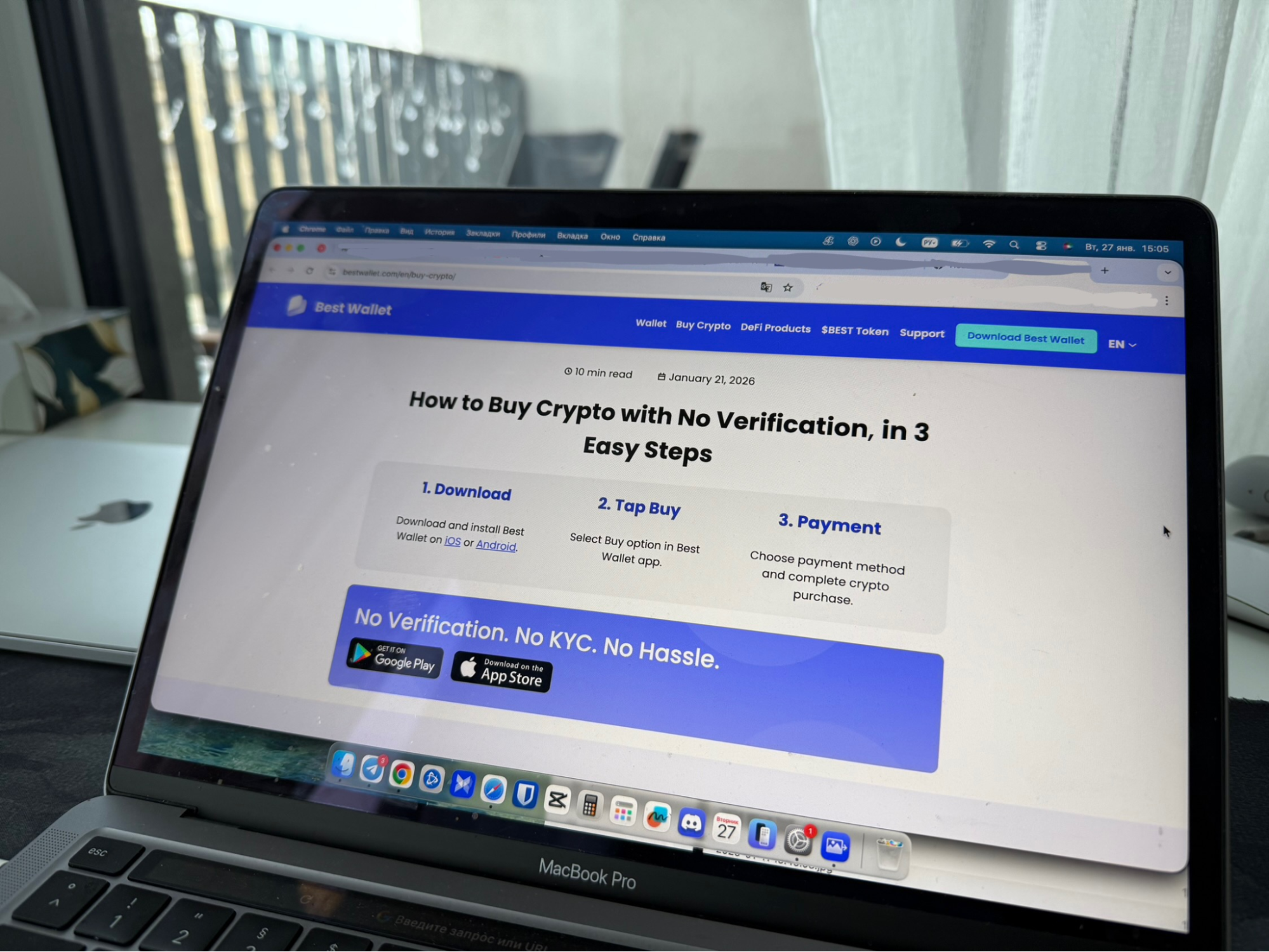
In daily use, Best Wallet functions as a multifunctional mobile hub for managing cryptocurrencies and DeFi tools, rather than just a storage solution. As with any non-custodial wallet, users bear full responsibility for safeguarding their access credentials, with the main risks remaining phishing attacks and mistakes when handling tokens during early-stage launches.
Core features & asset support
Best Wallet stands out for its broad support of digital assets and blockchain networks, allowing users to manage multiple cryptocurrencies within a single app.
The wallet supports major cryptocurrencies – a point consistently mentioned in Best Wallet crypto reviews – including Bitcoin, Ethereum, and tokens on popular blockchain networks. Users can store and send assets across different ecosystems without having to switch between multiple wallets.
NFT support is another highlight. Best Wallet lets users view and manage non-fungible tokens directly within the app, making it a convenient tool for those active on NFT marketplaces and Web3 projects.
Best Wallet offers a suite of built-in tools: fiat on-ramp via integrated payment services (bank cards, digital payments), built-in token swaps without external platforms, and support for multiple wallets within a single account for different usage strategies.
This approach reduces reliance on centralized exchanges and makes asset management more flexible and autonomous.
User experience & ease of use
One of Best Wallet’s key advantages is its ease of use and well-thought-out user experience. The initial wallet setup is intuitive and does not require deep technical knowledge, which is especially important for beginners. This accessibility is a recurring theme in Bestwallet reviews and one of the main reasons the app is recommended for new users.
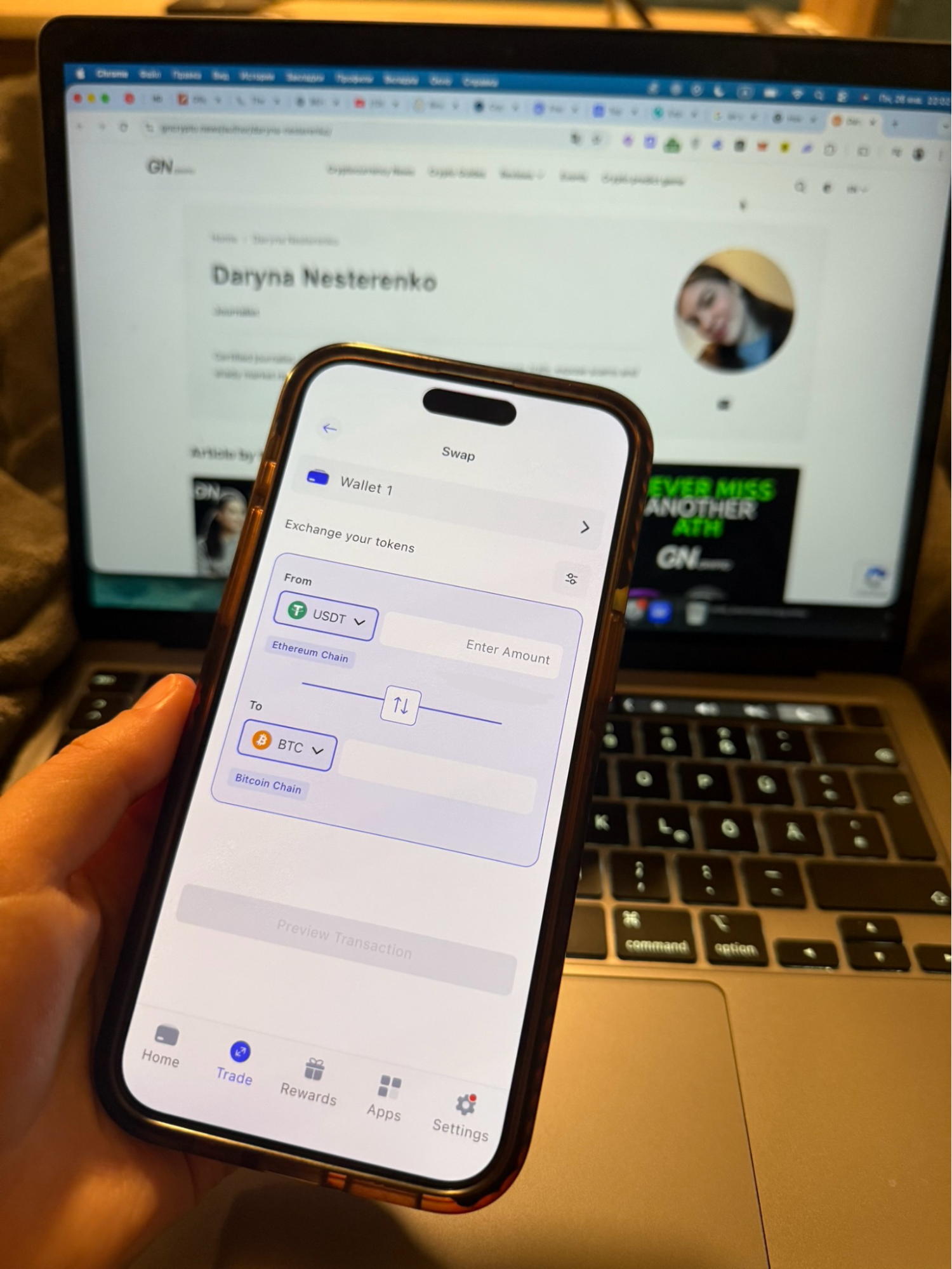
The interface is designed in a minimalist mobile format: core functions – sending, receiving, buying, and swapping assets – are accessible directly from the main screen. Navigation is logical, and the app’s structure makes it easy to orient oneself even when managing multiple networks and tokens.
For newcomers, the wallet feels approachable thanks to:
- the absence of complex manual settings
- clear function and asset names
- built-in features that do not require connecting to external dApps
At the same time, more experienced users gain sufficient flexibility through multi-chain support and the ability to manage multiple wallets within a single app.
Overall, Best Wallet focuses on practicality: it is not overloaded with professional trading tools, yet it covers the main cryptocurrency use cases – from storage and transfers to swaps and interaction with Web3 assets.
Pros and cons of using Best Wallet
In summary, here’s what we found to be the most important aspects of Best Wallet – and what to consider before deciding to use it. This overview highlights both the strengths and limitations, giving you a clear idea of what to expect.
Strengths:
- Early access to new tokens. Users can participate in presale projects and receive tokens at the early stages directly through the wallet. This is especially convenient for those following new DeFi projects and looking to act quickly on investment opportunities.
- Universal multi-chain swaps. The wallet supports token swaps across multiple networks from a single interface, making it easy for users holding assets on different blockchains.
- Built-in security features. Best Wallet employs self-custody, biometric authentication, and two-factor authentication to help reduce the risk of unauthorized access.
- Smarter market tracking. The app provides real-time data on price movements, asset performance, and market sentiment, simplifying decision-making.
- Portfolio and risk management. Users can manage multiple wallets, monitor overall balances and asset allocation, and track positions across networks, aiding in HODL and trading strategies.
Weaknesses:
- Limited analytics for advanced users. While the wallet offers a basic analytics dashboard and market sentiment insights, experienced users may find it insufficient compared to professional platforms like Dune, Nansen, or DeFiLlama.
- Limited desktop functionality. Best Wallet is designed as a mobile app, which may be inconvenient for users who prefer desktop solutions or browser extension integrations.
- Inconsistent performance across networks. As with any multi-chain wallet, features such as swapping, staking, and Launchpad support can vary in quality and availability across different blockchains. Users should be aware that the experience on Ethereum may differ from that on Solana or other networks.
Trustworthiness check
Best Wallet is a mobile non-custodial wallet founded in 2023 and publicly launched in August 2024. The platform integrates multi-chain functionality, presale tokens, and basic market analytics.
Regulatory status: The wallet does not hold licenses from major financial regulators (no FCA, SEC, or equivalent oversight). This is typical for self-custody wallets, but the lack of a prominent “About Us” section or transparent leadership team means users rely entirely on the software’s performance and the company’s reputation.
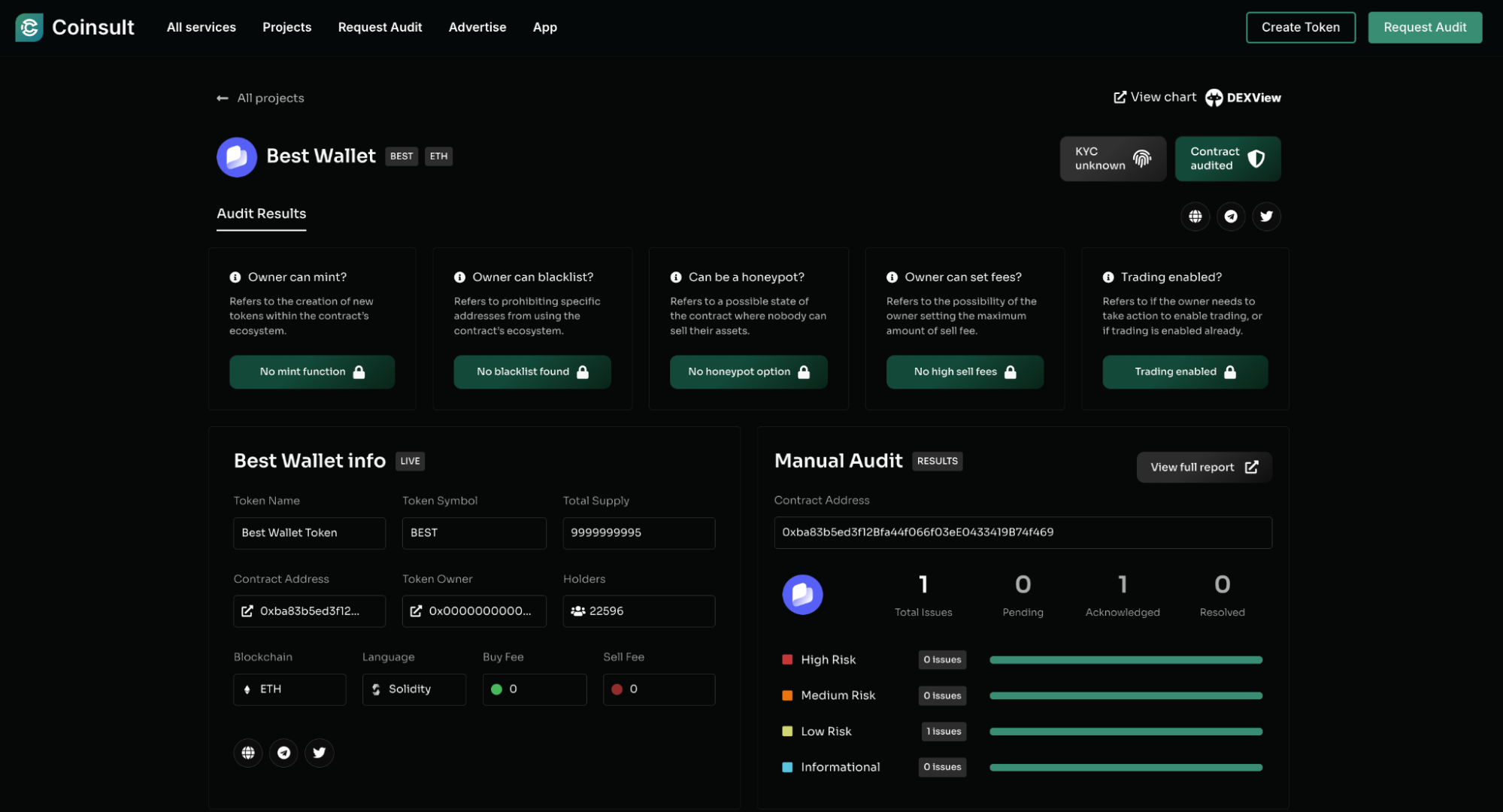
Code audit status: As of January 2026, the $BEST native token has been audited by Coinsult. However, the core mobile application code has not yet undergone a public security audit by top-tier firms like Trail of Bits or Halborn. This remains a notable gap compared to audited veterans like MetaMask.
Security architecture: The platform utilizes Multi-Party Computation (MPC) technology and a 3-factor authentication recovery model. This allows for “seedless” recovery options, providing a modern balance between security and convenience, though it differs from the traditional “12-word phrase only” decentralization model.
Geographic restrictions: Platform availability may be restricted in countries with strict crypto regulations (China, some Middle Eastern countries) or sanction regimes (Russia, Iran, North Korea). Users should verify local compliance before use.
Security incidents: We found no publicly reported security breaches or hacks as of January 2026. However, the wallet’s relative youth means its security track record is shorter than established competitors.
Partnership transparency: Best Wallet integrates third-party services like Moonpay for fiat on-ramps and various presale projects via its Launchpad. Users should understand that these integrations introduce additional trust dependencies beyond the wallet software itself.
Testing process
We installed Best Wallet on iOS and created a new wallet in under 2 minutes. Setup included generating a 12-word seed phrase (displayed once, with manual confirmation required) and setting a 6-digit PIN. Biometric authentication (Face ID) activated immediately after PIN setup.
Multi-wallet test: Created a second wallet within the same app in 30 seconds. Switching between wallets took 2 taps from the main screen.
Transaction tests: Send $15 USDT (Polygon) from external wallet to Best Wallet. Funds appeared in 45 seconds (2 confirmations). Sent $10 ETH (Ethereum) to external address – gas fee quoted: $1.85 (Normal speed), confirmation: 2 minutes.
Multi-chain swap test: Swapped $50 USDC (Polygon) for ETH (Ethereum) using built-in bridge/swap feature. Process: select source chain → select destination chain → confirm. Total cost: $2.40 (0.3% swap fee $0.15 + $2.25 bridge gas). Execution time: 8 minutes (cross-chain settlement).
Same-chain swap test: Swapped $30 USDT for USDC on Polygon. Fee: 0.5% ($0.15) + $0.08 network gas. Total: $0.23. Execution: 12 seconds.
Presale token test: Accessed built-in Launchpad, connected to test presale project. Process required: wallet connection (instant) → allocate USDC → confirm transaction. We allocated $25 USDC to mock presale. Transaction confirmed in 30 seconds, presale tokens appeared in the “Upcoming” tab with vesting schedule visible.
NFT display test: Send test NFT (Polygon) to Best Wallet address. NFT appeared in the “Collectibles” tab within 2 minutes with image, metadata, and collection name displayed correctly.
Fiat on-ramp test: Initiated $100 BTC purchase via built-in Moonpay integration. KYC required (not completed in test). Process flow clear: amount → payment method → KYC. Estimated fee: 4.5% ($4.50) shown before KYC.
Recovery test: Deleted app, reinstalled on second device (iPad). Used 12-word seed phrase to restore wallet. All balances, transaction history, and saved wallets were restored in under 90 seconds. No cloud backup required.
Customer support: Submitted ticket via in-app “Help” section asking about network support. Response received in 14 hours via email with a detailed list of supported chains.
GNcrypto’s overall Best Wallet rating
After testing Best Wallet with wallet creation, multi-chain swaps, presale token participation, and recovery on a second device, the wallet delivered on mobile convenience (2-minute setup, 90-second recovery, clean interface) and presale access (direct Launchpad integration with vesting visibility). We rated it moderately for security (12-word seed phrase with biometric lock, but no public code audit), recovery (standard seed phrase backup with no cloud option), and analytics (basic portfolio tracking, insufficient for advanced users). Strong for mobile-first multi-chain users and presale hunters, weak for desktop users and DeFi power users.
| Criterion | Score |
|---|---|
| Security & Key Management | 3.0 |
| Supported Assets & Networks | 4.0 |
| Transaction Costs & Speed | 4.0 |
| User Experience & Interface | 4.0 |
| DeFi & dApp Integration | 4.0 |
| Recovery & Backup Systems | 3.0 |
| Customer Support & Documentation | 5.0 |
| Total | 3.8 / 5.00 |
How we test hot crypto wallets
At GNcrypto, we put transparency first when evaluating hot cryptocurrency wallets. Our reviews are based on hands-on testing and thorough analysis across all key dimensions that matter for self-custody and daily crypto use.
We do not audit wallet code or guarantee security against all attack vectors. Instead, our scores reflect usability, feature completeness, and observable security practices. We do not accept payment for ratings or modify scores based on partnerships.
Categories & weights
We rate hot wallets on seven criteria. Security and Asset Support are weighted heaviest because a wallet that isn’t safe or can’t hold your coins is useless, regardless of how pretty the UI is.
- Security & Key Management – 25%
- Supported Assets & Networks – 20%
- Transaction Costs & Speed – 15%
- User Experience & Interface – 15%
- DeFi & dApp Integration – 10%
- Recovery & Backup Systems – 10%
- Customer Support & Documentation – 5%
The material on GNcrypto is intended solely for informational use and must not be regarded as financial advice. We make every effort to keep the content accurate and current, but we cannot warrant its precision, completeness, or reliability. GNcrypto does not take responsibility for any mistakes, omissions, or financial losses resulting from reliance on this information. Any actions you take based on this content are done at your own risk. Always conduct independent research and seek guidance from a qualified specialist. For further details, please review our Terms, Privacy Policy and Disclaimers.
Articles by this author