
Deribit Review: Futures Fees and Our Mystery-Shopping Test
Affiliate Disclosure:
GNCrypto editors review services independently. If you click on affiliate links, we may earn commissions, which help support our testing. The goal of our reviews is to provide our readers with the most objective and unbiased overviews of available platforms for spot crypto trading.
Deribit

Deribit is a solid pick for active futures traders who want 0.00% maker fees and transparent margin mechanics. But the learning curve is steep, and liquidation mistakes are expensive — we’re here to explain why.
GNcrypto's Verdict

If you come to Deribit specifically for futures, the platform is a derivatives-first trading tool with a clean, functional interface. In our mystery-shopping test, derivatives fees were predictable: 0.00% maker on most contracts, with clear documentation on margin and liquidation mechanics. The main downside is the learning curve. Misconfigured margin settings can trigger liquidations before you’ve worked through the documentation, and the platform assumes you already understand maintenance margin calculations.
- Low trading fees on futures and perpetuals if you trade with discipline
- Strong documentation on margin, risk metrics, and liquidation mechanics
- An official testnet for practicing scenarios and testing API integrations
- Derivatives are the platform’s main product, so beginners without preparation will struggle
- Jurisdiction limits (including the U.S.) and compliance-driven access
- Liquidation fees are material, so mistakes can be expensive
On this page
- Deribit Futures Trading Overview: Contract Types and Margin Mechanics
- Registration, KYC, and access to trading
- API keys and connection security
- Moving into futures trading
- What futures products Deribit offers
- How Deribit handles margin
- What to know about liquidations
- Futures Fees and Cost Structure: What a Trade Really Costs
- Is Deribit Good for Futures Traders?
- Pros and Cons of Using Deribit
- Trustworthiness Check
- GNcrypto's Overall Deribit Rating
- Methodology – Why This Review Is Trustworthy
- How Data Is Collected
- Categories & Weights

Fees & Funding
4.5/5
Leverage & Margin
4.5/5

Fees & Funding
4.2/5
Leverage & Margin
4.2/5

Fees & Funding
4.2/5
Leverage & Margin
4.3/5

Fees & Funding
4.4/5
Leverage & Margin
4.2/5

Fees & Funding
4.5/5
Leverage & Margin
4/5
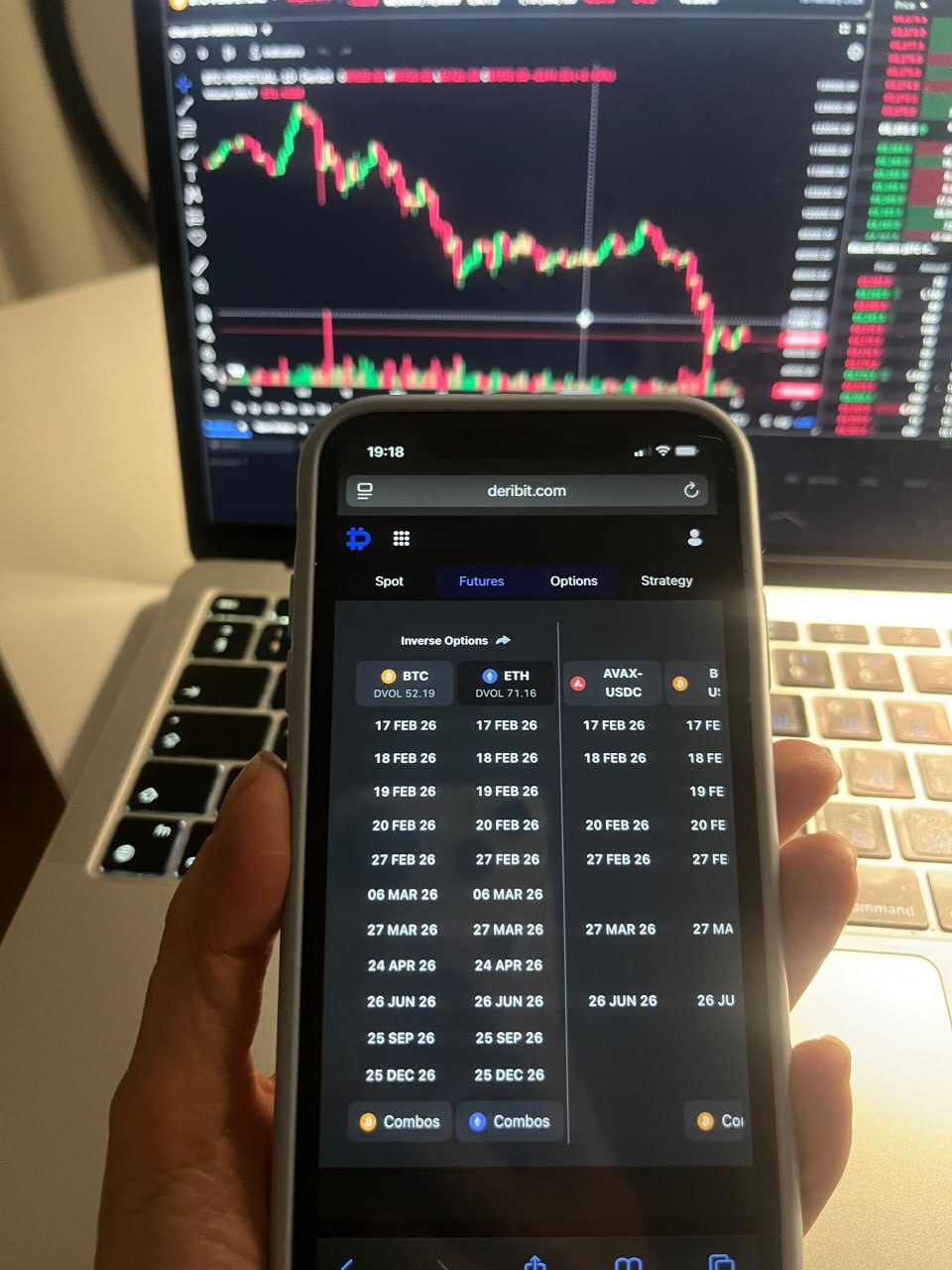
Deribit is an exchange where futures and perpetuals are the core product, and the interface is built for active trading. In our test, we noted the official testnet as a key feature: beginners can run their scenarios without real money and see how margin behaves. Platform rules and product mechanics are documented in the knowledge base, but access depends on jurisdiction and customer status.
Deribit Futures Trading Overview: Contract Types and Margin Mechanics
The Deribit user experience starts with onboarding, so we began with the basics: account registration, security setup, and verifying product access.
Registration, KYC, and access to trading
After creating an account, Deribit prompts you to set up protections (for example, 2FA) and complete identity verification. Under Deribit’s rules, KYC is required before a user can fund the account and start trading derivatives. Verification is available for both individual and corporate accounts, and requirements vary by status.
Access depends on jurisdiction. Check the restricted jurisdictions list before onboarding – users from the U.S., Canada, Japan, and Iran are blocked.
API keys and connection security
If your workflow involves bots or external terminals, Deribit lets you create API keys with permission scopes (read / trade / withdraw) and enable IP whitelisting to restrict key use to specific addresses. For stricter setups, Deribit also supports request signing with a private key on your side: the exchange stores only the public key, and the private key is never transferred to, or stored on, Deribit servers.
Moving into futures trading
After onboarding, we moved into the core trading flow: finding the contract, opening a position, and checking margin requirements and risk metrics. In this Deribit exchange review, we are not evaluating strategy performance. We focus on clarity of mechanics and practical execution.
What futures products Deribit offers
The platform offers several instrument types:
- Perpetuals: perpetual contracts where the position is maintained via funding (the exchange does not charge a funding fee; funding flows between longs and shorts).
- Dated futures: futures with expiry; the expiry settlement price is calculated using an index TWAP over the last 30 minutes.
- Inverse vs. linear: instruments settled in the base crypto (inverse, for example BTC/ETH) and linear USDC-settled futures.
- DVOL futures: futures on a volatility index (useful for volatility-hedging strategies, not only price exposure).
How Deribit handles margin
In practice, the UI emphasizes risk metrics and margin indicators. The key parameters are visible in the trading view instead of being buried in settings. Deribit offers multiple margin models: segregated vs. cross collateral, plus standard margin vs. portfolio margin (four combinations total). Portfolio margin is especially relevant if you hedge positions and want risk to be evaluated at the portfolio level instead of leg by leg.
What to know about liquidations
Deribit uses incremental auto-liquidation. When equity is no longer sufficient to maintain positions (as evaluated by the risk engine), part of the position is closed automatically. Deribit does not send margin-call prompts. Positions are auto-liquidated when equity drops below maintenance margin. Monitor your margin ratio constantly.
Futures Fees and Cost Structure: What a Trade Really Costs
The base setup for most futures and perpetuals is 0.00% maker and 0.05% taker. Weekly futures can include a maker rebate of -0.01% with the same 0.05% taker.
In Deribit reviews, three items are most often missed when people look only at maker and taker:
- Delivery fees at expiry. Some instruments charge a separate fee at settlement on expiry. For example, Deribit lists 0.025% for certain dated BTC/ETH futures, while weekly futures are often exempt (0%).
- Liquidation fees. If a position is liquidated, the fee is meaningfully higher than the standard trading fee. Specs vary by instrument. Some BTC instruments list 0.75%, and ETH can be 0.90%.
- Your role in the order book. Deribit notes that a limit order does not always guarantee maker status. To increase the odds, you need post-only (and not an iceberg order in some cases).
Real test example (BTC perpetual, $10,000 position):
- Entry: limit order, filled as maker → $0 fee
- Exit after 48 hours: market close → $5 taker fee (0.05% on $10k)
- Funding paid during hold: -$0.80 (2 cycles at -0.008%)
- Net fees: $4.20 total
Deribit is cost-efficient for disciplined limit-order trading. If you’re regularly liquidated, fees spike: 0.75% BTC liquidation fee on $10k = $75, not $5.
| Scenario | Rate | Estimated cost |
|---|---|---|
| Maker (futures/perpetuals) | 0.00% | $0 |
| Taker (futures/perpetuals) | 0.05% | ~$5 |
| Delivery fee on some futures | 0.025% | ~$2.50 |
| Liquidation (if it happens) | 0.75%–0.90% | ~$75–$90 |
Test case: BTC perpetual trade
We opened a small test position to verify fee mechanics:
- Contract: BTCUSD perpetual (inverse)
- Size: 1,000 USD notional
- Entry: limit buy, filled as maker → $0 fee
- Hold period: 48 hours (2 funding cycles)
- Funding paid: -$0.08 total (negative funding rate of -0.008% per 8h)
- Exit: market sell → $0.50 taker fee (0.05% on $1k)
- Total cost: $0.58
For comparison: same trade on a 0.02%/0.05% maker/taker exchange would cost $0.20 entry + $0.50 exit = $0.70 total. Deribit’s 0.00% maker saved $0.20, offset slightly by negative funding.
Key observation: maker rebate on weekly futures (-0.01%) would have resulted in a $0.10 credit instead of $0 fee, making total cost $0.48 instead of $0.58.
Is Deribit Good for Futures Traders?
To close the Deribit review, we mapped our findings to trader profiles.
Who Deribit fits well:
- Active futures traders who work the order book and want to minimize fees.
- Risk hedgers who benefit from portfolio margin calculations and clear rules for risk and margin computation.
- Algo and quant users who need an API and a safe way to validate logic on the official testnet.
Who should avoid Deribit:
- Beginners unfamiliar with leverage and maintenance margin – auto-liquidation happens without warnings.
- Users who want a universal exchange with a wide spot asset menu (Deribit focuses on derivatives and a limited set of underlying assets).
- Users in restricted jurisdictions (including the U.S.) or anyone who needs simple fiat rails.
GNcrypto’s final view: Deribit is a strong futures venue if you understand margin and treat risk management as part of the product. It is built for traders who value control and predictable rules.
Pros and Cons of Using Deribit
As part of our Deribit exchange review, we looked at futures trading quality: liquidity on key markets, total trade cost (trading fees, expiry fees, and liquidation fees), and day-to-day terminal usability. For retail-size trades, BTC and ETH derivatives order books offered sufficient depth in our tests. The interface includes an L2 book, charts, and execution controls (post-only, reduce-only). Based on specs, minimum order size on inverse futures is 10 USD for BTC and 1 USD for ETH – small test trades are possible.
Strengths:
- Low base fees on futures and perpetuals: 0.00% maker and 0.05% taker; weekly futures can include a maker rebate of -0.01%.
- Core order types and execution controls: limit, market, market-limit, stop-market, stop-limit; post-only and reduce-only are available.
- Expiry settlement rules are documented; for dated futures, settlement price is calculated using an index TWAP over the last 30 minutes.
- An official testnet for practicing trading scenarios and validating margin mechanics without real funds.
- APIs (REST/WebSocket) and key-security settings, including IP whitelisting.
Weaknesses:
- Access and feature availability vary by jurisdiction; restricted jurisdictions include, among others, the United States, Canada, Japan, and Iran.
- In stress scenarios, total costs can rise materially: some dated futures have a 0.025% delivery fee, and auto-liquidation can apply liquidation fees around 0.75% (BTC) and 0.90% (ETH).
- The product is derivatives-focused; the range of underlying assets for futures is narrower than on general-purpose exchanges with hundreds of altcoins.
- Deribit does not offer tiered volume discounts, so high-frequency traders cannot materially reduce fees as activity scales up.
- Withdrawals have operational constraints: withdrawals are available only from the main account, and subaccounts require an internal transfer first.
Trustworthiness Check
We include this section so readers can see the official compliance context around Deribit alongside our test conclusions. We relied on regulator documents and public legal materials, not social media summaries.
First, in the UK, Deribit is on the FCA Warning List as an unauthorized firm. This means the FCA has not authorized it to provide, or promote, regulated financial services in the UK, and the regulator explicitly warns users about the risks of dealing with such companies.
Second, based on VARA publications in Dubai, Deribit FZE is listed in the public register as a licensed VASP. The register states that the license is for Exchange Services, including VA Derivatives Trading, and it includes an important limitation: the company is authorized to serve Institutional Investors and Qualified Investors. This is not a general retail license for any user.
Another layer of trust and risk involves access rules and KYC. Deribit publishes a Restricted Jurisdictions list (updated January 13, 2026). If a user is located in, or is a resident of, for example the United States, Canada, Japan, or Iran, access to the platform and services is prohibited. This matters because jurisdiction mismatches often lead to account restrictions, position closures, and requests for additional documents.
For individual accounts, Deribit explains which identity details and financial profile fields are required for KYC, and it states that it may request additional documents (for example, proof of address, a selfie or video for a liveness check, source-of-funds documents, or a bank statement). The same policy notes that if a user provides inaccurate information about identity or residency, Deribit may close the account and liquidate open positions.
Finally, we note the corporate context: on August 14, 2025, Coinbase publicly reported that Deribit became part of Coinbase. This affects ownership structure and may raise compliance standards at the group level, but does not guarantee solvency or user fund safety.
GNcrypto’s Overall Deribit Rating
| Criteria | Rating (out of 5) |
|---|---|
| Trading Fees & Funding Costs | 3 |
| Leverage & Margin Requirements | 5 |
| Contract Selection & Liquidity | 4 |
| Platform Performance & Risk Controls | 4 |
| Security & Regulatory Compliance | 4 |
| User Experience & Trading Interface | 5 |
| Customer Support & Educational Resources | 4 |
Methodology – Why This Review Is Trustworthy
We at GNcrypto use a weighted rating model: we combine open data (rules, fees, contract specs) with checks of the user journey, from onboarding and KYC to order placement flows and risk-metric readability. For Deribit, we also used the official testnet to run standard scenarios without financial risk.
How Data Is Collected
- Open sources: the fee schedule, expiry and settlement terms, margin and liquidation articles, and the Restricted Jurisdictions list.
- UX checks: registration and verification, finding contracts (perpetual vs. dated), order-book trading with post-only, and reviewing the risk engine and margin requirements.
Important: this methodology is not a solvency audit and does not provide any guarantee of financial stability. The rating reflects usability and rule transparency from a user perspective.
Categories & Weights
- Trading Fees & Funding Costs: 25%
- Leverage & Margin Requirements: 20%
- Contract Selection & Liquidity: 15%
- Platform Performance & Risk Controls: 15%
- Security & Regulatory Compliance: 10%
- User Experience & Trading Interface: 10%
- Customer Support & Educational Resources: 5%
Latest News





Recommended Articles/Reviews




The material on GNcrypto is intended solely for informational use and must not be regarded as financial advice. We make every effort to keep the content accurate and current, but we cannot warrant its precision, completeness, or reliability. GNcrypto does not take responsibility for any mistakes, omissions, or financial losses resulting from reliance on this information. Any actions you take based on this content are done at your own risk. Always conduct independent research and seek guidance from a qualified specialist. For further details, please review our Terms, Privacy Policy and Disclaimers.