
BloFin Reviews 2026: Futures Fees, Funding Rules, and Who It Is Best For
Affiliate Disclosure:
GNCrypto editors review services independently. If you click on affiliate links, we may earn commissions, which help support our testing. The goal of our reviews is to provide our readers with the most objective and unbiased overviews of available platforms for spot crypto trading.
BloFin Futures

BloFin is a strong futures pick if you want a full order toolkit and clear risk rules, but we would start simple in UTA and watch funding spikes that can change settlement frequency.
GNcrypto's Verdict

BloFin is a centralized exchange built around USDT-margined perpetual futures. In our testing, it feels feature-rich but workable for beginners, with bracket-style orders, trailing stops, and TWAP for controlled execution. Funding is typically 8-hour but can settle more often in stress, so carry cost matters. UTA adds cross and isolated margin plus multi-currency options, and demo trading lets you practice first.
- Strong order toolkit for risk-managed futures trading
- Clear mark price and liquidation logic
- Demo trading plus UTA for scaling up
- UTA settings can overwhelm first-time users
- Funding can settle more often in stress
On this page

Fees & Funding
4.5/5
Leverage & Margin
4.5/5

Fees & Funding
4.2/5
Leverage & Margin
4.2/5

Fees & Funding
4.2/5
Leverage & Margin
4.3/5

Fees & Funding
4.4/5
Leverage & Margin
4.2/5

Fees & Funding
4.5/5
Leverage & Margin
4/5
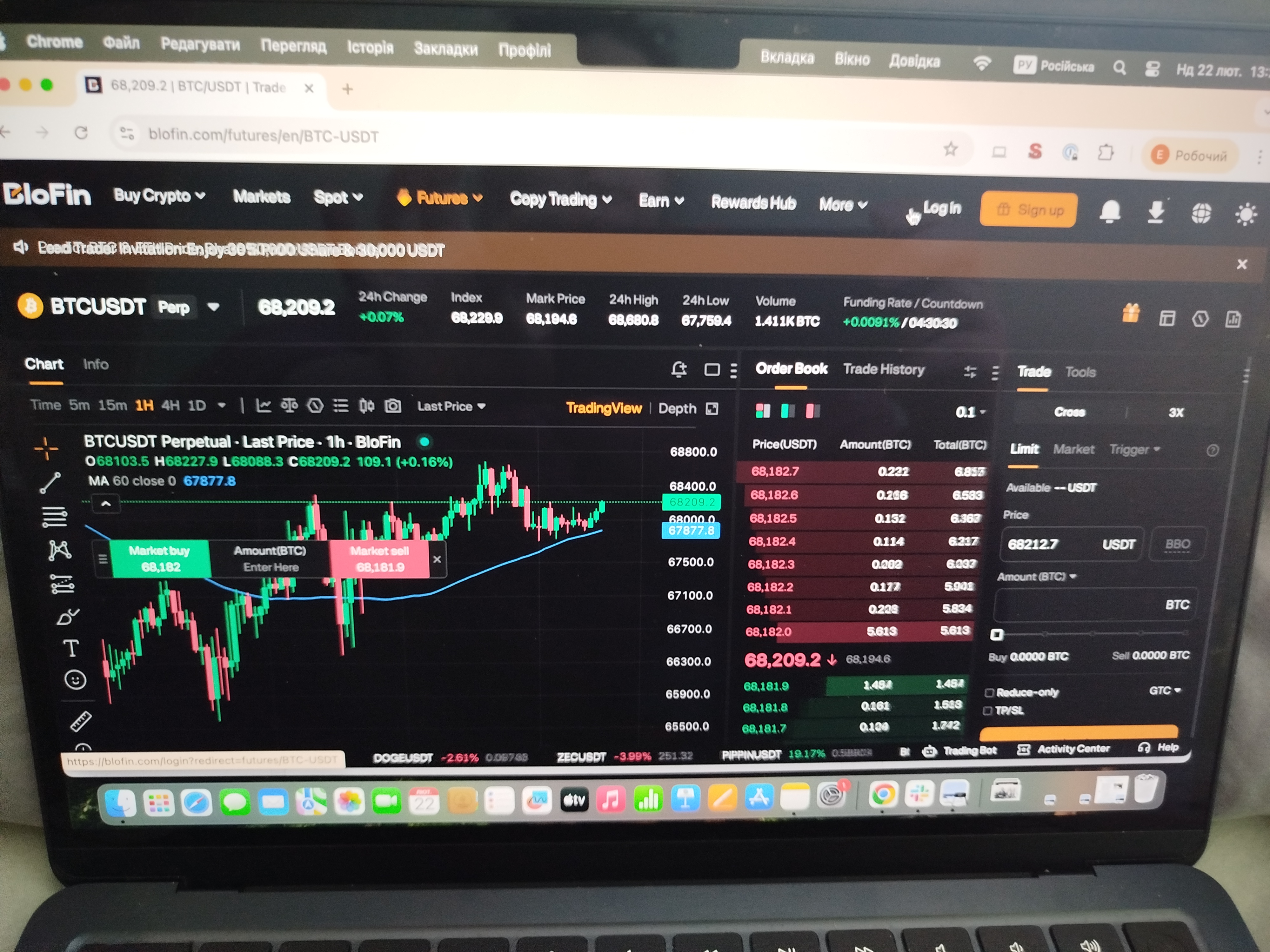
GNcrypto tested BloFin futures with a beginner-size workflow, focusing on real fees, 8-hour funding that can switch to hourly in stress, UTA margin settings, and how stops and mark price behave on BTC and ETH. We then map who it fits best and what to check before depositing.
Blofin at a Glance
BloFin is a futures-focused exchange built around USDT-margined perpetuals. For beginners, that matters because the workflow is familiar and linear: you pick a market, choose how you want margin to behave, place the position, and manage risk without dealing with contract expiries.
In the BloFin reviews we ran for this guide, BloFin felt like a “mid-to-upper tier” derivatives venue: more feature-complete than many smaller perps exchanges, but not trying to be the all-in-one mega ecosystem. The documentation and the product menus suggest BloFin expects you to trade actively and use protective orders, not just click long and hope.
The main switch you need to understand is the Unified Trading Account (UTA). It is designed to consolidate spot and perps under one account and unlock more margin configurations as you scale. We think that is useful, but it is not something you need on day one. If you are new to futures, start with the simplest setup, learn how margin and liquidation prices move, and only then add more “knobs.”
BloFin also offers demo trading, which is one of the easiest ways to build muscle memory for stops and position sizing before you fund a live account. And as with most global exchanges, availability varies by jurisdiction, so it is worth checking access early, before you plan your whole workflow around it.
Trading Experience & Core Features
Trading on BloFin feels built for people who actually use risk orders, not just a leverage slider. In this BloFin exchange review, we focused on the parts a beginner will notice immediately: how clearly you can manage margin and liquidation risk, whether the order tools help you stay disciplined, and how execution behaves when markets move fast.
Interface and day-to-day flow. The platform keeps the essentials visible: position size, margin mode, unrealized PnL, and funding context. Where beginners usually slip up is not the charting, but the settings around the margin. Our take is to start with an isolated margin, keep position sizes small, and only graduate to cross or multi-currency setups once you can predict how your liquidation price shifts when you add or remove margin.
Order tools that act like guardrails. BloFin supports the kind of order menu we like to see on a futures venue: bracket-style workflows (so you can define exits at the moment you enter), trailing stops (to avoid panic-closing winners too early), and TWAP (to avoid slamming the book with one emotional market order). The practical beginner use case is simple: if you tend to chase, TWAP helps you slow down; if you tend to freeze, brackets and trailing stops help you commit to a plan.
Risk engine basics, in plain English. BloFin’s futures mechanics lean on index and mark price concepts, with liquidation triggers tied to mark price. We like that because it reduces the odds of a position being judged by a single noisy last trade print. BloFin also documents backstops like an insurance fund and ADL. You do not need to memorize the details, but you should know what they are: the insurance fund is designed to absorb bankrupt positions, and ADL is the last-resort mechanism if that buffer is not enough.
Execution and liquidity expectations. On majors like BTC and ETH, BloFin is typically where execution feels most predictable at retail sizes. Once you go into the long tail, the safest habit is still “limit first.” In our testing mindset, you want to control slippage, especially if you are using higher leverage.
Practice and automation. BloFin offers demo trading, which is the best way to rehearse stop placement without paying tuition to the market. If you plan to scale into more systematic trading later, BloFin’s API documentation is also a plus, but we would treat automation as a second step after you can trade one clean manual setup consistently.
Is Blofin Worth Using?
So, is BloFin actually worth using for futures in 2026? Our BloFin review takeaway is that it can be a very solid choice if you like trading with structure – and you are willing to keep your setup simple at the start.
If you are a beginner who wants guardrails, BloFin is appealing because it gives you multiple ways to turn your rules into orders. Demo trading also makes the learning curve cheaper: you can practice the same entry and stop routine until it feels automatic.
If you mainly trade BTC and ETH, BloFin tends to make sense as a “majors-first” venue where execution feels more predictable at retail sizes. This is where the platform’s risk plumbing and order tooling matter most, because you can focus on process rather than fighting thin books.
If you hold positions for days, BloFin can still work, but you need to treat funding as part of the trade plan. The important nuance is that funding can settle more often during stress, so multi-day holds deserve an extra check when markets get overheated.
If jurisdiction and access are your top concern, we would verify availability before you deposit. It is not fun to build a workflow around a platform and then learn you are in a restricted location.
How we would start as a new futures trader is simple: run a few demo sessions, trade majors first, use isolated margin until you can predict liquidation distance, and keep leverage conservative. Once you can execute one clean setup consistently, then it makes sense to explore UTA modes and more advanced workflows.
Pros and Cons of Using BloFin Futures
In our BloFin futures review, this is what we think you will actually notice in daily leveraged trading: whether you can define exits before you enter, whether execution feels controllable on majors, and how much attention you need to pay to funding when volatility heats up.
Strengths:
- If you overtrade with market orders, TWAP and bracket-style entries help you slow down and execute with a plan.
- If you panic-close winners too early, trailing stops make it easier to lock gains without watching the chart nonstop.
- If you are still learning, demo trading lets you rehearse stops and sizing before you fund a live account.
Weaknesses:
- UTA is powerful but settings-heavy, so we would start simple before enabling multi-currency logic.
- Funding can settle more often in stress, so multi-day holds need active carry-cost tracking.
Trustworthiness Сheck
Here are the compliance and safety signals we found while researching BloFin, plus the beginner checks we would do before depositing.
- Proof of Reserves is available, with guidance on how to verify your data using a Merkle-tree style check.
- Core account security is well documented, including anti-phishing code setup and other basic protections you should enable on day one.
- BloFin has published warnings about lookalike scam platforms, so bookmarking the official domain is a must.
- Restricted locations are listed in the Terms of Use, so you should confirm access in your jurisdiction before you commit.
- We also found public regulatory and warning-list mentions in some regions, which is another reason to double-check local rules first.
GNcrypto’s Overall BloFin Futures Rating
| Criteria | Rating (out of 5) |
|---|---|
| Trading Fees & Funding Costs | 4.3 |
| Leverage & Margin Requirements | 4.4 |
| Contract Selection & Liquidity | 4.3 |
| Platform Performance & Risk Controls | 4.2 |
| Security & Regulatory Compliance | 4.0 |
| User Experience & Trading Interface | 4.3 |
| Customer Support & Educational Resources | 4.2 |
| Total | 4.3 / 5.0 |
Methodology – Why You Should Trust Us
We use a weighted, category-based model, collect standardized data from each platform (open data + hands-on testing), and convert that into a 1.0–5.0 star score in 0.1 increments.
Our focus is futures trading quality: real fees + funding costs, leverage flexibility, market depth, execution speed during volatility, and the user-facing risk controls.
How We Collect Data
- Public data: fee schedules (maker/taker/VIP), funding rate history, margin tiers, and regulatory status.
- First-hand testing: we place test trades, open leveraged positions (10x–50x), measure spreads and slippage during market moves, and verify stop-loss execution.
We do not rate solvency or make guarantees about financial stability. Ratings reflect the trader’s experience, not a balance-sheet audit.
Categories & Weights
- Trading Fees & Funding Costs – 25%
- Leverage & Margin Requirements – 20%
- Contract Selection & Liquidity – 15%
- Platform Performance & Risk Controls – 15%
- Security & Regulatory Compliance – 10%
- User Experience & Trading Interface – 10%
- Customer Support & Educational Resources – 5%
Latest News




Recommended Articles/Reviews




The material on GNcrypto is intended solely for informational use and must not be regarded as financial advice. We make every effort to keep the content accurate and current, but we cannot warrant its precision, completeness, or reliability. GNcrypto does not take responsibility for any mistakes, omissions, or financial losses resulting from reliance on this information. Any actions you take based on this content are done at your own risk. Always conduct independent research and seek guidance from a qualified specialist. For further details, please review our Terms, Privacy Policy and Disclaimers.